TheJakartaPost
Please Update your browser
Your browser is out of date, and may not be compatible with our website. A list of the most popular web browsers can be found below.
Just click on the icons to get to the download page.


Popular Reads
Top Results
No results found. Please check your search term and try again
Can't find what you're looking for?
View all search results
Popular Reads
Top Results
No results found. Please check your search term and try again
Can't find what you're looking for?
View all search resultsWhy Pari Island’s climate lawsuit matters
The decision of the Cantonal Court of Zug, Switzerland, in the case brought by Pari residents against Holcim marks a significant milestone in the development of global climate litigation.
Change text size
Gift Premium Articles
to Anyone
Share the best of The Jakarta Post with friends, family, or colleagues. As a subscriber, you can gift 3 to 5 articles each month that anyone can read—no subscription needed!
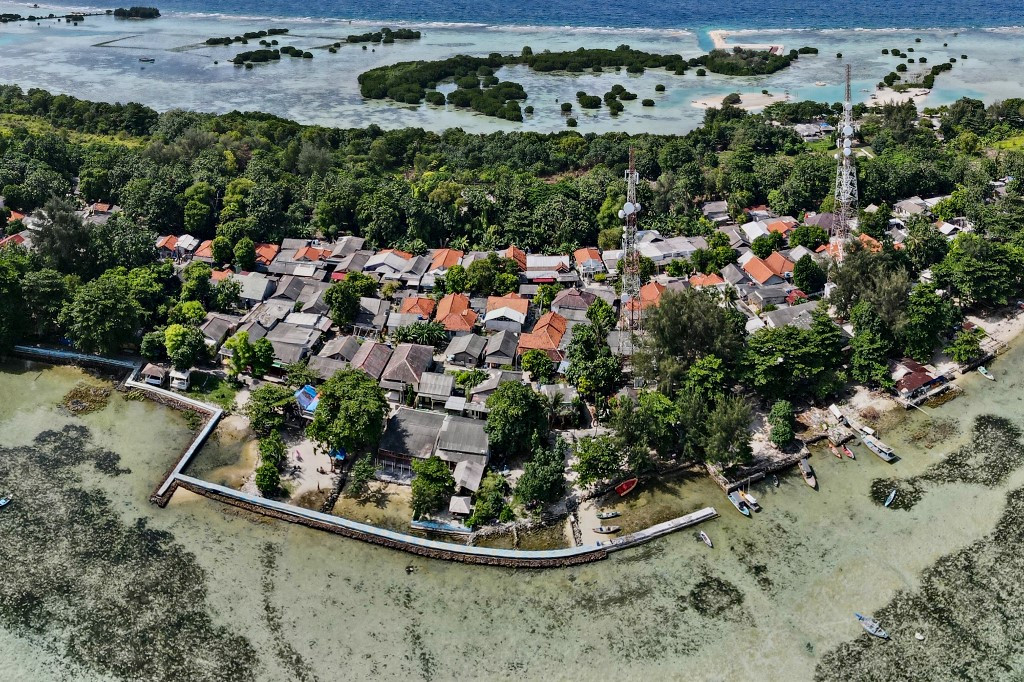 In this aerial picture taken on Feb. 22, 2023, a concrete embankment, used to stem rising sea levels, is seen around part of Pari Island in Thousand Islands regency, Jakarta. (AFP/Bay Ismoyo)
T
he climate crisis is often discussed in distant terms, targets, percentages and long-term projections. Yet for many communities, especially those living on small islands, the crisis is neither abstract nor something that will happen in the future. It is immediate and urgent. Homes are lost, livelihoods disappear, and living spaces slowly sink due to rising sea levels. Despite this reality, small islands and their communities remain largely marginalized in mainstream climate discussions.
Indonesia's smaller islands offer a clear example of this climate injustice, many of them face an existential threat from sea level rises, coastal erosion and increasingly frequent tidal flooding. At the same time, these territories are burdened by extractive industries that further erode their environmental carrying capacity.
WALHI data (2025) records at least 248 mining permits operating on 43 small islands across Indonesia. The impacts have been severe: deforestation, marine pollution and a drastic decline in the number of fishers over the past decade. The Constitutional Court and Supreme Court have even classified extractive activities on small islands as abnormally dangerous activities.
Without fundamental policy change, thousands of coastal villages and outermost small islands face the risk of submergence. This situation will not only accelerate ecological degradation but also generate growing numbers of climate refugees, deepening Indonesia’s social and environmental crisis.
These conditions are experienced firsthand by the residents of Pari Island in the Thousand Islands regency, Jakarta. The island has lost approximately seven to 10 meters of land each year due to coastal erosion. Tidal flooding has become a recurring event that disrupts daily life. In 2020, for the first time, Pari experienced tidal flooding twice in a single year. Not only did the frequency increase, but the impacts were also severer than in previous years.
Confronted with the threat of losing their island, Pari residents took an extraordinary step. In 2022, four residents filed a lawsuit against the Holcim Group in a Swiss court. The lawsuit is grounded in a core principle of climate justice: those who contribute the most to the climate crisis must be held accountable for the harm it causes.

The decision of the Cantonal Court of Zug, Switzerland, in the case brought by Pari residents against Holcim marks a significant milestone in the development of global climate litigation. By rejecting all procedural objections raised by Holcim and allowing the case to proceed to substantive examination, the court affirmed that the climate crisis is not merely a matter of public policy, but a legal issue that can and must be adjudicated.