The Jakarta Post
Please Update your browser
Your browser is out of date, and may not be compatible with our website. A list of the most popular web browsers can be found below.
Just click on the icons to get to the download page.


Popular Reads
Top Results
No results found. Please check your search term and try again
Can't find what you're looking for?
View all search results
Popular Reads
Top Results
No results found. Please check your search term and try again
Can't find what you're looking for?
View all search resultsThe irony of Indonesia’s UN human rights presidency
If Indonesia’s diplomacy remains entrenched in selective silence, the privilege of presiding over the council will devolve into symbolic prestige devoid of impact.
Change text size
Gift Premium Articles
to Anyone
Share the best of The Jakarta Post with friends, family, or colleagues. As a subscriber, you can gift 3 to 5 articles each month that anyone can read—no subscription needed!
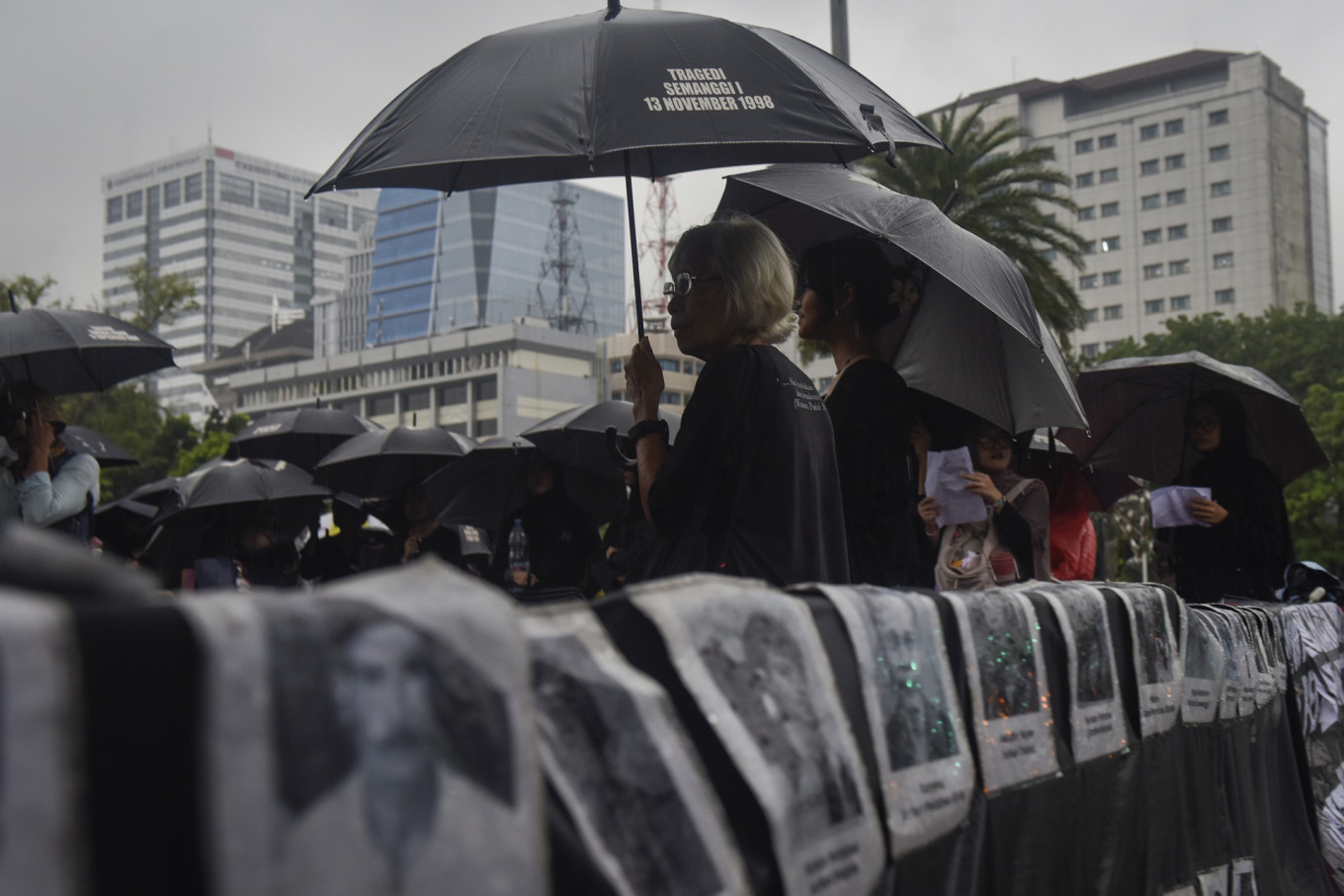 Human rights activist and Kamisan (Thursday) silent protest initiator Maria Catarina Sumarsih (center) stands under an umbrella on Dec. 4, 2025, during a rally near Merdeka Palace in Central Jakarta. During the 889th edition of the Kamisan protests, activists demand several points, including the cessation of criminalizing human rights defender, and the fair resolution of past human rights violations. (Antara/Aditya Pradana Putra)
I
ndonesia has been officially elected as the president of the United Nations Human Rights Council for the upcoming one-year term. Theoretically, this prestigious position should signal hope for human rights advocates, suggesting that the government will finally align its policies with universal principles, particularly in addressing the unresolved cases that continue to cast a shadow over the nation.
However, this appointment risks becoming a bitter international irony. The human rights index compiled by the SETARA Institute shows Indonesia’s cumulative scores declining from 3.2 in a scale between 0 and 7 in 2023 to 3.1 in 2024, and further to 3.0 in 2025. The freedom of expression and opinion indicator was the lowest of the 11 other indicators. This indicator has continued to experience regression since two years ago, specifically 1.3 in 2023, 1.1 in 2024, and receiving a record low of 1.0 in 2025.
Furthermore, Indonesia’s stance on humanitarian crises, both regionally and globally, has often been ambiguous, adopting a posture of "selective silence". The 2025 Human Rights Day report from the Commission for the Disappeared and Victims of Violence (KontraS) reveals that the recurrence of violent incidents reflects a catastrophic reality. This deterioration exposes the state’s neglect of its fundamental obligation to protect its citizens.
The year 2025 witnessed alarming trends, marked by a strengthening "legalistic autocracy". This was evident in the legislative processes surrounding controversial bills, such as the amendments of the TNI Law, the Criminal Law Procedure Code (KUHAP), and the State-Owned Enterprises Law. These processes frequently occurred without meaningful public participation, using legal instruments as tools of power for criminalization.
Moreover, repression by the state apparatus against civic space continued unabated. A series of police brutalities against individuals exercising their rights to freedom of expression throughout 2025 provides undeniable evidence of this oppression. Incidents ranged from large demonstrations opposing the TNI Law revision in March 2025 across 58 regions, to protests in August against a rise in land and property tax in Pati regency, Central Java.
A staggering 5,101 individuals fell victim to arbitrary detention, physical and digital intimidation, violence resulting in injuries and fatalities, and short-term enforced disappearances.

Deteriorating conditions are also apparent in the priority policies of President Prabowo Subianto and Vice President Gibran Rakabuming Raka. One notable example is the free nutritious meals program. As articulated by constitutional law expert Herlambang P. Wiratraman of Gadjah Mada University at the Constitutional Court, this policy undermines the principle of "progressive realization". By diverting massive fiscal resources, it risks neglecting access to vital economic, social, and cultural rights, particularly sustainable education and health infrastructure.