TheJakartaPost
Please Update your browser
Your browser is out of date, and may not be compatible with our website. A list of the most popular web browsers can be found below.
Just click on the icons to get to the download page.


Popular Reads
Top Results
No results found. Please check your search term and try again
Can't find what you're looking for?
View all search results
Popular Reads
Top Results
No results found. Please check your search term and try again
Can't find what you're looking for?
View all search resultsThe Malari incident after 52 years: The silent cry for equality
The current situation of democratic decline amid increasingly centralized control reminds that Indonesia has been here before in 1974.
Change text size
Gift Premium Articles
to Anyone
Share the best of The Jakarta Post with friends, family, or colleagues. As a subscriber, you can gift 3 to 5 articles each month that anyone can read—no subscription needed!
 Set as preferred source
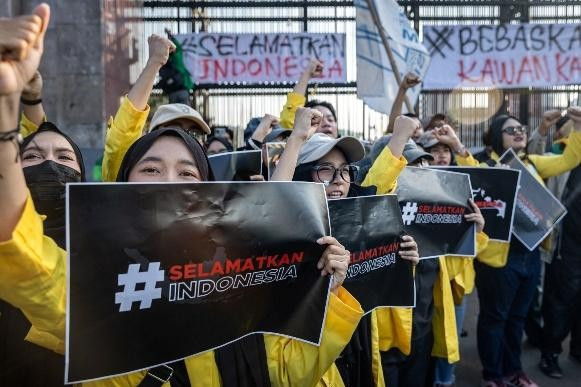 Members of the Indonesian Student Executive Board Alliance rally outside the Senayan Legislative Complex in Central Jakarta on Sept. 4, 2025, expressing support for the “17+8” reform demands presented by the Tuntutan Rakyat (people’s demands) movement during the nationwide protests from August to September. (AFP/Kristianto Purnomo)
S
ome histories never truly pass. They merely change shape, alter their language and disguise their faces. The Malapetaka 15 Januari (disaster of Jan. 15), better known as the 1974 Malari incident, is one such history.
The student protests were neither an outbreak of street violence nor an eruption of anger that coincided with the visit of Japanese prime minister Kakuei Tanaka. Malari 1974 was a moment when the republic looked into the mirror and recoiled from what it saw.
Malari did not emerge from a vacuum. It grew out of alienation amid promises of progress. As the state spoke of growth, stability and modernization, many citizens felt increasingly excluded from the results. Development advanced, but justice limped behind.
Foreign capital flowed in and grand projects rose, yet prosperity failed to reach villages and urban peripheries. A widening chasm appeared between the language of power and the lived experience of the people. This gap gradually hardened into a dark social conviction that development was indeed taking place, but not for everyone.
In the early years of the New Order, development was understood primarily as accelerated economic accumulation. The state positioned itself as the controller while capital, particularly foreign capital, was welcomed in the name of "catching up”. The logic was seductive in its simplicity: Grow the economic pie first, and distribution would follow later.
Malari revealed what statistics failed to capture. Growth is not merely numerical; it is lived. When development is felt only at the centers of power while ordinary people face rising prices, land dispossession and limited job opportunities, stability turns into a false calm.

As Herbert Feith once noted, "stability without legitimacy is only a temporary silence". Feith pointed not to the absence of open conflict but to a condition in which dissatisfaction is suppressed because avenues of expression are closed. Such stability is not the product of social consent but of fear. Malari shattered that silence, not because society suddenly became noisy but because it had been forced to remain silent for too long.