TheJakartaPost
Please Update your browser
Your browser is out of date, and may not be compatible with our website. A list of the most popular web browsers can be found below.
Just click on the icons to get to the download page.


Popular Reads
Top Results
No results found. Please check your search term and try again
Can't find what you're looking for?
View all search results
Popular Reads
Top Results
No results found. Please check your search term and try again
Can't find what you're looking for?
View all search resultsAnalysis: Workers, businesses battle as minimum wage falls below cost of living
Change text size
Gift Premium Articles
to Anyone
Share the best of The Jakarta Post with friends, family, or colleagues. As a subscriber, you can gift 3 to 5 articles each month that anyone can read—no subscription needed!
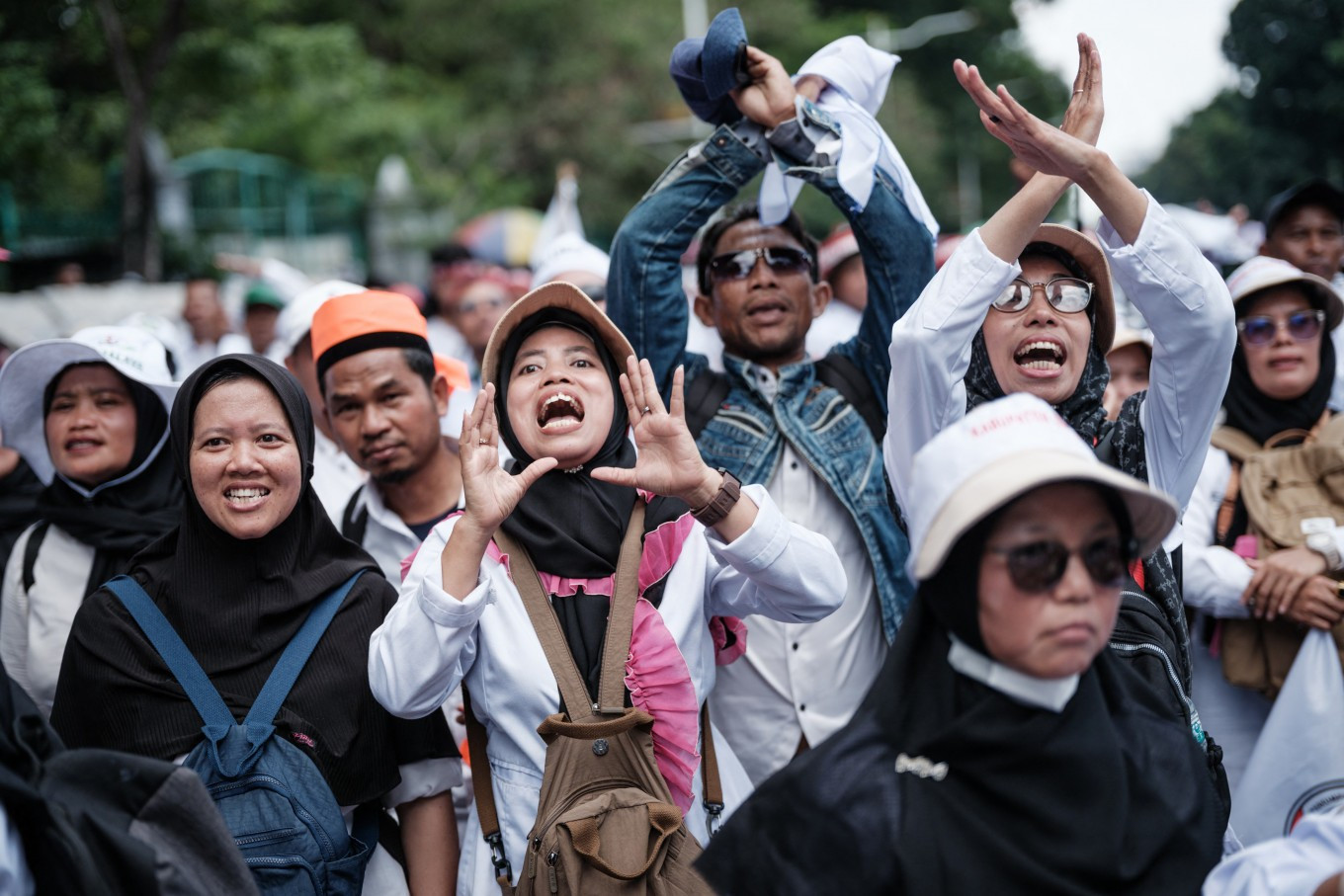 Loud and proud: Demonstrators react as the music pauses during a labor rally calling for better working conditions on Oct. 30, 2025, near the National Monument (Monas) park in Central Jakarta. (AFP/Yasuyoshi Chiba)
T
he 2026 provincial minimum wage (UMP) announcements have triggered a backlash from both labor unions and businesses. On average, minimum wages rose by more than 5 percent year-on-year (yoy) compared with 2025. However, in most provinces, the final nominal wages remain below the basic cost of living (KHL), indicating a decline in real wages. This tension unfolds amid an economic slowdown, marked by persistent layoffs in labor-intensive sectors and weak household consumption.
According to Manpower Ministry data as of Jan. 5, Jakarta continues to record the highest UMP at around Rp 5.73 million (US$340.9) per month. Despite leading nationally, Jakarta's UMP still falls short of its KHL by Rp 168,635. The following are provinces facing challenging logistics, namely Papua Highlands and South Papua, each setting their UMP at approximately Rp 4.51 million per month. At the lower end of the spectrum, West Java, Central Java and Yogyakarta post the lowest UMP levels at Rp 2.32 million, Rp 2.33 million and Rp 2.42 million per month, respectively. Yogyakarta's UMP is particularly concerning, trailing its KHL by roughly Rp 2.2 million.
The UMP and city/regency minimum wage (UMK) are determined using the formula stipulated in Article 26 of Government Regulation (PP) No. 49/2025, the second revision of PP No. 36/2021 on wages. Article 26(2) specifies that minimum wage calculations incorporate regional economic growth, inflation and a "certain index," known as alpha. Alpha reflects the contribution of labor to economic growth, while balancing labor and business interests and maintaining proportionality with living costs.
Under Article 26(4), the minimum wage equals the previous year's wage plus an adjusted value. Article 26(5) explains that this adjusted value is calculated by multiplying regional economic growth by alpha, adding inflation and then applying the result to the prior year's minimum wage.
Alpha has emerged as the most contentious parameter. Articles 26(6) and (7) allow provincial, city or regency wage councils to set alpha between 0.5 and 0.9. Labor unions, particularly in regions where the UMP remains below the KHL, have pushed for alpha to be set at the upper bound of 0.9 to narrow the living-cost gap. In contrast, business groups argue that such a level exceeds firms' capacity. Employers advocate for a much lower alpha, around 0.1 to 0.3, and, at most, 0.3 to 0.5 in regions where the UMP still lags the KHL.
Beginning in 2026, KHL calculations follow International Labour Organization (ILO) standards. The KHL comprises household consumption components, including food, clothing, housing, education, health care, transportation, recreation and savings. Estimates are derived from surveys conducted jointly by regional wage councils, the Manpower Ministry, Statistics Indonesia (BPS) and the National Economic Council (DEN). The per-capita consumption cost is multiplied by household size and divided by the number of working household members. For 2026, Jakarta posts the highest KHL at Rp 5.89 million per month, while East Nusa Tenggara records the lowest at Rp 3.05 million. Even so, NTT's UMP remains Rp 598,601 below its KHL.

Only six provinces have set their 2026 UMP above their respective KHL. These include North Sulawesi, where the UMP of Rp 4 million exceeds the KHL by Rp 138,406; South Sumatra, with a Rp 3.94 million UMP surpassing the KHL by Rp 643,056; and South Sulawesi, where the Rp 3.92 million UMP is Rp 251,003 higher than the KHL. Overall, the UMP increased by an average of 5.9 percent year on year, yet still lags the KHL by Rp 772,487 on average across regions.