TheJakartaPost
Please Update your browser
Your browser is out of date, and may not be compatible with our website. A list of the most popular web browsers can be found below.
Just click on the icons to get to the download page.


Popular Reads
Top Results
No results found. Please check your search term and try again
Can't find what you're looking for?
View all search results
Popular Reads
Top Results
No results found. Please check your search term and try again
Can't find what you're looking for?
View all search resultsHow to make EU-CEPA work for Indonesia
It is time to strengthen national mechanisms for accountability and transparency to monitor responsible business conduct under the IEU-CEPA.
Change text size
Gift Premium Articles
to Anyone
Share the best of The Jakarta Post with friends, family, or colleagues. As a subscriber, you can gift 3 to 5 articles each month that anyone can read—no subscription needed!
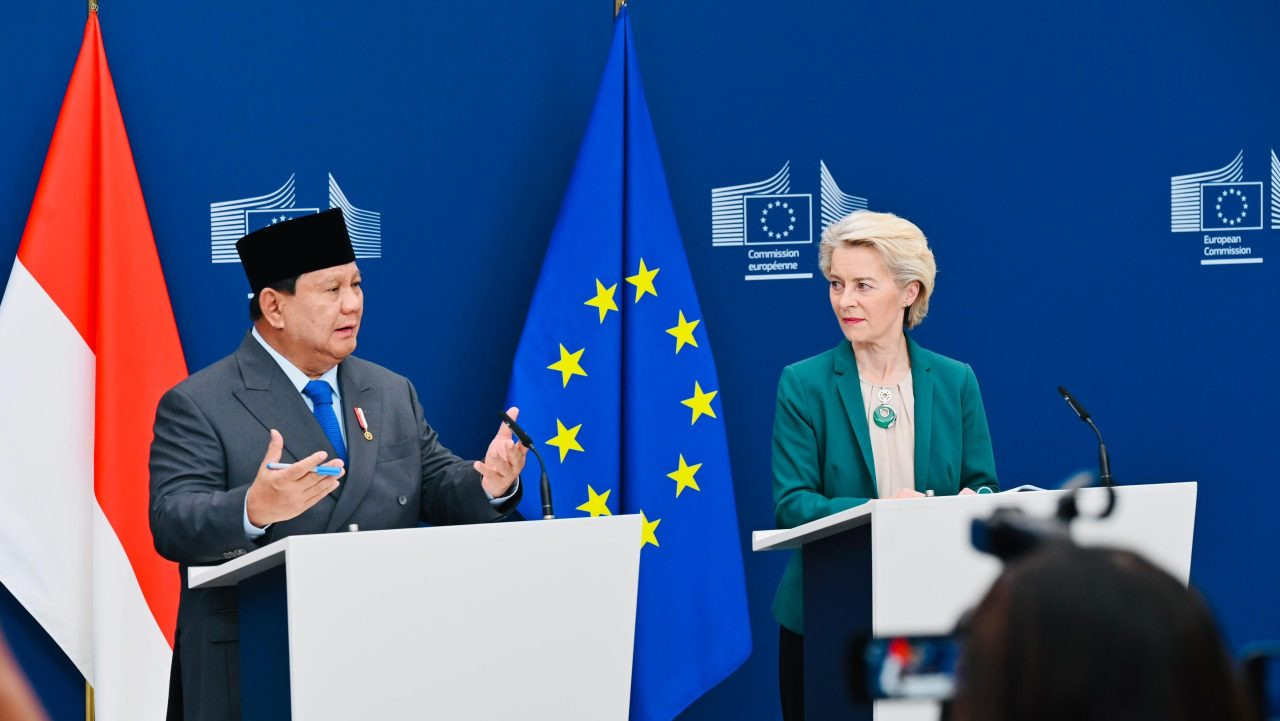 President Prabowo Subianto (left) and European Commission President Ursula von der Leyen (right) announce the 'political agreement' of the Indonesia-EU Comprehensive Partnership Agreement (IEU-CEPA) on July 14, 2025 in Brussels. (Presidential Secretariat Press Bureau/Laily Rachev)
T
he signing of the Indonesia-European Union Comprehensive Economic Partnership Agreement (IEU-CEPA) marks a significant milestone in enhancing Indonesia's global economic engagement. It serves as a new bridge for strengthening bilateral ties between Indonesia and Europe.
However, the challenge ahead is whether, at a practical level, Indonesia can utilize the agreement to contribute to inclusive and sustainable growth. Success will depend entirely on fulfilling compliance with responsible business conduct on the ground.
While this opportunity will undoubtedly open market access and boost investment, it must be noted that the CEPA is not merely about tariffs and trade volumes. It is a values-based agreement that embeds principles of sustainable development, environmental protection and human rights into the very architecture of trade.
The critical question is: How will the CEPA affect inclusive and sustainable growth for both businesses and workers in Indonesia? Is the country truly ready to implement the commitments that come with it?
The CEPA offers a golden opportunity for Indonesia to boost export competitiveness in sectors such as palm oil, fisheries, manufacturing, textiles and critical minerals. Job creation is expected to rise in export-oriented industries gaining better access to the EU’s 450 million consumers.
Yet, on the flip side, issues regarding labor rights, environmental safeguards and due diligence will emerge amid growing concerns over the EU’s Corporate Sustainability Due Diligence Directive (CSDDD) and Forced Labor Regulation. These regulations signal a new era of responsible supply chains, requiring Indonesian exporters to prove they are not causing, contributing to or directly linked to forced labor, deforestation or human rights violations.

This situation reveals the double-edged nature of the IEU-CEPA. It juxtaposes job creation with decent work, and exports with ethical supply chains. The absence of safeguards and a rush to meet demand could unintentionally increase informal work, undermine local communities’ rights and expedite environmental degradation.