The Jakarta Post
Please Update your browser
Your browser is out of date, and may not be compatible with our website. A list of the most popular web browsers can be found below.
Just click on the icons to get to the download page.


Popular Reads
Top Results
No results found. Please check your search term and try again
Can't find what you're looking for?
View all search results
Popular Reads
Top Results
No results found. Please check your search term and try again
Can't find what you're looking for?
View all search resultsBeyond claims: Why Indonesia must anchor the South China Sea COC
Amid the resurgence of global power politics, Indonesia must continue to wield its unique geopolitical legitimacy, conferred by its geography, in pressing for the consistency of maritime norms in the South China Sea.
Change text size
Gift Premium Articles
to Anyone
Share the best of The Jakarta Post with friends, family, or colleagues. As a subscriber, you can gift 3 to 5 articles each month that anyone can read—no subscription needed!
 Set as preferred source
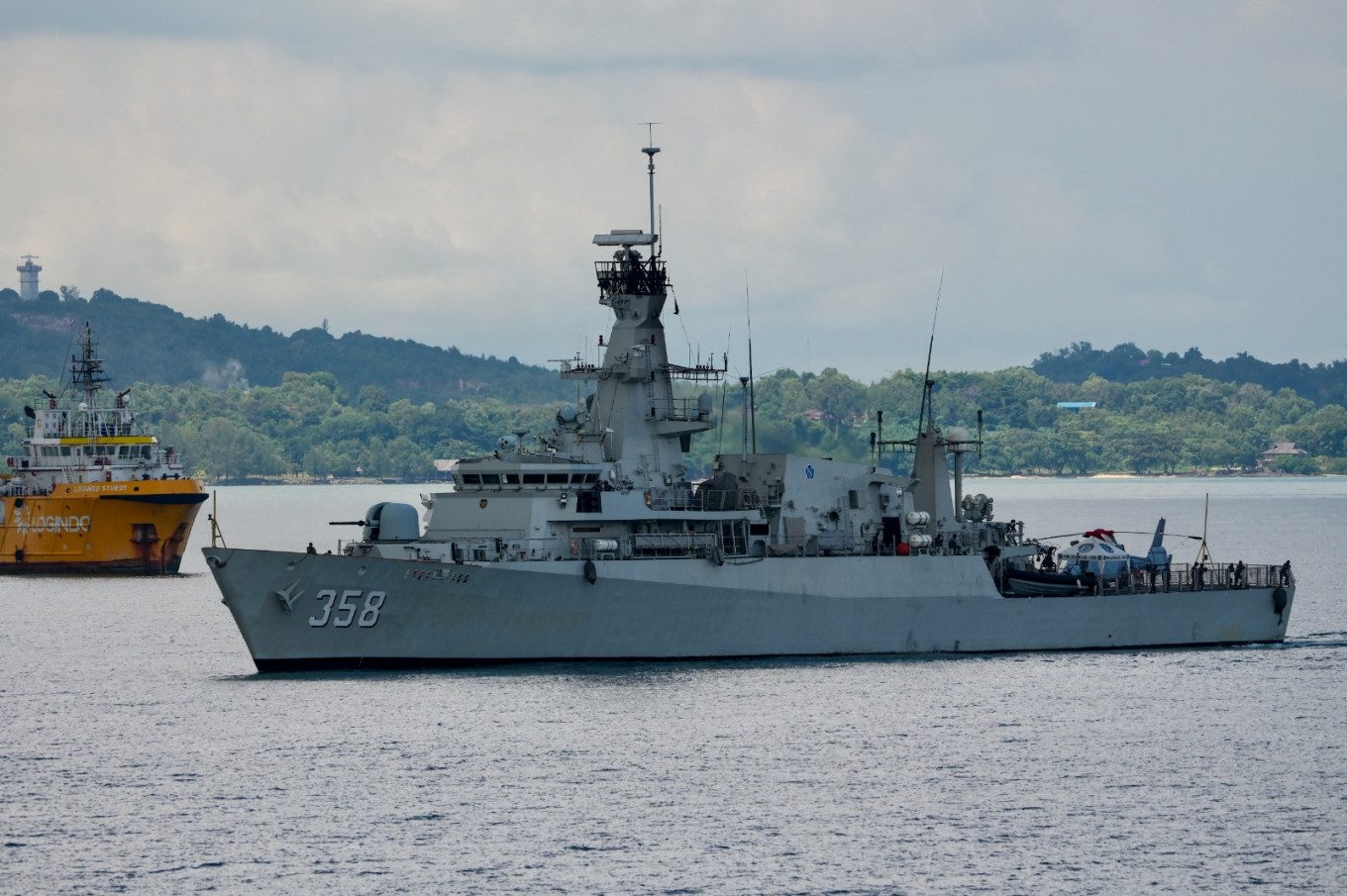 The Indonesian Navy's KRI John Lie, a Bung Tomo-class corvette, arrives on Sept. 20 at a naval base in the Riau Islands during the ASEAN Solidarity Exercise in Natuna 2023, which involved six countries. (AFP/Bay Ismoyo)
J
apan’s recent diplomatic outreach to the Philippines, with the South China Sea squarely at the center of discussions, is a timely reminder that the Code of Conduct (COC) is no longer a narrow ASEAN-China technical exercise. It has become a strategic litmus test of whether international norms can still operate in an era increasingly shaped by raw power, resource competition and maritime coercion.
Yet amid the focus on claimant states and great power maneuvering, one country’s significance is often underappreciated: Indonesia.
Jakarta may not be a formal claimant to most disputed features in the South China Sea, but it is arguably the most consequential ASEAN actor in determining whether the COC will be credible, enforceable and meaningful. The reason is simple but profound: Maritime geography is destiny.
Indonesia possesses the sixth-largest exclusive economic zone (EEZ) in the world, ranking just behind France, the United States, Russia, the United Kingdom and Australia and ahead of Canada and Japan.
This is not a symbolic statistic. It places Indonesia among a small group of states whose strategic interests are defined as much by the sea as by land. Countries with vast EEZs share a common vulnerability: instability at sea threatens not only sovereignty but also food security, energy access, undersea cables, shipping routes and national credibility.
For Indonesia, whose archipelagic waters connect the Indian and Pacific oceans, the South China Sea is not peripheral. It is structurally linked to the security of the Java Sea, the Natuna waters, the Makassar Strait and the wider archipelagic sea-lanes upon which regional and global trade depends. This is why Indonesia cannot afford a South China Sea governed by ambiguity, coercion or selective rulemaking.

Indonesia is not a claimant but a "system holder". Its importance in the COC process stems precisely from the fact that it is not driven by maximalist territorial claims.