The Jakarta Post
Please Update your browser
Your browser is out of date, and may not be compatible with our website. A list of the most popular web browsers can be found below.
Just click on the icons to get to the download page.


Popular Reads
Top Results
No results found. Please check your search term and try again
Can't find what you're looking for?
View all search results
Popular Reads
Top Results
No results found. Please check your search term and try again
Can't find what you're looking for?
View all search resultsDPRD-led local elections a threat to Indonesia's popular sovereignty
Indirect regional elections will disproportionately expand the legislature's power while drastically reducing public participation, effectively shifting the fundamental principle of popular sovereignty.
Change text size
Gift Premium Articles
to Anyone
Share the best of The Jakarta Post with friends, family, or colleagues. As a subscriber, you can gift 3 to 5 articles each month that anyone can read—no subscription needed!
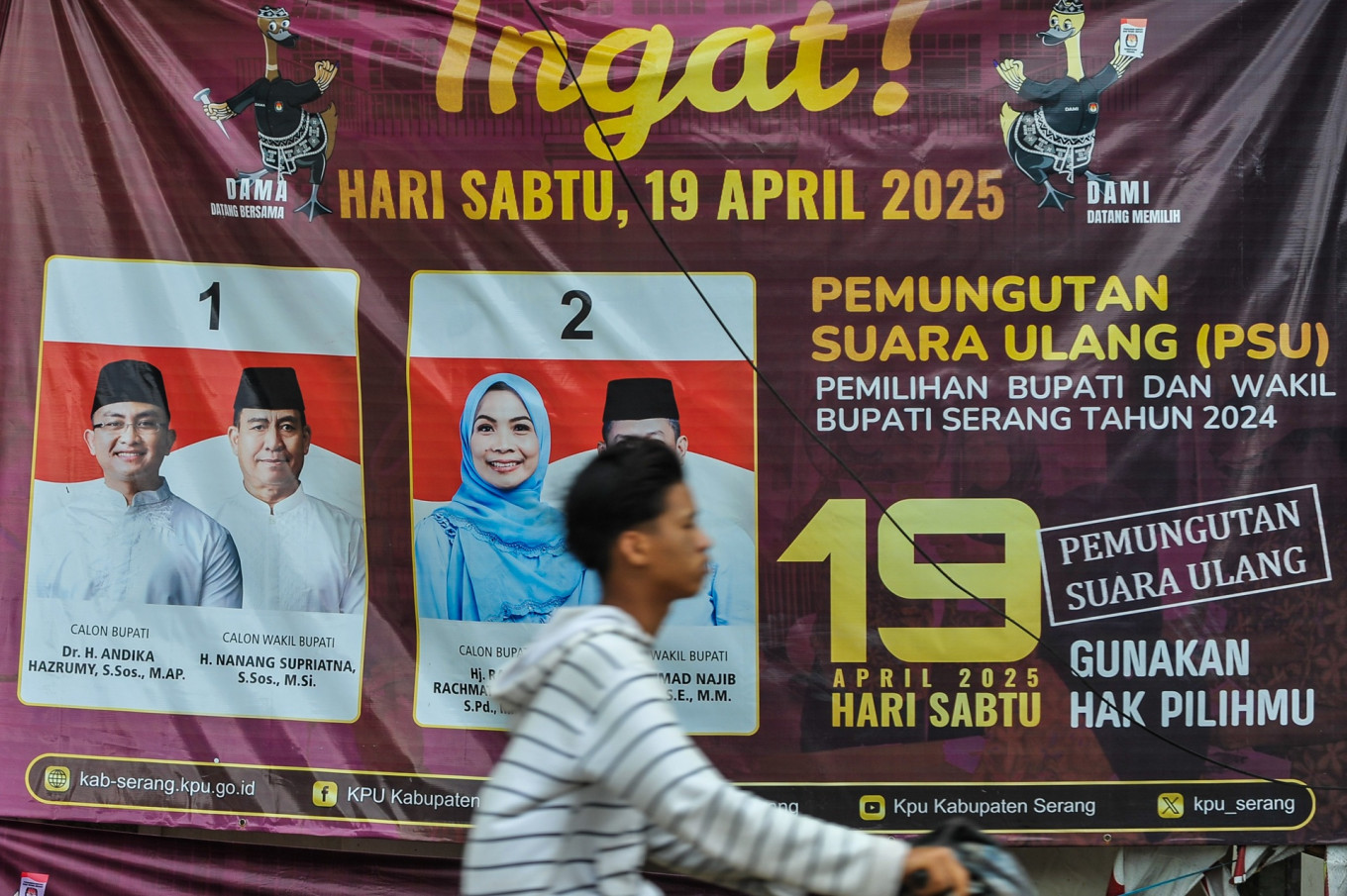 A motorist passes in front of a banner on April 18, 2025, about the 2024 regional election revote in Serang regency, Banten. The regency is one of 24 regions ordered by the Constitutional Court in February to hold a rerun of the 2024 regional elections. (Antara/Muhammad Bagus Khoirunas )
T
he public backlash against the proposal to revise the Regional Head Elections (Pilkada) Law has resurfaced. Political parties within the government coalition are once again pushing to return the power to elect regional heads to the Regional Legislative Council (DPRD).
The arguments are familiar: cost efficiency, stability in local government and reducing the risk of grassroots electoral conflict.
Yet, this discourse remains highly controversial and faces widespread resistance. A joint survey by LSI Denny JA and the Populi Center, released in January 2026, shows overwhelming public rejection of the proposal. This demonstrates that the debate is not merely about technical election mechanics, it touches on the deeper, more fragile issue of representative democracy itself.
As if to confirm the finding, a poll by Kompas research arm Litbang Kompas revealed that 89.5 percent of Generation Z, those under the age of 26, support the direct voting mechanism for local leaders.
Why does the public insist on rejecting regional elections by the DPRD? The answer lies in a crisis of representation, visible through four key perspectives: legal legitimacy, democratic performance data, public trust and political theory.
First of all, from a legal perspective, the plan to revive the indirect local elections creates a conflict of constitutional norms. A review of Law No. 10/2016, Law No. 17/2014, Law No. 23/2014 and Law No. 7/2017 places the people, not the legislature, as the primary source of legitimacy. The DPRD is designed as a legislative, oversight and budgeting institution, not as an electoral college for regional heads.

Returning regional head elections to the DPRD would distort its institutional function. It would disproportionately expand the legislature's power while drastically reducing public participation, effectively shifting the fundamental principle of popular sovereignty.