TheJakartaPost
Please Update your browser
Your browser is out of date, and may not be compatible with our website. A list of the most popular web browsers can be found below.
Just click on the icons to get to the download page.


Popular Reads
Top Results
No results found. Please check your search term and try again
Can't find what you're looking for?
View all search results
Popular Reads
Top Results
No results found. Please check your search term and try again
Can't find what you're looking for?
View all search resultsHow to feed ten billion people
Meeting the nutritional needs of a growing population requires not just a radical increase in food production but also a more equitable distribution to ensure that no one is food-insecure.
Change text size
Gift Premium Articles
to Anyone
Share the best of The Jakarta Post with friends, family, or colleagues. As a subscriber, you can gift 3 to 5 articles each month that anyone can read—no subscription needed!
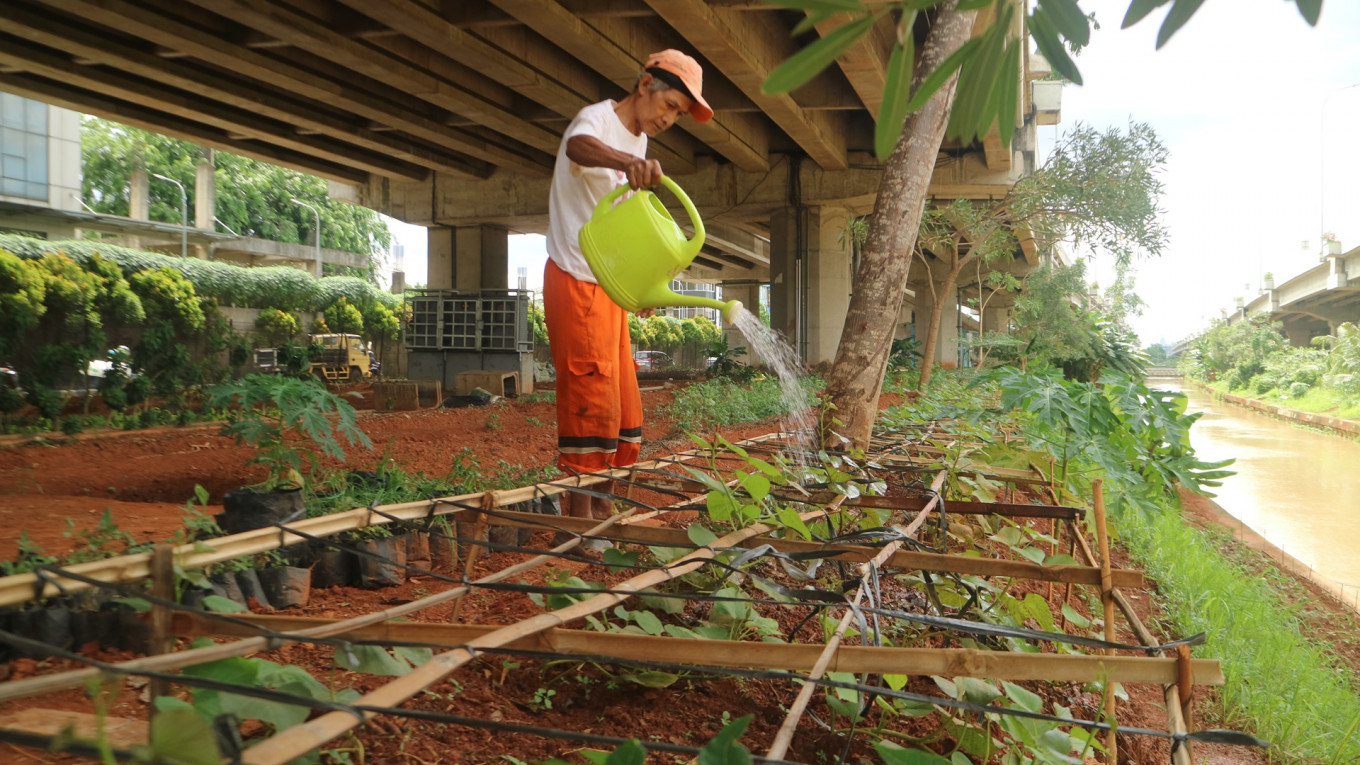 Urban farmer Hasanuddin, 60, waters sweet potatoes on Nov. 9, 2025, in an urban farming site beneath the Bekasi-Cawang-Kampung Melayu (Becakayu) toll road in Makassar district, East Jakarta. (JP/Gembong Hanung)
W
ith the world struggling to feed eight billion people today, how will we feed ten billion by 2050? Meeting the nutritional needs of a growing population requires not just a radical increase in food production — almost all of it plant-based — but also a more equitable distribution to ensure that no one is food-insecure.
That is a tall order. The current food system is already buckling. Roughly 673 million people go to bed hungry every night, and in 2025, we witnessed two famines (in Gaza and Sudan), each driven by conflict, climate shocks and soaring food prices. At the same time, 1.66 billion hectares — 60 percent of which are agricultural land — have been degraded by the very practices we rely on to feed the world.
Global hunger stems not from a lack of capacity to produce enough food, but partly from our failure to produce it efficiently and distribute it evenly. Conflict and insecurity remain the dominant causes of hunger across 20 countries and territories, leaving nearly 140 million people facing acute food insecurity. Disasters have inflicted an estimated US$3.26 trillion in agricultural losses worldwide over the past 33 years — an average of $99 billion annually, or roughly 4 percent of global agricultural output; and recent supply-driven food-price spikes have pushed tens of millions of people into hunger almost overnight. Worse, these are not one-off shocks. They represent the new normal.
For decades, the agriculture sector has responded well to rising demand by developing higher-yielding crops and using more of everything: more fertilizer, more pesticides and more water. Yet this trend has produced unnecessary waste, polluted rivers, degraded the soil and released ever-more greenhouse gases (GHGs). We need to find a better path, and science can show us the way. We already have the knowledge and the tools to optimize what we use and diversify what we grow.
One priority is to improve efficiency. Between 1990 and 2020, fertilizer use rose 46 percent and pesticide use doubled. But only 30-60 percent of fertilizer nutrients and 20-70 percent of pesticides are effectively absorbed; the rest washes into rivers, degrades soil or releases GHGs. Fortunately, research shows that optimizing nitrogen use can boost yields by up to 19 percent and slash fertilizer use by 15-19 percent. Improved pesticide management — through precision spraying, biopesticides and residue monitoring — reduces chemical waste while safeguarding biodiversity. Agroecological practices, such as intercropping, crop rotation and integrating trees into farm systems, further enhance soil health, lower input dependence and strengthen long-term resilience.
The next priority is to diversify the food system. Decades of productivity gains have fostered a dangerous dependency on just three crops. Wheat, rice and maize now provide most of the world’s calories. Such reliance on monocultures creates profound vulnerability to pests, diseases and climate change. The solution lies in the crops we have marginalized. Traditional and underused species — hardy millets, nutrient-dense legumes, indigenous fruits, robust yams — offer ample nutrition alongside other benefits such as climate resilience. United Nations Food and Agriculture Organization initiatives like Future Smart Food (in Asia) and 100 Crops for Africa demonstrate how these “forgotten” crops can simultaneously expand diets, boost farm incomes and restore degraded soils.

Finally, we must scale up effective technologies. Data analytics and precision-agriculture tools are already reshaping farming. Drones can plant seeds and deliver inputs with pinpoint accuracy. Artificial intelligence platforms can use satellite imagery to provide tailored, real-time recommendations. Robots can detect weeds for targeted spraying, avoiding the need for blanket herbicide applications. Digital soil tests and weather stations can guide day-to-day decisions, and blockchain systems can link smallholders to transparent and traceable markets.