The Jakarta Post
Please Update your browser
Your browser is out of date, and may not be compatible with our website. A list of the most popular web browsers can be found below.
Just click on the icons to get to the download page.


Popular Reads
Top Results
No results found. Please check your search term and try again
Can't find what you're looking for?
View all search results
Popular Reads
Top Results
No results found. Please check your search term and try again
Can't find what you're looking for?
View all search resultsBeyond bamboo diplomacy: Vietnam’s era of national rise in a volatile world
The 14th National Congress of the Communist Party of Vietnam, convened in Hanoi on January 19, marked a significant strategic pivot regarding the country's development. By formalizing the concept of an "Era of National Rise," the Congress signaled a decisive transition from a period of historical accumulation to a new phase driven by critical structural breakthroughs.
Change text size
Gift Premium Articles
to Anyone
Share the best of The Jakarta Post with friends, family, or colleagues. As a subscriber, you can gift 3 to 5 articles each month that anyone can read—no subscription needed!
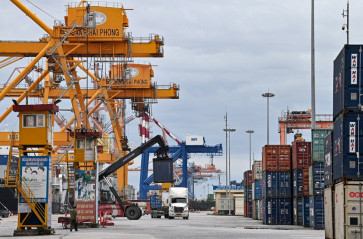
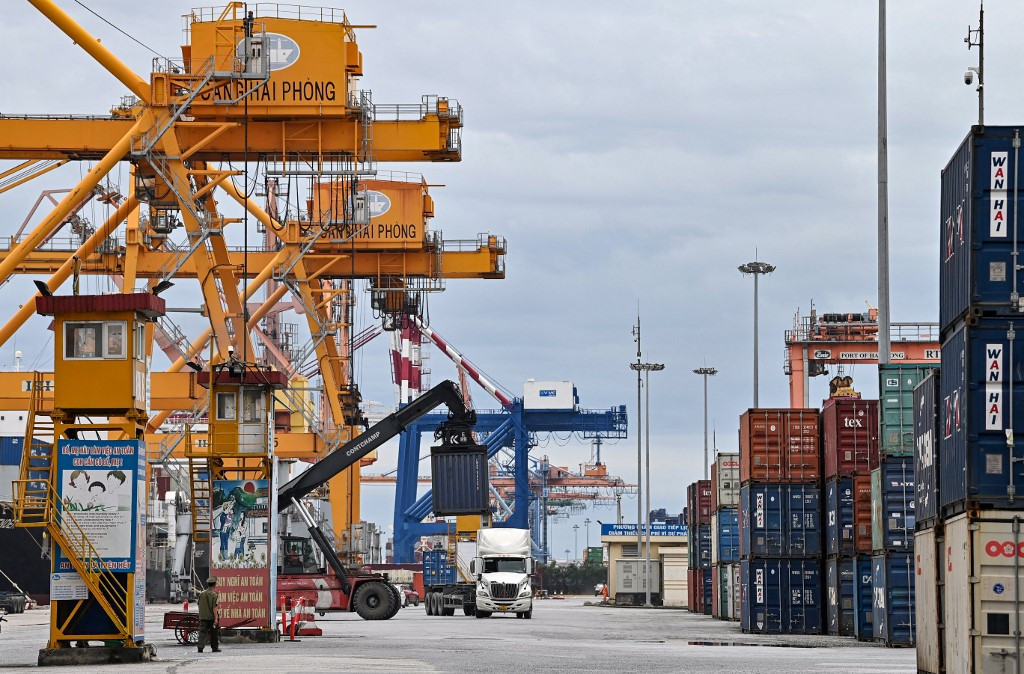 A container is loaded onto a truck on Aug. 29, 2023, at the Tan Vu container port in Hai Phong, Vietnam. The administration of former United States president Joe Biden sought to boost economic ties with Vietnam as Washington looked to reduce reliance on China. (AFP/Nhac Nguyen)
V
ietnam’s contemporary political development is best understood as a sequence of distinct phases, with the strategic imperative of each determined by historical circumstances.
Political and social mobilization between 1945 and 1975 was primarily aimed at resolving issues of sovereignty and territorial unity. The Đổi Mới (reform) process, initiated in 1986, addressed a radically different set of problems, economic stagnation and international isolation, through gradual reform rather than systemic rupture.
Within the Communist Party’s theoretical discourse, this protracted period has typically been viewed as one of "quantitative accumulation". Sustained investment in infrastructure, incremental institutional reforms oriented toward market principles and globalization provided a platform for economic growth over nearly 40 years.
However, recent results suggest that the scale of success has not, by itself, created the qualitative transformation necessary to break through the middle-income trap. Structural barriers have gradually exposed the deficiencies of a development approach that relies mainly on resource accumulation rather than productivity growth.
The importance of the 14th National Party Congress this week is evident in light of these limitations. The “Era of National Rise”, promoted by General Secretary Tô Lâm, represents a response to a historical threshold where cumulative national capacity demands a reordering of development logic.
The focus is shifting from a recovery-oriented vision to a quality-led developmental thrust. Governance, therefore, must move beyond long-term strategic patience to proactive policy intervention that seeks tangible change.

The confidence voiced ahead of the congress is tied to the achievements of the 13th term (2021–2025). The frequent observation of the late General Secretary Nguyễn Phú Trọng that Vietnam has “never had the fortune and potential it enjoys today” must be analyzed through empirical measures rather than accepted merely as a political slogan.