TheJakartaPost
Please Update your browser
Your browser is out of date, and may not be compatible with our website. A list of the most popular web browsers can be found below.
Just click on the icons to get to the download page.


Popular Reads
Top Results
No results found. Please check your search term and try again
Can't find what you're looking for?
View all search results
Popular Reads
Top Results
No results found. Please check your search term and try again
Can't find what you're looking for?
View all search resultsIndonesia’s ‘diplomacy of resilience’ and the missing rights agenda
As the initiator of the Bali Democracy Forum and the 2026 president of the United Nations Human Rights Council, Jakarta should continue to champion the protection of rights and democratic principles.
Change text size
Gift Premium Articles
to Anyone
Share the best of The Jakarta Post with friends, family, or colleagues. As a subscriber, you can gift 3 to 5 articles each month that anyone can read—no subscription needed!
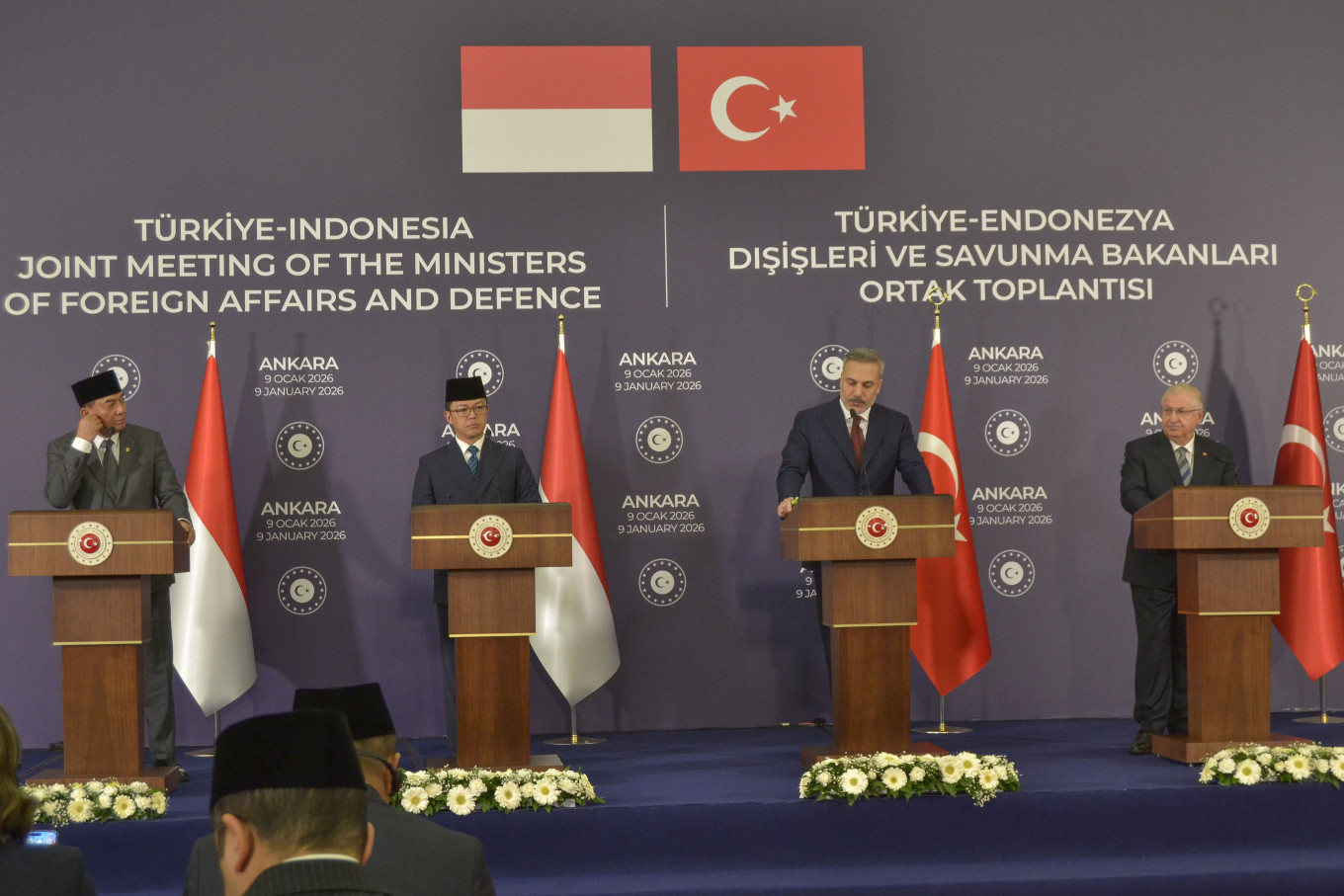 Defense Minister Sjafrie Sjamsoeddin (left), Foreign Minister Sugiono (second left), Turkey’s Foreign Minister Hakan Fidan (second right) and Turkey’s National Defense Minister Yasar Guler attend a joint press statement on Jan. 9, 2026, after the Indonesia-Turkey Joint Meeting of Foreign and Defense Ministers in Ankara. (Antara/Nabil Ihsan)
F
oreign Minister Sugiono’s annual press statement on Jan. 14 showcased an evolution in Indonesia’s foreign-policy outlook. Instead of framing diplomacy as a means to further principles, he presented it as a tool for national resilience.
As he put it, the key question for states today is no longer “which side to lean into” but “how to fortify national resilience so we retain the capacity to decide our own direction”. Countries without strategy, he warned, risk being buffeted by external forces, while those without resilience risk becoming mere “objects”.
This perspective reflects a sober reading of today’s international environment. Power competition is intensifying, global institutions are under strain and economic and technological interdependence is increasingly weaponized. From this standpoint, Indonesia’s emphasis on resilience is understandable and perhaps prudent. Ensuring economic stability, protecting supply chains, strengthening defense cooperation and expanding diplomatic networks are all sensible ways to preserve national agency in an unpredictable world.
Sugiono argues that diplomacy and defense are becoming ever more intertwined. One way to interpret this, as The Jakarta Post’s reported, is that defense is being positioned at the center of foreign policy. This is arguably showcased by the growing emphasis on "two-plus-two" dialogues between foreign and defense ministers with partners such as Australia, China, Japan and Turkey. This approach stems from the reflection that the global situation is increasingly risky, with blurred lines between peace and war, where closer coordination between partners is deemed necessary to mitigate risks.
Yet, the minister’s central organizing concept was not defense, but resilience. It is a catch-all term that broadly captures everything from food security to financial inclusion, and from attracting investment to technological cooperation. This is partly because Sugiono also serves as secretary-general of the Gerindra Party and is under pressure to promote domestic programs such as the free nutritious meals, food-energy-water self-sufficiency and the creative economy, even if they seem far removed from traditional foreign policy.
He quoted a book title by former United States diplomat Richard Haass: Foreign Policy Begins at Home. This concept is formulated mainly for a domestic audience. Although it does not prescribe withdrawal from international activism, it suggests limiting humanitarian roles and focusing domestically. This choice of reference signals how Sugiono translates the country’s “independent and active” foreign policy concept into practice.

Sugiono described Indonesia’s strategy as “strategic diversification,” with the Foreign Ministry engaging with a wide range of international groupings, from the Western-leaning Organisation for Economic Co-operation and Development (OECD) to the non-Western BRICS, and from the Group of 20 and Asia Pacific Economic Cooperation, the Organization of Islamic Cooperation and the D-8. Sugiono himself undertook 32 visits to 22 countries in 2025 because, in his words, “resilience is built through networks”. This is done to widen Jakarta’s options and reduce dependence on a single partner.