The Jakarta Post
Please Update your browser
Your browser is out of date, and may not be compatible with our website. A list of the most popular web browsers can be found below.
Just click on the icons to get to the download page.


Popular Reads
Top Results
No results found. Please check your search term and try again
Can't find what you're looking for?
View all search results
Popular Reads
Top Results
No results found. Please check your search term and try again
Can't find what you're looking for?
View all search resultsThe harm of free speech
The Grok controversy shows that Indonesia’s regulatory architecture for digital technology is still catching up with reality.
Change text size
Gift Premium Articles
to Anyone
Share the best of The Jakarta Post with friends, family, or colleagues. As a subscriber, you can gift 3 to 5 articles each month that anyone can read—no subscription needed!
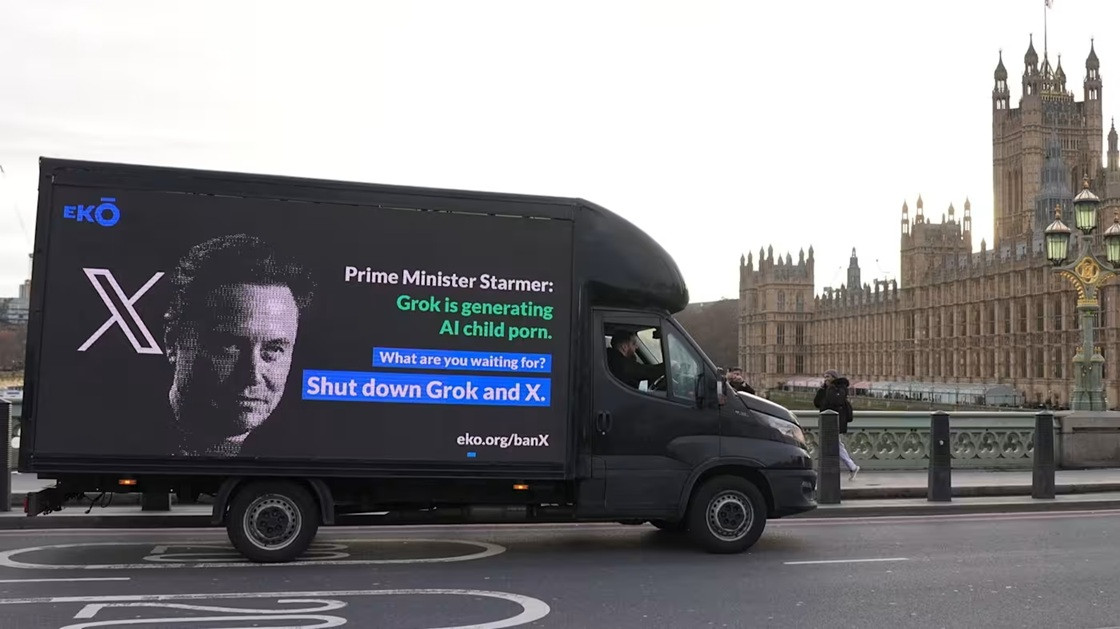 A billboard passes through Westminster on Jan. 14 urging United Kingdom Prime Minister Keir Starmer to stand up to Elon Musk and ban X and Grok. (Reuters/Maja Smiejkowska)
R
ecent regulatory pushback against Grok, the AI chatbot developed by Elon Musk’s xAI and integrated into the social platform X, has sparked a heated debate about how artificial intelligence should be governed in Indonesia.
Earlier this month, the government temporarily blocked access to Grok over concerns that users were exploiting the tool to generate sexually explicit and non-consensual deepfake images, including depictions involving women and minors, for entertainment and circulation online. The Communications and Digital Affairs Ministry cited serious violations of privacy, dignity and digital safety as grounds for the action.
Indonesia and Malaysia became the first countries in Southeast Asia to take such a step, but the response highlights an uncomfortable truth: the nation’s regulatory framework for AI remains rudimentary and reactive, rather than comprehensive and forward-looking.
Although Jakarta’s action to contain immediate harm had legal and ethical justification in this specific instance, it also exposed how much remains unaddressed in laws governing emerging technologies.
Of course, part of the problem is structural. Indonesia does not yet have a dedicated AI law or umbrella regulation that clearly defines the rights and responsibilities of developers, platforms and users of AI systems.
Domestic law currently treats AI under broader statutes such as the Electronic Information and Transactions (ITE) Law, which predates generative AI, and other rules on data and privacy, but none are tailored to address the unique and rapidly evolving challenges posed by systems such as Grok.

Expert analyses note that AI technologies raise new legal questions about algorithmic bias, data protection, transparency, accountability and citizen rights that existing frameworks cannot fully answer.