TheJakartaPost
Please Update your browser
Your browser is out of date, and may not be compatible with our website. A list of the most popular web browsers can be found below.
Just click on the icons to get to the download page.


Popular Reads
Top Results
No results found. Please check your search term and try again
Can't find what you're looking for?
View all search results
Popular Reads
Top Results
No results found. Please check your search term and try again
Can't find what you're looking for?
View all search resultsAs Rafale enters our airspace, Indonesia’s real test begins
Without discipline, diversification can produce an expensive “rolling museum” with low flying hours, low availability, and a posture that never reaches peak combat effectiveness.
Change text size
Gift Premium Articles
to Anyone
Share the best of The Jakarta Post with friends, family, or colleagues. As a subscriber, you can gift 3 to 5 articles each month that anyone can read—no subscription needed!
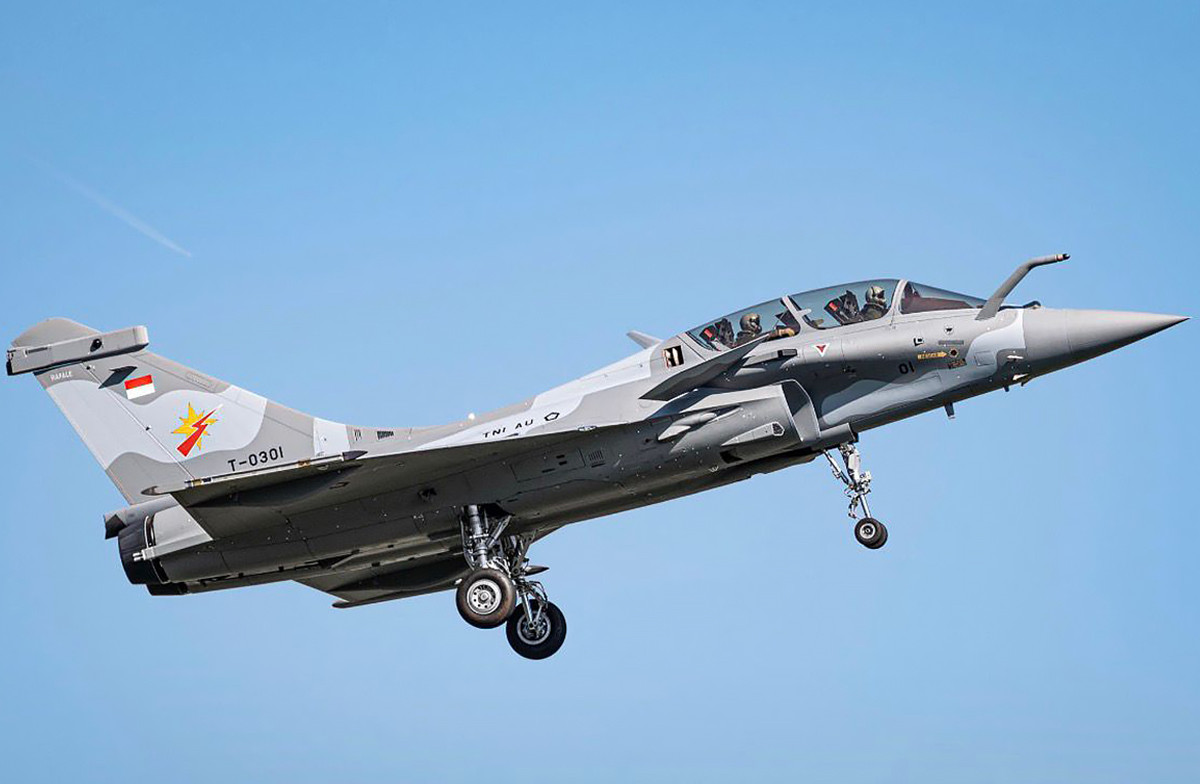 The first flight of the Air Force’s Rafale B, registration number T-0301, takes place in Mérignac, Bordeaux, France, on Sept. 19, 2025. (Courtesy of the Indonesian Air Force/Courtesy of the Indonesian Air Force)
B
arring unforeseen changes in the plan, the first wave of Rafale fighter jets is expected to fly in Indonesian skies in the coming days. Indonesia’s acquisition of France’s Dassault Rafale is not simply news about “new aircraft.” It is a political and strategic signal that Jakarta is trying to escape a familiar trap in defense modernization: dependence on one supplier, one weapons ecosystem and one geopolitical “permission slip”.
The Rafale contract has been structured in three tranches: six, then 18, then 18 aircraft for a total of 42, with the final tranche declared effective in early 2024. Initial deliveries have frequently been projected for early 2026.
The Rafale matters because it is not just a platform; it is an ecosystem. It therefore raises three immediate questions.
First, what exactly is the Rafale’s role inside Indonesia’s air power doctrine? Second, how will it coexist with a fleet that is already diverse and may become more so? Third, will this major purchase advance defense industrial autonomy, or merely replace an old dependency with a new one that is likely to be more expensive?
The Rafale is a 4.5-generation multirole fighter designed for modern combat, packed with sensors, data capabilities and layered air defenses. For Indonesia, it is often seen as a way to strengthen credible long-range capability while reducing exposure to the sanctions and embargo dynamics that have constrained the country in the past.
Strategically, it also deepens cooperation with France, a partner that has pursued a more ambitious defense relationship with Indonesia in recent years, including industry and technology transfer discussions. In a more competitive Indo-Pacific, the ability to secure one’s own airspace remains the clearest language of deterrence and sovereignty.

Diversifying fighter types can reduce "single point of failure" risks arising from embargoes, supplier politics or supply chain shocks. It can also increase operational flexibility across missions, from air superiority to strike and maritime roles.