The Jakarta Post
Please Update your browser
Your browser is out of date, and may not be compatible with our website. A list of the most popular web browsers can be found below.
Just click on the icons to get to the download page.


Popular Reads
Top Results
No results found. Please check your search term and try again
Can't find what you're looking for?
View all search results
Popular Reads
Top Results
No results found. Please check your search term and try again
Can't find what you're looking for?
View all search resultsFood estate projects: A new battlefield for military control
Under Prabowo, the military is no longer positioned chiefly as a protector of the people; it has been transformed into an active economic actor within the agrarian sector.
Change text size
Gift Premium Articles
to Anyone
Share the best of The Jakarta Post with friends, family, or colleagues. As a subscriber, you can gift 3 to 5 articles each month that anyone can read—no subscription needed!
 Set as preferred source
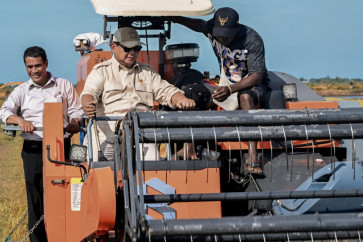
 President Prabowo Subianto (center) operates a rice plowing machine at a field cultivated as part of a national scheme to achieve food self-sufficiency, during his visit to Telaga Sari village, Merauke, South Papua, on Nov. 3, 2024. (AFP/Handout/Indonesian Presidential Palace)
I
n its annual report, the Consortium for Agrarian Reform (KPA) noted that President Prabowo Subianto’s policy of strengthening and expanding military dominance in food, energy and forest-area enforcement projects was identified as a key factor behind the significant increase in agrarian conflict in 2025.
The number of recorded conflicts rose to 341 incidents, exceeding the 295 cases documented in 2024. This trend was also marked by the growing militarization of agrarian conflict, shifting power relations on the ground away from dialogue with regional governments and relevant ministries toward the presence of armed forces.
Food and energy security have increasingly been positioned as integral components of the national defense agenda. Within President Prabowo’s political doctrine, articulated through the Asta Cita (eight goals), food self-sufficiency is framed as a fundamental prerequisite for national security.
However, the manner in which this conviction has been translated into state policy has given rise to serious concerns. The military has not merely been assigned a protective role; instead, it has been placed at the center of the production process itself.
By mid-2025, at least 34,520 additional personnel were recruited by the Indonesian Military (TNI) to form a special division dedicated to food security. This development reflects a significant shift in the military’s function. The institution is no longer confined to a defense-oriented mandate; it is now directly involved in the governance and management of the agrarian sector.
The involvement of the TNI in food-related affairs is not a recent development. In 2020, soldiers from the Military Resort Command (Korem) 102 Panju Panjung were directly involved in the food estate project in Central Kalimantan. The program was placed under the coordination of the Defense Ministry, which at the time was led by Prabowo, and was implemented through formal cooperation with the Agriculture Ministry.

Despite widespread criticism over technical failures and ecological damage resulting from forest clearing, the policy direction was not revised. Instead, it was reinforced and formally institutionalized through legal frameworks.