TheJakartaPost
Please Update your browser
Your browser is out of date, and may not be compatible with our website. A list of the most popular web browsers can be found below.
Just click on the icons to get to the download page.


Popular Reads
Top Results
No results found. Please check your search term and try again
Can't find what you're looking for?
View all search results
Popular Reads
Top Results
No results found. Please check your search term and try again
Can't find what you're looking for?
View all search resultsThe House must act on the Indonesia–Vietnam EEZ deal
Absence of clarity on the boundary in question raises legitimate questions about the government’s political will and institutional urgency.
Change text size
Gift Premium Articles
to Anyone
Share the best of The Jakarta Post with friends, family, or colleagues. As a subscriber, you can gift 3 to 5 articles each month that anyone can read—no subscription needed!
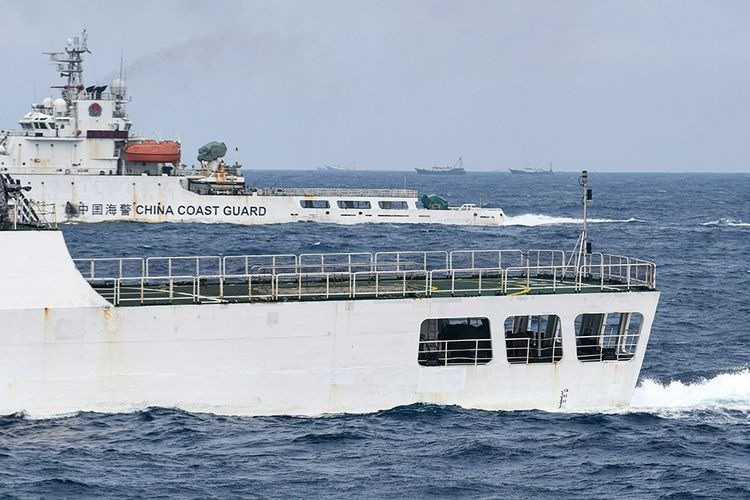 A China Coast Guard vessel draws alongside the Indonesian Navy ship KRI Usman Harun as the latter moves to intercept Chinese fishing boats on Nov. 1, 2020, in Indonesia's exclusive economic zone (EEZ) in the North Natuna Sea. (Antara/M Risyal Hidayat)
O
n Dec. 10, 2025, the Geospatial Information Agency released the new map of Indonesia. It contains important updates on, among others, the Indonesia-Malaysia and Indonesia-Papua New Guinea land boundaries and the administrative boundaries of provinces and Nusantara. It also includes updates on maritime boundaries, for instance Indonesia’s extended continental shelf on the westernmost point of Indonesia’s jurisdictional water, close to Aceh province.
The striking fact is that maritime boundaries on the North Natuna Sea are identical to the old map, namely the continental shelf boundary between Indonesia and Vietnam (agreed in 2003, entry into force in 2007) and the unilateral claim of the outer limit of the Exclusive Economic Zones (EEZ) by Indonesia. Where is the EEZ line of Indonesia and Vietnam that has been agreed upon in 2022?
Indonesia and Vietnam, through their respective maritime delimitation teams, have done their part. From Indonesia's side, the bill on the ratification of the EEZ boundary between Indonesia and Vietnam has been harmonized in November 2024, and submitted to the legislation for deliberation and enactment. In March 2025, President Prabowo Subianto promised to sign the bill. Nearly ten months later into the new year, we have yet to see our head of state’s promise fulfilled.
According to the House of Representatives’ Expertise Body per July 2025, the bill is still at the first deliberation phase, known as the “working group” phase. Procedurally, this bill will afterwards go to the next deliberation phase, or the Plenary Session where the House and the executive will agree on the bill and pass it to the President to be signed, officially becoming a law.
Two important points in this regard. First, this delay indicates a deviation from the working timeframe that ideally has been agreed. Article 98 of the House’ own regulation on law making procedure stipulates that representatives of the House and the government shall agree upon a working timeframe prior to substantive work at the first deliberation phase. Although the working timeframe is not publicly available, House Commission I, which oversees foreign affairs, has organized a session with three experts on April 23, 2025, demonstrating progress in the process. Hypothetically, there has been an agreed timeline, and therefore for transparency purposes a public explanation should be issued in case the timeline is not met.
Second, from a political point of view, this stall is puzzling. A total of 470 out of 580 seats in the House are part of the government coalition. Additionally, the Deputy Speaker of the House is from the Gerindra Party whose chairman is Prabowo himself. This means President Prabowo is more than capable of expediting the ratification process.

The absence of clarity on the boundary in question raises legitimate questions about the government’s political will and institutional urgency. After more than three years since the agreement was announced, continued neglect risks signaling hesitation rather than legal prudence. On the other side, speculative argument points to the invisible influence stemming from the heavily criticized joint statement between Indonesia and China issued in November 2024.