The Jakarta Post
Please Update your browser
Your browser is out of date, and may not be compatible with our website. A list of the most popular web browsers can be found below.
Just click on the icons to get to the download page.


Popular Reads
Top Results
No results found. Please check your search term and try again
Can't find what you're looking for?
View all search results
Popular Reads
Top Results
No results found. Please check your search term and try again
Can't find what you're looking for?
View all search resultsAnalysis: One Price, Many Costs: Stabilizing Rice Nationwide?
Change text size
Gift Premium Articles
to Anyone
Share the best of The Jakarta Post with friends, family, or colleagues. As a subscriber, you can gift 3 to 5 articles each month that anyone can read—no subscription needed!
 Set as preferred source
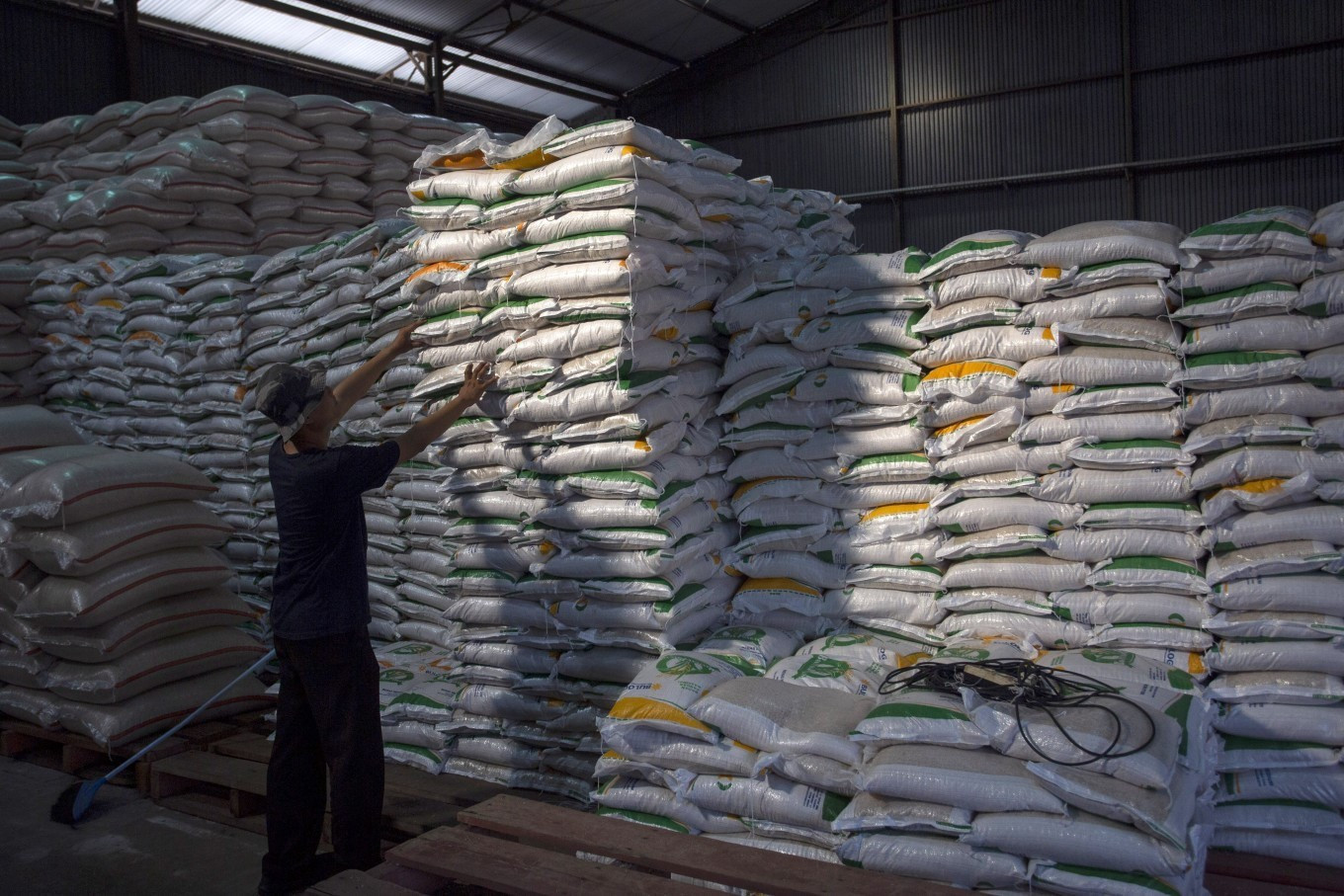 A worker tidies up a stack of locally produced rice on May 30, 2024, at state food company Perum Bulog’s warehouse in Indramayu, West Java. (Antara/Dedhez Anggara)
T
he government recently announced what appeared to be encouraging news for the country’s rice sector: the introduction of a single-price policy for medium-grade rice to be implemented nationwide this year, after he hailed the achievement of self-sufficiency in rice production. While politically attractive, the promise of a uniform rice price across the archipelago warrants closer scrutiny, particularly over whether the price stabilization policy can be sustained without continued reliance on imports or a risk of added fiscal costs.
To equalize the price of rice between Java and eastern regions, the government plans to introduce a single maximum retail price (HET) modeled after the single-price policy for fuel. State Logistics Agency (Bulog) president director Ahmad Rizal Ramdhani has clarified that the scheme will apply only to rice distributed under the food supply and price stabilization (SPHP) program and excludes premium rice sold by private producers. Under this scheme, SPHP rice from Bulog warehouses will be distributed at Rp 11,000 per kilogram, with the single HET rate imposed on retail prices across regions.
Implementing the single HET framework, however, requires confronting stark cost disparities across regions. While consumers will pay the same price nationwide, the distribution costs for rice vary widely between regions. Data from the National Food Agency (Bapanas) show that prior to the policy, SPHP rice prices ranged from Rp 12,500/kg in Zone 1, which covers much of western Indonesia, to Rp 13,500/kg in Zone 3 for eastern regions, reflecting significantly higher logistics and transportation costs. The adoption of a single price policy therefore does not eliminate these cost differences and instead requires their absorption elsewhere along the supply chain.
Doing so will require substantial financial backing, and the government has approved a sharp increase in Bulog’s margin, from Rp 50/kg to 7 percent. The adjustment is intended to strengthen the agency’s operational capacity so it can absorb cross-regional distribution costs, particularly in remote regions, primarily in the east. While the higher margin improves Bulog’s ability to carry out its mandate, it also blurs the line between operational financing and implicit subsidization, as Bulog will essentially internalize the cost of price equalization, ultimately to be borne by the state budget rather than reflected in market prices.
The sustainability of the single rice price policy is also closely tied to the national rice reserves that underpin it. Nationwide price stabilization assumes that sufficient rice stocks are released consistently across regions. According to the government, rice reserves totaled more than 3.4 million tonnes by end of 2025, well above the minimum requirement of around 1.5 million tonnes, or roughly 5 percent of domestic consumption per annum.
Officials have attributed high yield for the increase last year, when national rice output reportedly rose 13.5 percent to 34.77 million tonnes due to a 13 percent expansion in rice fields to 11.35 million hectares. Yet such a dramatic expansion in rice fields within a single year raises questions, particularly given the government’s long-standing challenges in agricultural data accuracy.

Historically, national rice statistics have been contentious. Past annual output projections from Statistics Indonesia (BPS) and the Agriculture Ministry, for example, have differed sharply at just over 30 million tonnes and above 50 million tonnes, respectively. Against this backdrop, the recent claims of rapid gains in cultivated land and rice output deserve careful verification.