TheJakartaPost
Please Update your browser
Your browser is out of date, and may not be compatible with our website. A list of the most popular web browsers can be found below.
Just click on the icons to get to the download page.


Popular Reads
Top Results
No results found. Please check your search term and try again
Can't find what you're looking for?
View all search results
Popular Reads
Top Results
No results found. Please check your search term and try again
Can't find what you're looking for?
View all search resultsBeyond credit: Rethinking KUR for real economic development
KUR must shift toward productivity-based targeting rather than merely maximizing borrower numbers.
Change text size
Gift Premium Articles
to Anyone
Share the best of The Jakarta Post with friends, family, or colleagues. As a subscriber, you can gift 3 to 5 articles each month that anyone can read—no subscription needed!
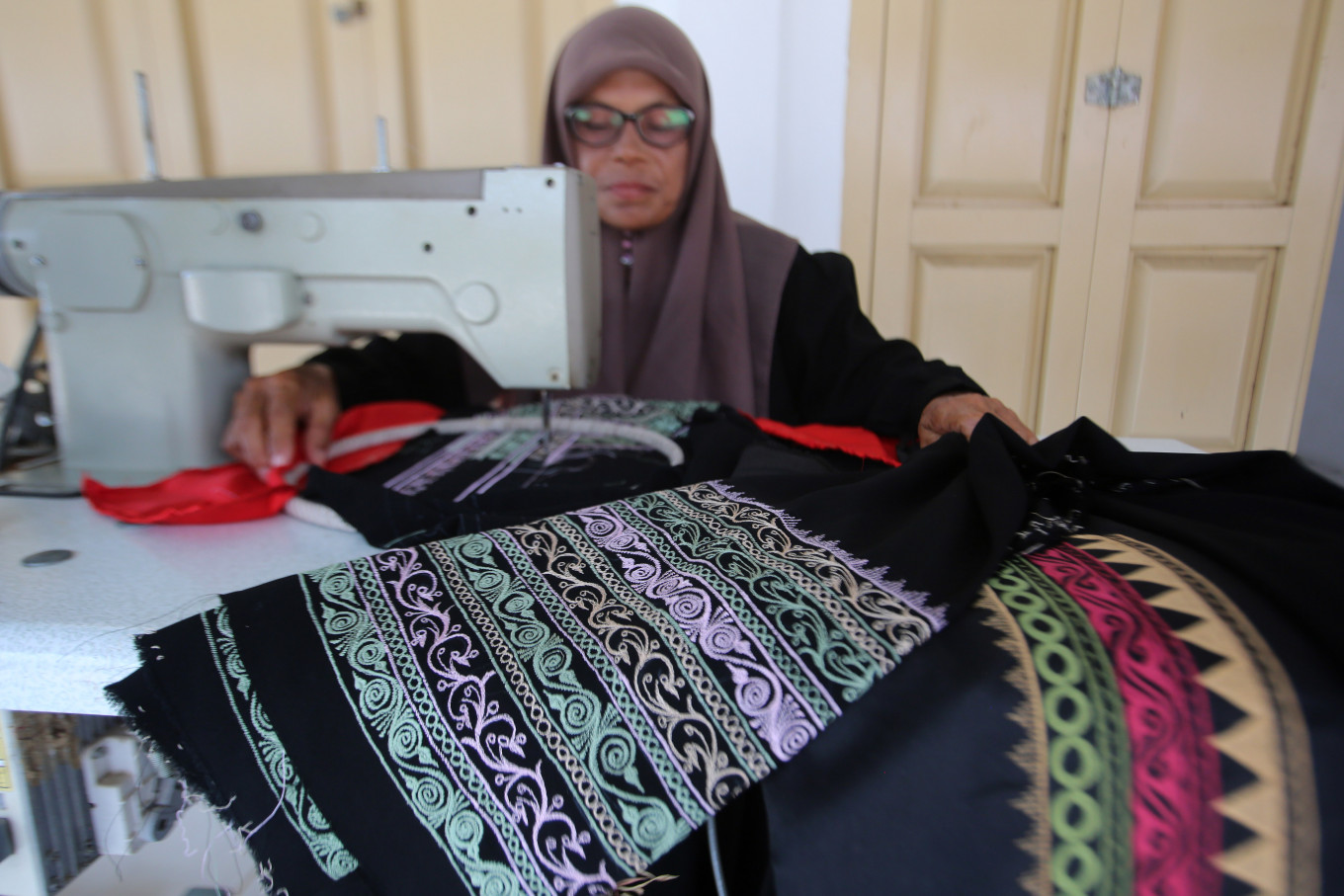 A craftswoman produces embroidered cloth on Monday, with a typical Acehnese motif at the Dekranasda micro, small, and medium enterprises (MSMEs) craft center in Aceh Besar regency, Aceh. MSMEs often struggle to scale production and maintain consistent quality, with many lacking certified processes and facing costly compliance requirements. (Antara/Ampelsa)
O
ne of Indonesia’s notable economic achievements has been the maintenance of macroeconomic stability, reflected in an average growth of approximately 5 percent over the past decade. Despite this progress, a structural challenge persists in the form of entrenched income inequality.
A 2023 report by the Institute for Economic and Social Research, University of Indonesia, documents that while the Gini ratio declined from 0.409 in 2012 to 0.384 in 2021, it remains at a comparatively high level. As a summary measure of income distribution, a lower Gini coefficient signifies a more equitable allocation of economic output across the population.
Regionally, inequality in Java is more severe than in non-Java regions, while urban areas exhibit higher inequality than rural areas. This reflects the coexistence of very high incomes alongside low-wage informal workers within the same geographic space. Moreover, compared to neighboring countries, Indonesia remains more unequal than India (0.345), Thailand (0.351), and Vietnam (0.368), and fares better only than the Philippines (0.407).
This inequality is further reflected in unequal access to formal banking credit, particularly among workers in the informal sector. In this context, market-driven credit mechanisms are generally unable to bridge the gap between credit demand and supply. Stiglitz and Weiss (1981) argue that credit market failures in such societies arise from information asymmetries between lenders and borrowers, leading to the systematic exclusion of low-income and financially marginalized populations from formal financial systems, despite their underlying creditworthiness.
Such market failures justify the necessity of a more proactive role for governments through micro lending policies to expand access to finance, particularly for micro, small, and medium enterprises (MSMEs). Empirical studies demonstrate that micro lending increases household income and asset accumulation, reduces vulnerability to transient poverty, and generates positive spillover effects for local economies through higher production activity and demand (Morduch & Haley, 2001; Khandker, 2005; Karlan & Goldberg, 2007).
In Indonesia, this government intervention in the credit market is primarily implemented through the Community Business Credit scheme (KUR). Along the years, KUR disbursement has expanded dramatically over the past 15 years. In 2009, total disbursement stood at approximately Rp 13 trillion (US$770 million), rising almost thirtyfold to around Rp 384 trillion in 2023.

Over the same period, the number of beneficiaries increased sharply from about 50,000 debtors in 2008 to nearly 10 million in 2022. Average loan size also rose significantly, from Rp 5.9 million per borrower in 2009 to approximately Rp 39 million in 2023. This indicates that both program coverage and financing scale per enterprise have expanded substantially.