The Jakarta Post
Please Update your browser
Your browser is out of date, and may not be compatible with our website. A list of the most popular web browsers can be found below.
Just click on the icons to get to the download page.


Popular Reads
Top Results
No results found. Please check your search term and try again
Can't find what you're looking for?
View all search results
Popular Reads
Top Results
No results found. Please check your search term and try again
Can't find what you're looking for?
View all search resultsAnalysis: New parties bank on powerful figures for survival
Change text size
Gift Premium Articles
to Anyone
Share the best of The Jakarta Post with friends, family, or colleagues. As a subscriber, you can gift 3 to 5 articles each month that anyone can read—no subscription needed!
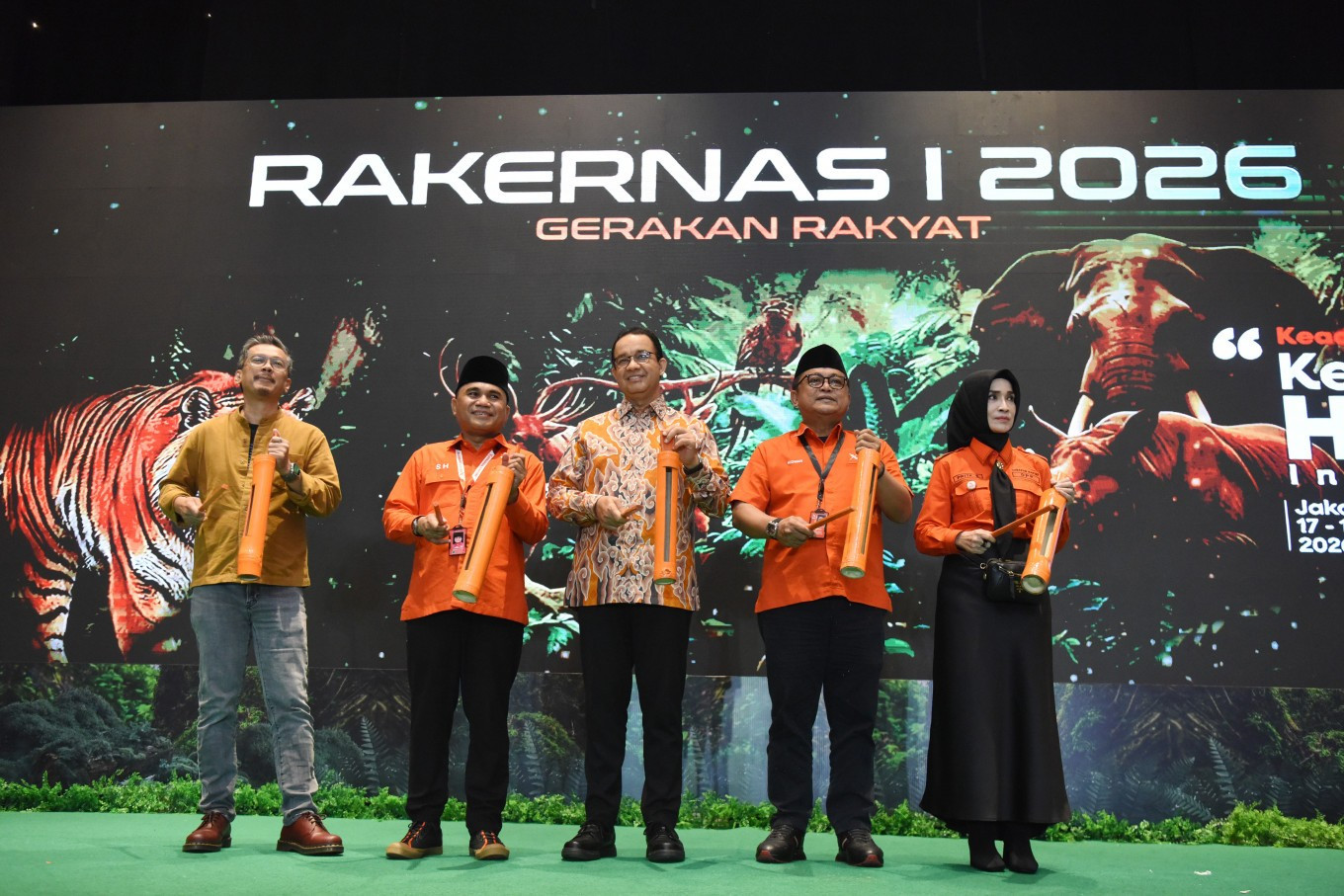 Chairman of the Gerakan Rakyat (People's Movement) Party Sahrin Hamid (second left), honorary member Anies Baswedan (center), head of the advisory council Sulfikar Amir (left), secretary-general M. Ridwan (second right) and treasurer Prita Subono (right) symbolically open the party's first national working meeting for 2026 in Jakarta on Jan. 17, 2026. (Antara/Indrianto Eko Suwarso)
T
he new year marked a start to a journey for two new political parties, which have both set their sights on contesting the 2029 legislative and presidential elections. From the outset, the National Resonance Party (PGB) and the People’s Movement Party (PGR) have associated their identities with national figures widely seen as potential contenders in the 2029 presidential race. This emphasis on personal endorsement signals a shifting pattern in Indonesian politics, raising questions about whether parties are moving away from their foundational role as institutions for political education and cadre development.
The PGB was launched on Jan. 17 under the leadership of Ahmad Rofiq, a former secretary-general of the Perindo Party and a member of the Joko “Jokowi” Widodo - Ma’ruf Amin campaign team in the 2019 presidential race. The PGB has openly declared its support for President Prabowo Subianto’s bid for a second term in 2029.
A day later, the PGR announced its transformation into a political party. It grew out of the People’s Movement, a volunteer network that backed Anies Baswedan and Muhaimin Iskandar in the 2024 presidential election. The party is chaired by Sahrin Hamid, who served as Anies’ spokesperson during the campaign. In its declaration, the party described Anies as a “role model” and a symbol of its ideological struggle, as well as the figure it hopes will try another luck in 2029.
Electorally, this strategy offers the new parties clear short-term incentives. Prabowo secured 58.59 percent of the vote alongside Gibran Rakabuming Raka to win the 2024 race. Anies, running with Muhaimin Iskandar, garnered 24.95 percent. These levels of support provide significant political capital that can, at least symbolically, be transferred to parties aligning themselves with these figures.
Few would deny that these moves are nothing sort of early maneuvering ahead of the 2029 election. They also see the launch of these parties as indicative of a broader shift in the function of political parties - transforming from institutions of representation and cadre building into electoral vehicles anchored to individual personalities. In this view, parties are shaped less by ideology, policy platforms and organizational structures than by calculations of a figure’s electability.
History suggests that while new parties often stand a reasonable chance of qualifying as election participants, they face a much steeper climb in translating participation into seats, given the parliamentary threshold of 4 percent of the national vote.

In the 2024 election, the General Elections Commission (KPU) recorded 43 registered political parties. Of these, 40 entered the verification process and 24 were declared eligible to compete - comprising 18 national parties and six Aceh-based local parties. Of the 18 national parties, only eight managed to beat the parliamentary threshold.