TheJakartaPost
Please Update your browser
Your browser is out of date, and may not be compatible with our website. A list of the most popular web browsers can be found below.
Just click on the icons to get to the download page.


Popular Reads
Top Results
No results found. Please check your search term and try again
Can't find what you're looking for?
View all search results
Popular Reads
Top Results
No results found. Please check your search term and try again
Can't find what you're looking for?
View all search resultsThis could be Indonesia’s moment to shape the international order
Today, Indonesia again occupies a position where its voice can shift the conversation, especially among states that feel trapped between great-power rivalry.
Change text size
Gift Premium Articles
to Anyone
Share the best of The Jakarta Post with friends, family, or colleagues. As a subscriber, you can gift 3 to 5 articles each month that anyone can read—no subscription needed!
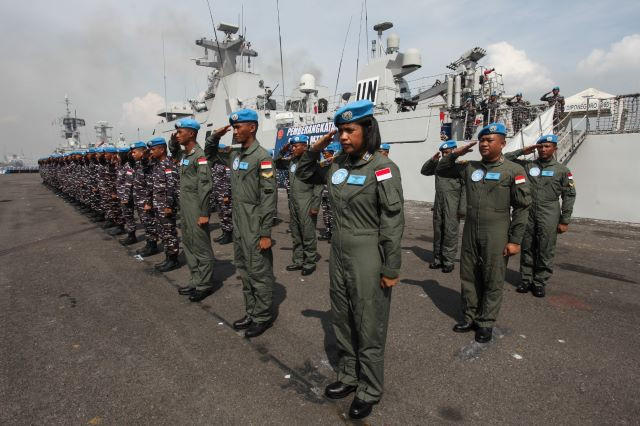 International duty: Indonesian Navy personnel grouped under the Maritime Task Force (MTF) KONGA XXVIII-O/UNIFIL TA 2023 attend a send-off ceremony on Dec. 6, 2023, at the Second Fleet Command headquarters in Surabaya, East Java. They will join the international peacekeeping force in Lebanon. (Antara/Didik Suhartono)
F
ormer president Susilo Bambang Yudhoyono’s recent warning about the growing risk of World War III has resonated far beyond social media. It resonates because it does not come from an activist or an academic, but from a former head of state who understands how quickly global systems can slide from tension into catastrophe.
Yet the most important implication of SBY’s message is not simply that the world is in danger. It is that this may be Indonesia’s moment to matter in history, not as a spectator, but as a shaper.
History rarely announces such moments clearly. They are recognized only in hindsight, once opportunities have been seized or squandered. Today’s global environment, fractured alliances, eroding institutions and deepening mistrust among major powers, resembles not only the years before the world wars, but also an earlier turning point: the moment when the United States emerged, tentatively and uncertainly, as a global actor at the start of the 20th century.
At that time, the US was not yet a superpower. But it was a rising power, demographically dynamic, economically expanding and increasingly influential beyond its borders. It still spoke the language of restraint and non-entanglement, even as its weight made disengagement impossible.
The question it faced then is the one Indonesia faces now: Would it merely benefit from the international order, or would it help shape it?
Indonesia today bears striking similarities. It is the world’s fourth most populous country, a growing economic force, and a pivotal state bridging the Indo-Pacific, the Islamic world and the Global South. It commands attention not through coercion, but through scale, credibility and convening power. Few countries are better positioned to speak across divides.

Crucially, Indonesia also carries a foreign policy tradition uniquely suited to this moment. Nonalignment was never about passivity. It was about autonomy, moral credibility and refusal to accept that global politics must be organized into hostile blocs. That principle was forged in the aftermath of colonialism and Cold War rivalry, but it looks strikingly relevant again today.