The Jakarta Post
Please Update your browser
Your browser is out of date, and may not be compatible with our website. A list of the most popular web browsers can be found below.
Just click on the icons to get to the download page.


Popular Reads
Top Results
No results found. Please check your search term and try again
Can't find what you're looking for?
View all search results
Popular Reads
Top Results
No results found. Please check your search term and try again
Can't find what you're looking for?
View all search resultsTrump’s Board of Peace is problematic
In terms of organizational structures, functions and role, status, and rules and procedure, the BoP resembles more like a privately-owned family company than an intergovernmental organization.
Change text size
Gift Premium Articles
to Anyone
Share the best of The Jakarta Post with friends, family, or colleagues. As a subscriber, you can gift 3 to 5 articles each month that anyone can read—no subscription needed!
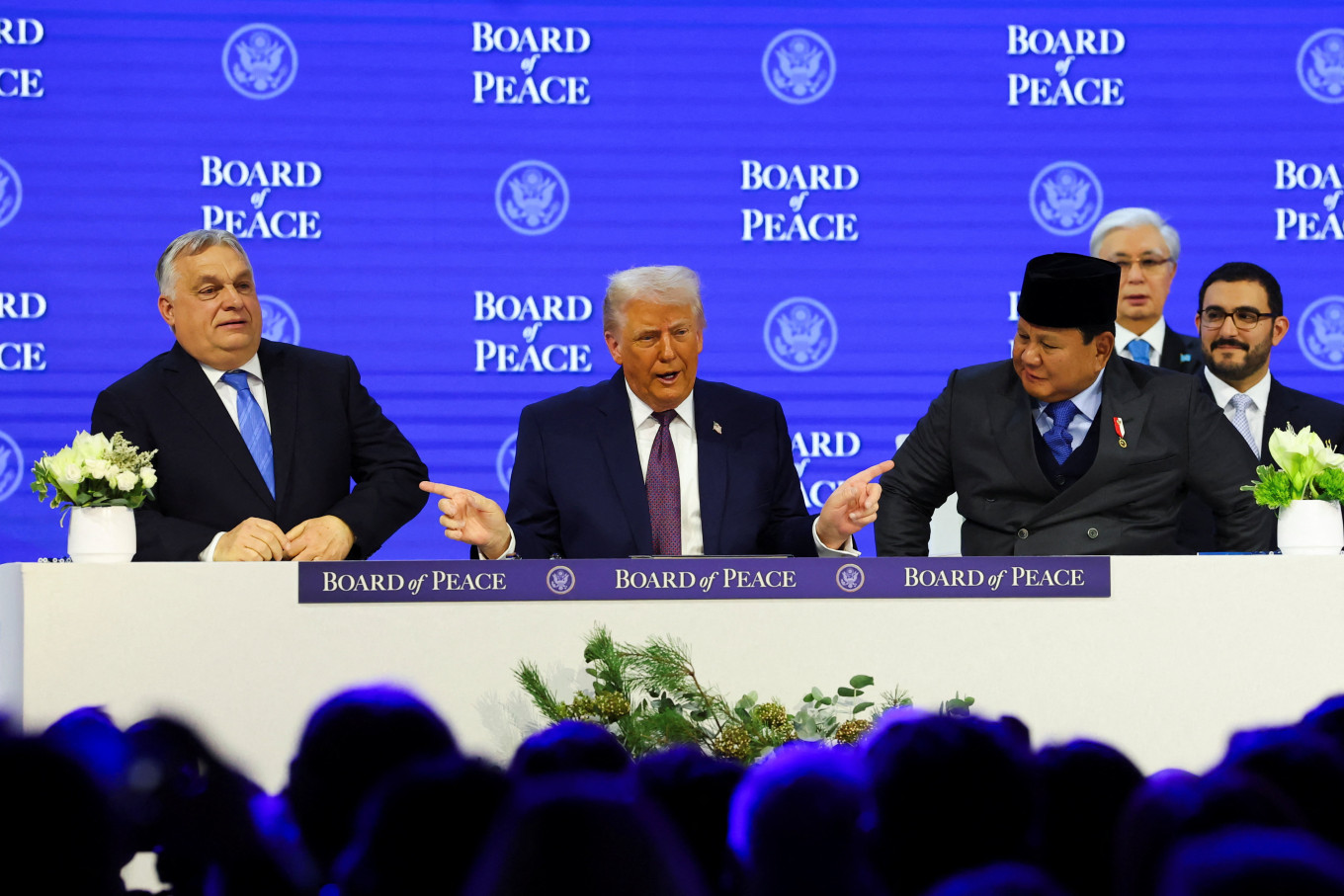 United States President Donald Trump (center) gestures towards President Prabowo Subianto (right) and Hungary's Prime Minister Viktor Orban, as they take part in an announcement on Jan. 22, 2026 for his Board of Peace initiative, alongside the 56th annual World Economic Forum (WEF), in Davos, Switzerland. (Reuters/Denis Balibouse)
W
hen news broke that United States President Donald Trump had sent invitations to about 60 governments inviting them to join his Board of Peace (BoP), it did not come as a big surprise. It was to be expected. What is surprising to many is the fact that Indonesia quickly decided to accept the invitation and joined the signing ceremony in Davos, Switzerland. Indeed, there had not been much public discussions prior to the decision.
In normal circumstances, foreign policy experts would argue that it was impossible to decide on such a serious issue within a week. Some suggested that Indonesia should carefully study the proposal first. However, the Indonesian government once again proved pundits wrong.
President Prabowo Subianto joined the stage in Davos with 20 representatives of other participating countries. Indonesia, together with Mongolia, was one of two East Asian countries present in what soon became a subject of controversy both at home and abroad.
Within Indonesia, criticisms came swiftly from the Indonesian Council of Ulamas (MUI). Sudarnoto Abdul Hakim, MUI chairman for foreign relations, stated that the BoP “is fundamentally flawed” and warned Indonesia “not to provide moral legitimacy to a scheme that would undermine Palestine’s independence”. Former deputy minister for foreign affairs Dino Patti Djalal questioned the adequacy of Foreign Minister Soegiono’s explanation about the decision. While both social and conventional media were abuzz with diverse, but mostly critical, views of the BoP.
Indeed, the BoP itself is a problematic body, in almost every front. The event, to be fair, is a historic one, but not in a positive way. The signing ceremony in Davos did not give any impression of an inauguration of a new international organization destined to create a better international order than the existing one. It is hard to read the ceremony as a celebration of a renewed commitment by states to work on peace-making. In fact, it looked more like a well-choreographed act of acknowledgement of, almost submission to, the power of the US.
In terms of organizational structures, functions and role, status, and rules and procedure, the BoP resembles more like a privately-owned family company than an intergovernmental organization. The BoP Charter, for example, bestows Trump the title of chairman for life with absolute authority. It gives him the right to veto all BoP’s decisions and the right to appoint his successor as a chairman. This makes the BoP an authoritarian institution, where Trump sits at the top with an emperor-like power.

The BoP is also problematic because it is never about Gaza, let alone about the plan to support an independent Palestinian state. As explained by a member of the BoP Executive Board Jared Kushner in Davos, the organization would turn Gaza into a gigantic and ambitious development (read: a real estate) project. Yet, such a plan lacks moral, ethical and humane legitimacy. In effect, the plan clearly disregards, and buries, the evidence of Israel’s atrocities and genocide against tens of thousands of Palestinians.