The Jakarta Post
Please Update your browser
Your browser is out of date, and may not be compatible with our website. A list of the most popular web browsers can be found below.
Just click on the icons to get to the download page.


Popular Reads
Top Results
No results found. Please check your search term and try again
Can't find what you're looking for?
View all search results
Popular Reads
Top Results
No results found. Please check your search term and try again
Can't find what you're looking for?
View all search resultsWhy multilateralism matters more than ever for global economic stability
Without coherent multilateral standards, well-intentioned environmental rules risk becoming de facto trade barriers that favor those with the deepest pockets for administrative costs.
Change text size
Gift Premium Articles
to Anyone
Share the best of The Jakarta Post with friends, family, or colleagues. As a subscriber, you can gift 3 to 5 articles each month that anyone can read—no subscription needed!
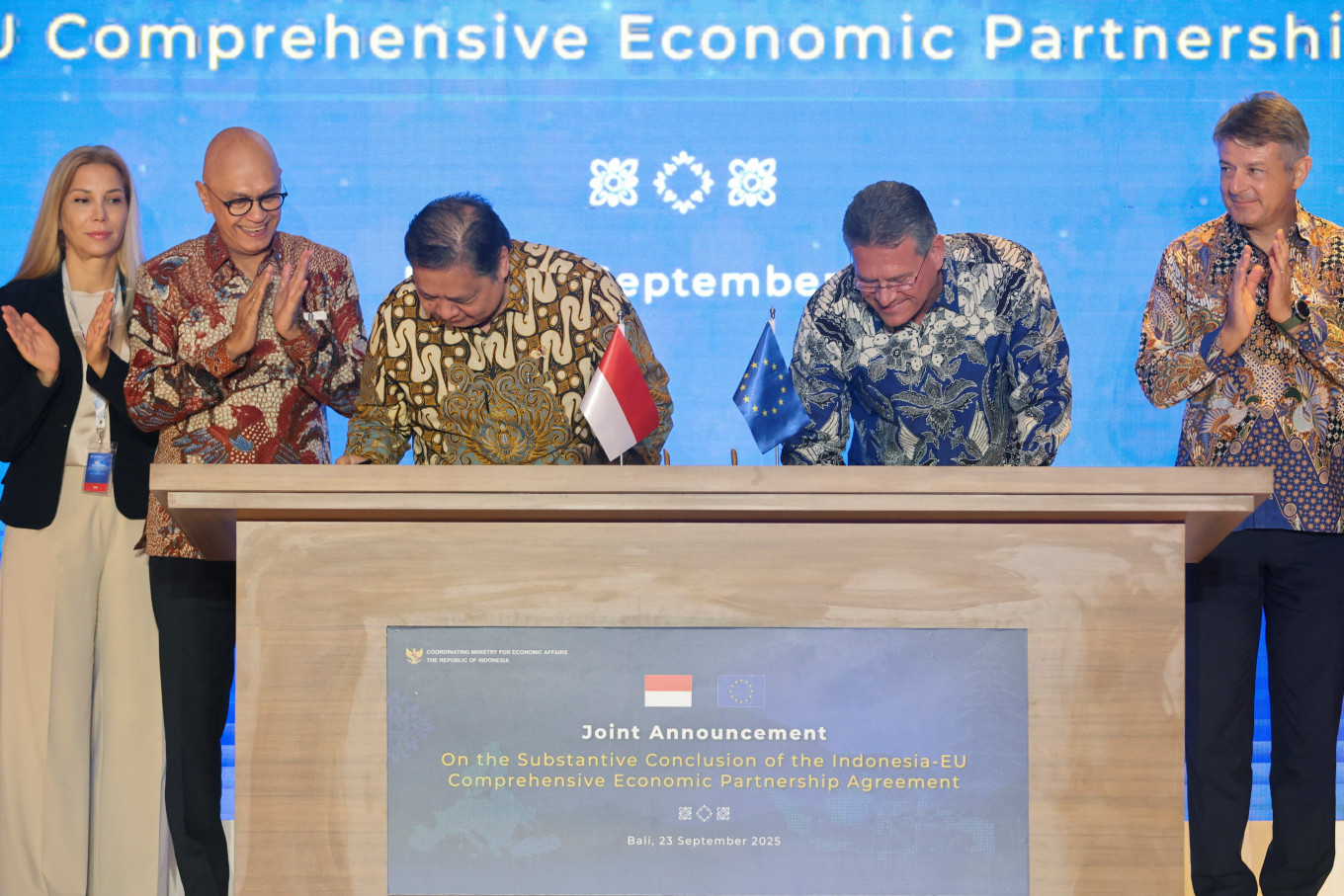 Airlangga Hartarto, Indonesia's Coordinating Minister for Economic Affairs, and Maros Sefcovic, European Commissioner for Trade and Economic Security, sign documents during a signing ceremony on Sept. 23, 2025, on the substantive conclusion of the Indonesia-European Union Comprehensive Economic Partnership Agreement (IEU-CEPA) in Nusa Dua, Bali. (REUTERS/Johannes P. Christo)
The global economy enters 2026 standing at a critical crossroads. Geopolitical tensions have evolved from episodic disturbances at the margins of economic life into a defining feature of the global operating environment.
Strategic rivalries between major powers, escalating trade frictions and the weaponization of economic policy are no longer just diplomatic hurdles; they are reshaping how nations interact and how businesses plan, invest and grow.
The World Economic Forum’s Global Risks Report 2026 captures this reality with striking clarity. Geoeconomic confrontation, manifested through tariffs, sanctions and protectionist measures, has overtaken conventional armed conflict as the most significant global risk in the near term. From transatlantic frictions to the enduring instability in the Middle East and high-stakes confrontations in South America, these flashpoints underscore how rapidly geopolitical tensions spill over into systemic economic risk.
At the heart of this uncertainty lies a deep structural concern: the weakening of the multilateral trading system that has underpinned decades of prosperity.
For the private sector, this is not an abstract diplomatic issue. It translates directly into higher overheads, disrupted value chains and narrowing market opportunities. When trade rules lose their authority, businesses are forced to absorb risks that were once managed collectively through international disciplines.
Today, global trade suffers less from a lack of agreements than from the weakening of mechanisms that ensure those agreements are upheld. The prolonged paralysis of the World Trade Organization’s (WTO) Appellate Body is the primary example of this decay.

Even when WTO panels find merit in Indonesia’s positions, such as in disputes involving palm oil-based biodiesel, the absence of a functioning appeals mechanism prevents final, binding rulings. Consequently, discriminatory treatments persist, and Indonesian exporters are left to navigate a vacuum of legal uncertainty that stifles long-term investment.