TheJakartaPost
Please Update your browser
Your browser is out of date, and may not be compatible with our website. A list of the most popular web browsers can be found below.
Just click on the icons to get to the download page.


Popular Reads
Top Results
No results found. Please check your search term and try again
Can't find what you're looking for?
View all search results
Popular Reads
Top Results
No results found. Please check your search term and try again
Can't find what you're looking for?
View all search resultsArtificial intelligence and the future of education
Trying to prepare people for a fixed set of challenges, when those challenges are constantly changing, is a losing strategy.
Change text size
Gift Premium Articles
to Anyone
Share the best of The Jakarta Post with friends, family, or colleagues. As a subscriber, you can gift 3 to 5 articles each month that anyone can read—no subscription needed!
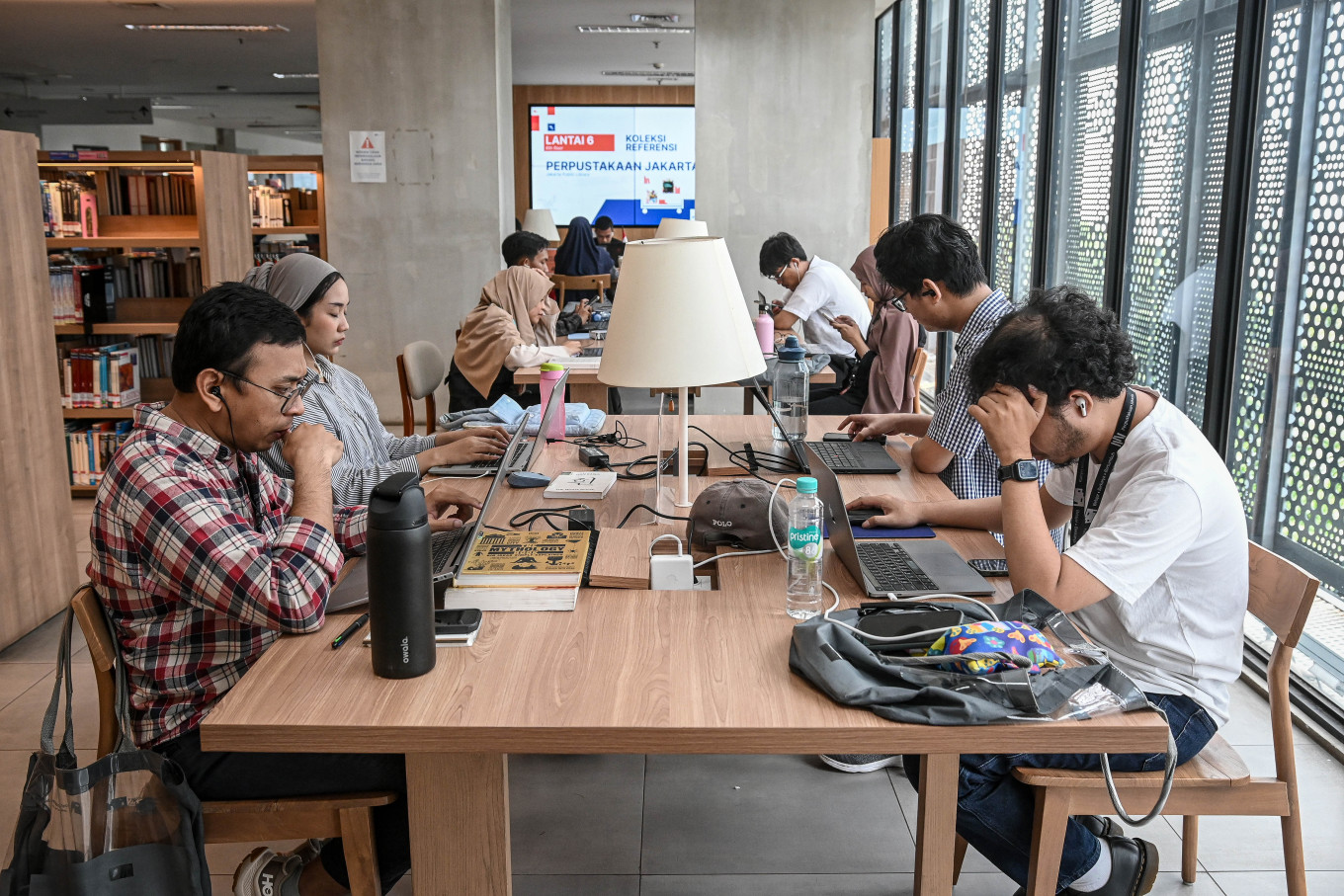 People use laptops to carry out tasks on Dec. 29, 2025, at the Jakarta Public Library in the Taman Ismail Marzuki cultural center, Cikini, Central Jakarta. (Antara/Sulthony Hasanuddin)
T
he rapid progress of large language models (LLMs) over the past two years has led some to argue that artificial intelligence will soon make college education, especially in the liberal arts, obsolete. According to this view, young people would be better off skipping college and learning directly on the job.
I strongly disagree. Learning through hands-on experience is valuable and always has been. But it works best when people have a good sense of which jobs and skills will be in demand. If there is one thing we can be confident about, it is that the future of work is highly uncertain. Advising young people to forgo college in favor of early entry into the labor market is misguided, at best.
Geoffrey Hinton, widely regarded as one of the pioneers of modern AI, once compared progress in his field to navigating through “fog”: you can see what lies immediately ahead, but not what comes next. Accordingly, the central challenge for educators is to prepare students to operate effectively in fog-like conditions. The answer is not to train them for specific tasks that may soon become obsolete, but to make them as adaptable as possible. Trying to prepare people for a fixed set of challenges, when those challenges are constantly changing, is a losing strategy. We want skilled drivers who can navigate unfamiliar roads and unexpected obstacles.
From this perspective, education, and especially higher education, plays a more important role than ever. Because we do not know which specific skills will be in demand in the future, a return to fundamentals is imperative. Liberal education emphasizes how to think, rather than what to do. It trains students to reason, to read carefully, to write clearly and to evaluate evidence. These skills will age far better than narrow technical competencies.
This does not mean ignoring technology. On the contrary, students must learn to work with AI. But the goal should be to make them critical users and informed judges of AI tools, not passive consumers. It remains essential to teach basic mathematics, logic and reasoning; to engage with foundational texts; and to learn how arguments are constructed and tested. These are the skills that allow individuals to stay ahead of rapidly evolving technology.
This principle raises two practical questions: what should we teach, and how should we teach it? The first question is difficult and will inevitably generate debate. While there may be broad agreement on the importance of core concepts, the details will change over time. Our experience with earlier technologies offers useful guidance. The introduction of calculators and computers did not eliminate the need to teach arithmetic. Students still learn how calculations work, but time-consuming manual computation is now delegated to machines. Similarly, spelling and grammar remain important, but software has largely replaced the need for endless drills.

AI calls for a similar adjustment across many domains. LLMs now perform tasks such as summarizing text or identifying main ideas, longtime staples of education, extremely well. The same is increasingly true for programming, solving quantitative problems and even drafting text. Though these activities should not disappear from the curriculum, the goal should shift. Students need to understand the underlying concepts and logic, rather than mastering every step of the execution.