The Jakarta Post
Please Update your browser
Your browser is out of date, and may not be compatible with our website. A list of the most popular web browsers can be found below.
Just click on the icons to get to the download page.


Popular Reads
Top Results
No results found. Please check your search term and try again
Can't find what you're looking for?
View all search results
Popular Reads
Top Results
No results found. Please check your search term and try again
Can't find what you're looking for?
View all search resultsEmbracing pragmatic transactional realism to survive Trump’s world
The long era of the liberal international order seems to be fading, replaced by a new and colder reality that could be best described as pragmatic transactional realism.
Change text size
Gift Premium Articles
to Anyone
Share the best of The Jakarta Post with friends, family, or colleagues. As a subscriber, you can gift 3 to 5 articles each month that anyone can read—no subscription needed!
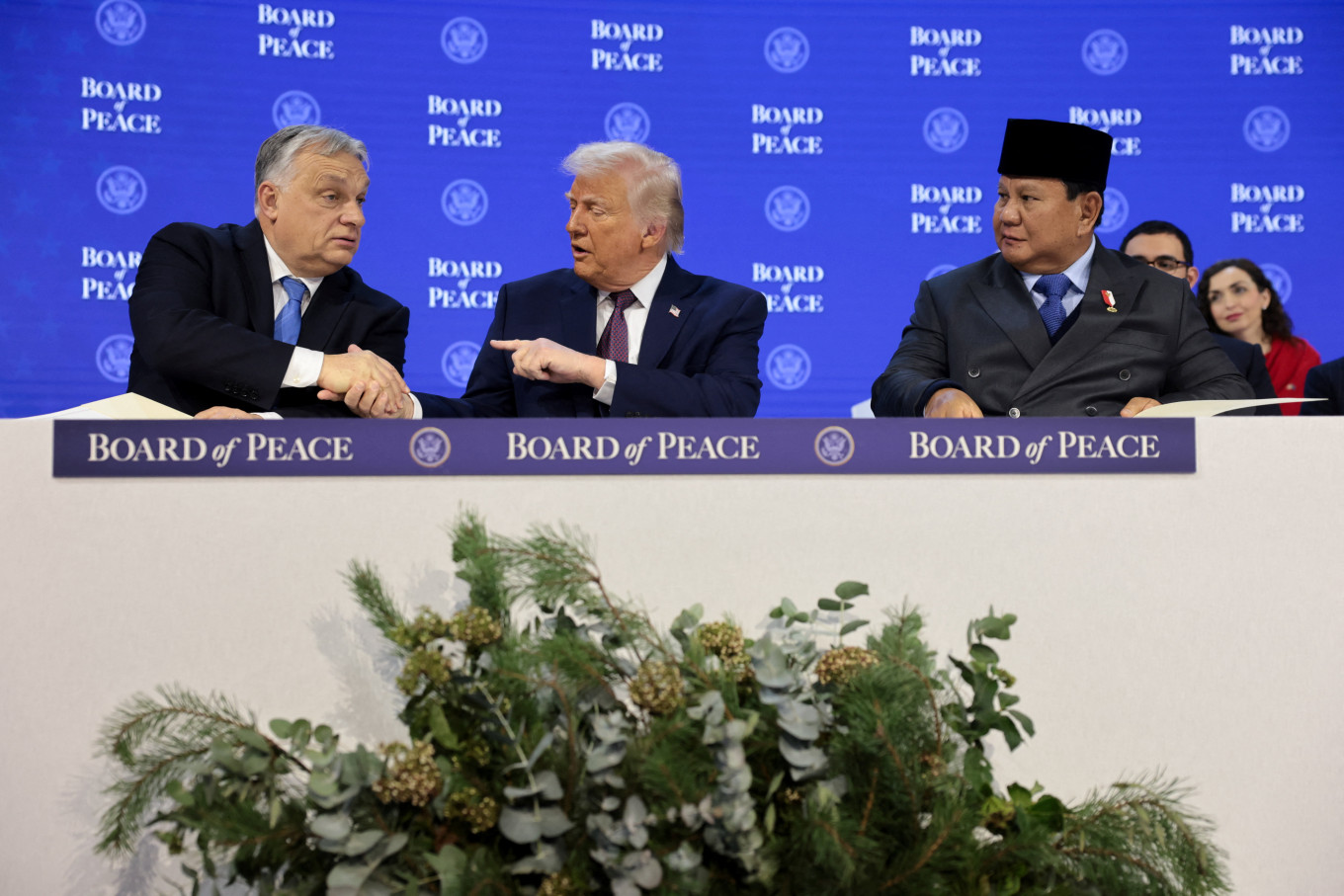 United States President Donald Trump shakes hands with Hungary's Prime Minister Viktor Orban on Jan. 22, 2026, next to's President Prabowo Subianto, as they take part in a charter announcement for Trump's Board of Peace initiative aimed at resolving global conflicts, alongside the 56th annual World Economic Forum (WEF), in Davos, Switzerland. (Reuters/Jonathan Ernst)
A
s global leaders gather in Davos for the World Economic Forum last week, the atmosphere appears to be shifting fundamentally. The long era of the liberal international order seems to be fading, replaced by a new and colder reality that could be best described as pragmatic transactional realism.
To understand this profound change, we might look to the words of Niccolo Machiavelli, who famously noted that the promise given was a necessity of the past while the word broken is a necessity of the present. This cynical wisdom appears to guide the strategy of United States President Donald Trump in his second term, as he moves to dismantle the system America once built to serve a new national purpose.
The liberal international order stood on three main pillars that provided global stability for decades: collective security through treaties like NATO, economic openness promoting free trade and respect for international institutions like the United Nations.
However, US President Trump seems to view these pillars not as assets, but as expensive liabilities. He appears to be turning security into a business deal, as evidenced by the recent friction over Greenland. When Denmark refused to sell its territory, Washington threatened heavy tariffs, suggesting that an alliance might no longer protect a country if the US sees a better deal elsewhere.
The disruption continues with the rise of the Board of Peace, a new organization launched by Trump reportedly to rival the UN. Unlike the UN, this Board appears to work on a strictly pay-to-play basis. Reports indicate that permanent membership requires a substantial financial commitment, effectively destroying the idea of sovereign equality and replacing it with a system where influence is purchased.
For Indonesia, this shifting landscape presents a critical need for evolution. For decades, Jakarta adhered to the doctrine of “free and active”. However, in this ruthless environment, simple neutrality is no longer sufficient. To survive, Indonesia appears to be embracing a different approach: strategic transactionalism.

This new approach replaces passive neutrality with active calculation, treating every diplomatic engagement as a business transaction. We see the first signs of this approach in Indonesia’s decision to join the US-led Board of Peace. However, a cynical observation of domestic financial maneuvers suggests this pivot can be easily funded by the private sectors. The reported issuance of the “Patriot Bond 2” by the Danantara agency, aiming to raise roughly $1.2 billion (Rp 20 trillion), aligns suspiciously well with the estimated $1 billion “entry fee” for permanent membership on Trump’s Board. This coincidence suggests that the cost of joining this exclusive club is being easily supported by releasing these bonds, effectively creating a direct pipeline from national savings to the purchase of geopolitical relevance.