The Jakarta Post
Please Update your browser
Your browser is out of date, and may not be compatible with our website. A list of the most popular web browsers can be found below.
Just click on the icons to get to the download page.


Popular Reads
Top Results
No results found. Please check your search term and try again
Can't find what you're looking for?
View all search results
Popular Reads
Top Results
No results found. Please check your search term and try again
Can't find what you're looking for?
View all search resultsThe Philippines inherits an ASEAN in turmoil
ASEAN will now need to make decisions about its future purpose and whether it will seek to restore the established order or strike out in a new direction.
Change text size
Gift Premium Articles
to Anyone
Share the best of The Jakarta Post with friends, family, or colleagues. As a subscriber, you can gift 3 to 5 articles each month that anyone can read—no subscription needed!
 Set as preferred source
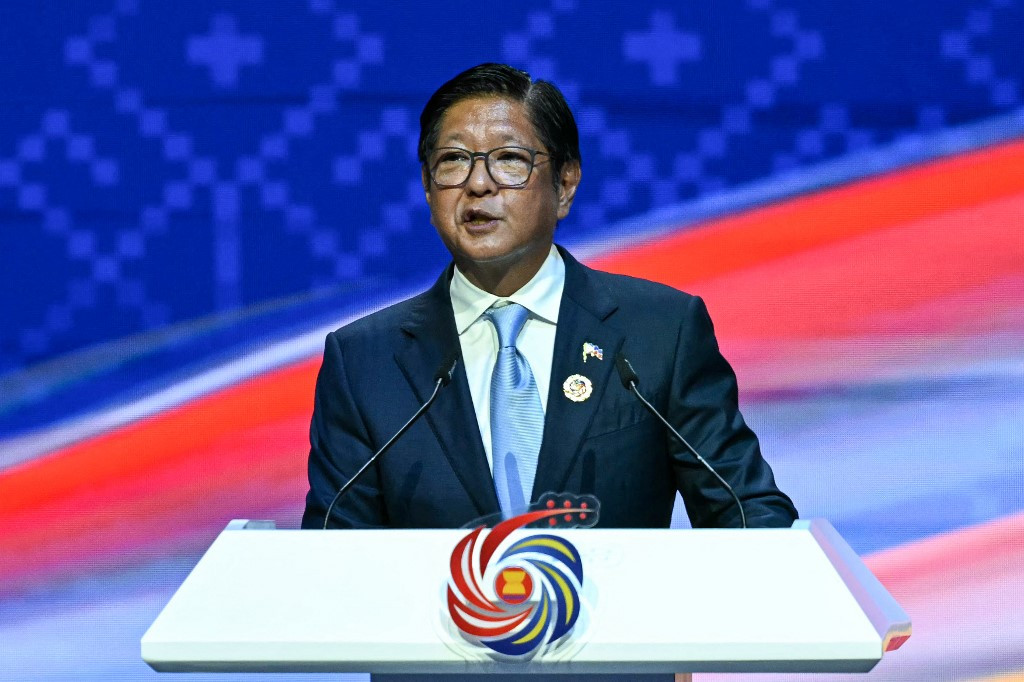 Philippines' President Ferdinand Marcos Jr delivers remarks during the ASEAN chairmanship handover ceremony as part of the closing ceremony of the 47th ASEAN Summit in Kuala Lumpur on Oct. 28, 2025. (AFP/Mohd Rasfan)
T
he year 2025 brought a whirlwind of challenges to Southeast Asia. From the United States tariffs and organized cybercrime threatening the region's economy, to rising tensions along the Taiwan Strait and over half a million displaced people resulting from the Thai-Cambodian conflict, Malaysia’s chairmanship of ASEAN was defined by its response to a host of regional crises.
In the case of the Thai-Cambodian border conflict, the association’s divisive intervention tested the principle of non-intervention and showed that the region can engage, with influence, in major geopolitical debates alongside the US and China. While Malaysia's Foreign Minister Mohamad Hasan stressed that ASEAN had not strayed into the domestic arena of either country, acting only as a neutral facilitator, this view was not universally accepted. In November, Thai protesters gathered at the Malaysian embassy claiming Prime Minister Anwar Ibrahim had overstepped in his role as ASEAN chair and meddled in Thailand’s efforts to uphold its sovereignty.
The shift in the positioning of the association has created an awkward dilemma for the 2026 chair, the Philippines. Under the leadership of Ferdinand Marcos Jr., ASEAN will now need to make decisions about its future purpose and whether it will seek to restore the established order or strike out in a new direction.
An immediate and defining challenge will be in its engagements with the world’s two superpowers, the US and China. Manila’s tensions with Beijing have grown in recent years, particularly around the South China Sea, and have resulted in a scaling up of military spending (including US$2.5 billion in US defense aid), exit from the Belt and Road Initiative, and most recently a new defense pact with Tokyo to deepen military cooperation. As chair, the Philippines will need to carefully straddle its own tensions with China with work that will be beneficial to the entire bloc.
Relations with the US, meanwhile, will also pose issues. Efforts by the bloc to negotiate a collective reduction in US tariffs, last year, ultimately failed, forcing member states to pursue their own bilateral agreements. In the case of Cambodia and Thailand, a reduction was tied to their agreeing to a US brokered ceasefire, in July. While the Philippines, historically a strong ally for the US in the region, negotiated a 19 percent tariff rate, a small reduction from the original 20 percent announced on “liberation day”. Others, such as Indonesia, which faced a 32 percent levy, are yet to sign agreements with the US.
The brazen capture of Venezuelan President Nicolas Maduro by US special forces will also have sharpened minds among regional leaders about Washington’s ambitions and expectations in Southeast Asia. Described by one voice in the bloc as a “dangerous precedent", the method by which Maduro was extracted has shown that nothing is out-of-bounds when it comes to US foreign policy. Indeed, it may explain why Cambodian authorities moved at pace to apprehend and extradite Chen Zhi, a key figure in Southeast Asia’s cyberscam industry.

While, ostensibly, welcome news for the curbing of what is now a multi-billion dollar ($40 billion in 2023) industry in the region, the decision to hand Chen to Chinese authorities, rather than Western agencies, which had filed for his arrest in October, suggests that ASEAN’s struggles with cybercrime, and positioning within the US-China power dynamic, could rumble on. A US Commission report, published last year, found that China is “selectively cracking down” on scam centers that target Chinese victims. If this is the case, countries such as Indonesia, which saw 3.6 billion scam attacks across the first seven months of 2025, could still face grave risks to their economy and security. With artificial intelligence, a technology increasingly exploited in scam operations, set to be a core pillar of its 2026 chairmanship, the Philippines must choose whether to steer ASEAN toward closer alignment with its US ally, or allow greater national autonomy in a space often shaped by Beijing’s influence. How Manila navigates this decision will test ASEAN’s commitment to tackling a rapidly growing threat in the year ahead.