TheJakartaPost
Please Update your browser
Your browser is out of date, and may not be compatible with our website. A list of the most popular web browsers can be found below.
Just click on the icons to get to the download page.


Popular Reads
Top Results
No results found. Please check your search term and try again
Can't find what you're looking for?
View all search results
Popular Reads
Top Results
No results found. Please check your search term and try again
Can't find what you're looking for?
View all search resultsGold ETFs: Democratizing wealth amid price surges
Gold ETFs offer a modern solution to the strucutural hurdles of accessibility and liquidity as regards traditional gold investment in Indonesia, ensuring securty for all investors as they turn to safe-haven assets amid ongoing economic fragility.
Change text size
Gift Premium Articles
to Anyone
Share the best of The Jakarta Post with friends, family, or colleagues. As a subscriber, you can gift 3 to 5 articles each month that anyone can read—no subscription needed!
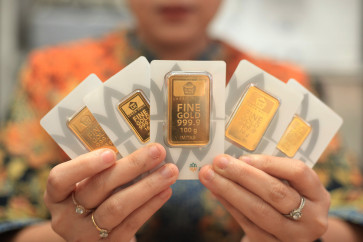
 An employee holds up packets of gold bullion on Oct. 15, 2025, at an outlet of Butik Emas LM Antam, a public gold vendor operated by state-owned miner PT Aneka Tambang (Antam), located inside the Setiabudi One shopping mall in South Jakarta. (Antara/Reno Esnir)
S
ince early 2025, Indonesia has navigated a climate of persistent economic uncertainty, fueling significant concern within the investment community. Global volatility and cross-sector instability have underscored the fragility of the current economic landscape, prompting retail investors to seek refuge in safe-haven assets.
The value of gold, long regarded as a primary hedge during periods of crisis, has rallied significantly amid geopolitical tensions and international trade frictions. By October 2025, global gold prices climbed above US$4,000 per ounce, a 55 percent increase year-to-date, with J.P. Morgan forecasting a rise to $5,400 by the end of 2027.
The impact is even more pronounced in Indonesia, where gold prices have surged 59 percent since the start of 2025 to reach Rp 2.41 million ($143.74) per gram.
Despite its enduring appeal, traditional gold investment in Indonesia faces two structural hurdles: accessibility and liquidity. Currently, access is largely restricted to physical bullion through outlets such as Aneka Tambang (Antam), UBS and Galeri 24. In 2025, unprecedented demand led to a scarcity of physical bars, with even internationally certified producers like Antam struggling to meet daily requirements.
Furthermore, physical purchases are restricted to fixed denominations such as 1 g, 2 g or 5 g, forcing investors to accumulate specific amounts before they can enter or exit the market. This rigid model imposes storage costs, security risks and wide market spreads, making it increasingly unsuitable for the fast-moving needs of middle-income and retail investors.
Gold exchange-traded funds (ETFs) offer a modern solution to these legacy challenges. Gold ETFs allow investors to gain exposure to gold prices through the stock exchange while maintaining the security of an asset backed by physical bullion.

Unlike traditional purchases, ETFs enable fractional ownership, real-time trading and lower transaction costs without the need for safe deposit boxes or minimum weight requirements. This shift is already visible globally: By the final quarter of 2025, gold represented 2.8 percent of the total assets under management (AUM) in global equities, driven largely by ETF inflows.