TheJakartaPost
Please Update your browser
Your browser is out of date, and may not be compatible with our website. A list of the most popular web browsers can be found below.
Just click on the icons to get to the download page.


Popular Reads
Top Results
No results found. Please check your search term and try again
Can't find what you're looking for?
View all search results
Popular Reads
Top Results
No results found. Please check your search term and try again
Can't find what you're looking for?
View all search resultsTrump’s Board of Peace and Sukarno’s CONEFO: Two visions, two worlds
As a nation born of anticolonial struggle, Indonesia cannot afford moral complacency or strategic naïveté.
Change text size
Gift Premium Articles
to Anyone
Share the best of The Jakarta Post with friends, family, or colleagues. As a subscriber, you can gift 3 to 5 articles each month that anyone can read—no subscription needed!
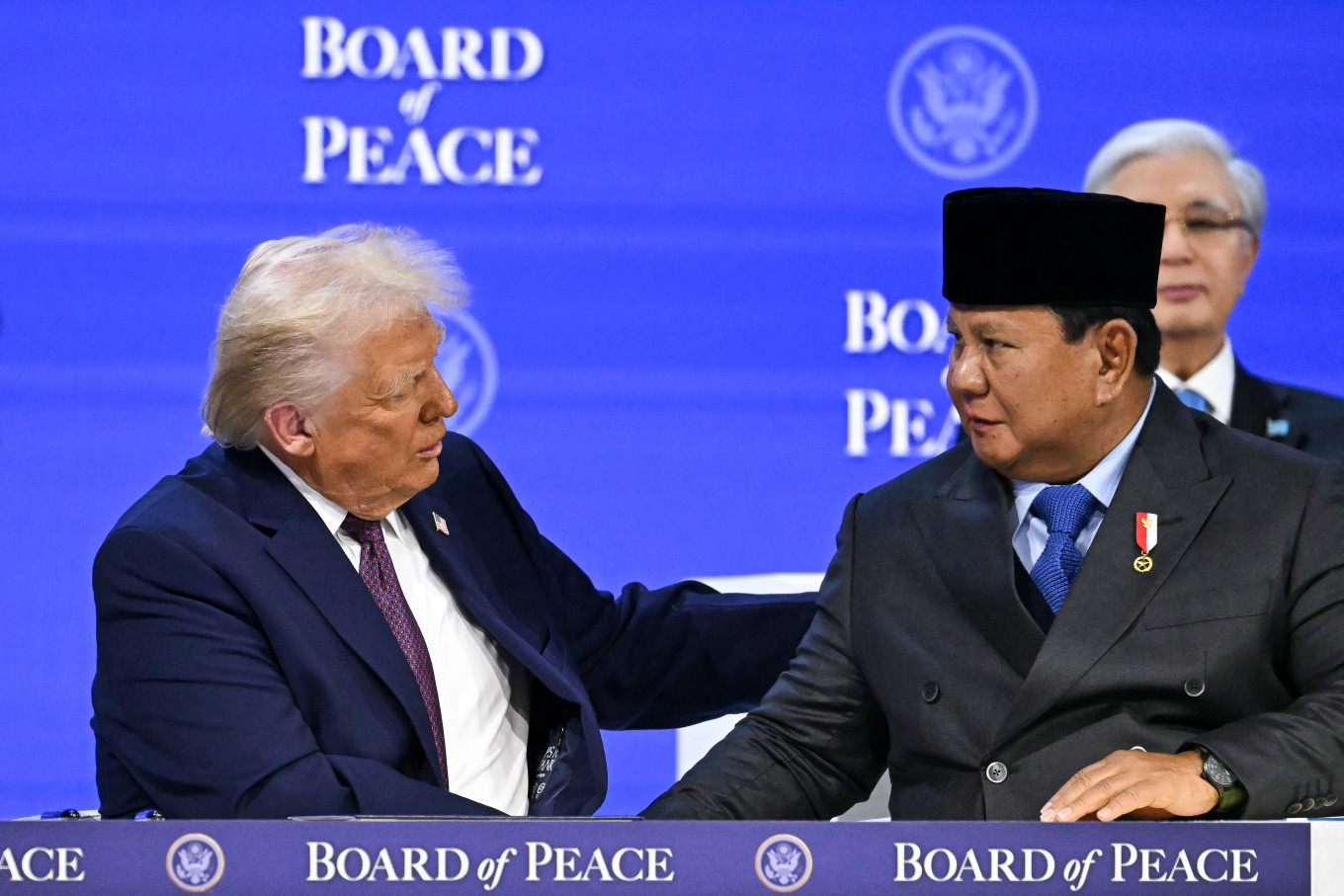 Peace gambit: President Prabowo Subianto (right) shakes hands with United States President Donald Trump on Thursday, Jan. 22, at the Board of Peace launch event during the World Economic Forum (WEF) annual meeting in Davos, Switzerland. (AFP/Fabrice Coffrini)
D
uring a recent discussion regarding Indonesia’s engagement with United States President Donald Trump’s proposed Board of Peace, my colleague Dr. Rizal Sukma recalled the Conference of the New Emerging Forces (CONEFO), Indonesia’s founding president Sukarno’s bold, internationalist vision.
While historical references to CONEFO are often relegated to the archives, its core principles feel strikingly contemporary. What follows is not a mere historical reconstruction, but an attempt to rearticulate Sukarno’s moral imagination in light of today’s fractured global order.
The proposal for a board of peace emerges during a period of profound global exhaustion. Prolonged conflicts, unresolved occupations and humanitarian catastrophes have created a widespread yearning for stability. Trump’s proposal speaks directly to this desire, defining "peace" primarily as the absence of open warfare, sustained through dialogue among major powers and managed via elite bargaining.
Set against this is a vastly different legacy from Indonesia’s diplomatic history: CONEFO. For Sukarno, peace was never merely the management of conflict; it was inseparable from justice, emancipation and the dignity of newly independent nations. He believed that a world structured by domination could never produce lasting peace, only a temporary, uneasy silence.
The Board of Peace rests on the logic of stability. It seeks to contain conflict through direct communication among major powers, prioritizing speed, efficiency and the "art of the deal." In this conception, justice is often a secondary consideration. While this approach may yield short-term de-escalation, it risks producing a peace that is purely transactional and fundamentally fragile.
CONEFO was conceived as an ideological challenge to such arrangements. Sukarno viewed the Cold War not simply as a rivalry between East and West, but as the continuation of colonial domination in new forms. He critiqued the United Nations as being overly shaped by the interests of the "Old Established Forces" (OLDEFOS), where newly independent states were granted a voice but denied real influence.

CONEFO was imagined as a radical corrective, a political platform for the "New Emerging Forces" (NEFOS) to assert their right to shape global norms. In Sukarno’s view, the world did not suffer from a lack of peace conferences; it lacked the courage to name injustice as such.