The Jakarta Post
Please Update your browser
Your browser is out of date, and may not be compatible with our website. A list of the most popular web browsers can be found below.
Just click on the icons to get to the download page.


Popular Reads
Top Results
No results found. Please check your search term and try again
Can't find what you're looking for?
View all search results
Popular Reads
Top Results
No results found. Please check your search term and try again
Can't find what you're looking for?
View all search resultsCan Indonesia-Japan ties keep regional peace?
Jakarta’s Comprehensive Strategic Partnership with Japan and its analogous agreement with Australia are important examples of the responsible exercise of middle-power status.
Change text size
Gift Premium Articles
to Anyone
Share the best of The Jakarta Post with friends, family, or colleagues. As a subscriber, you can gift 3 to 5 articles each month that anyone can read—no subscription needed!
 Set as preferred source
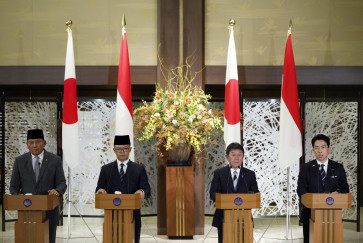
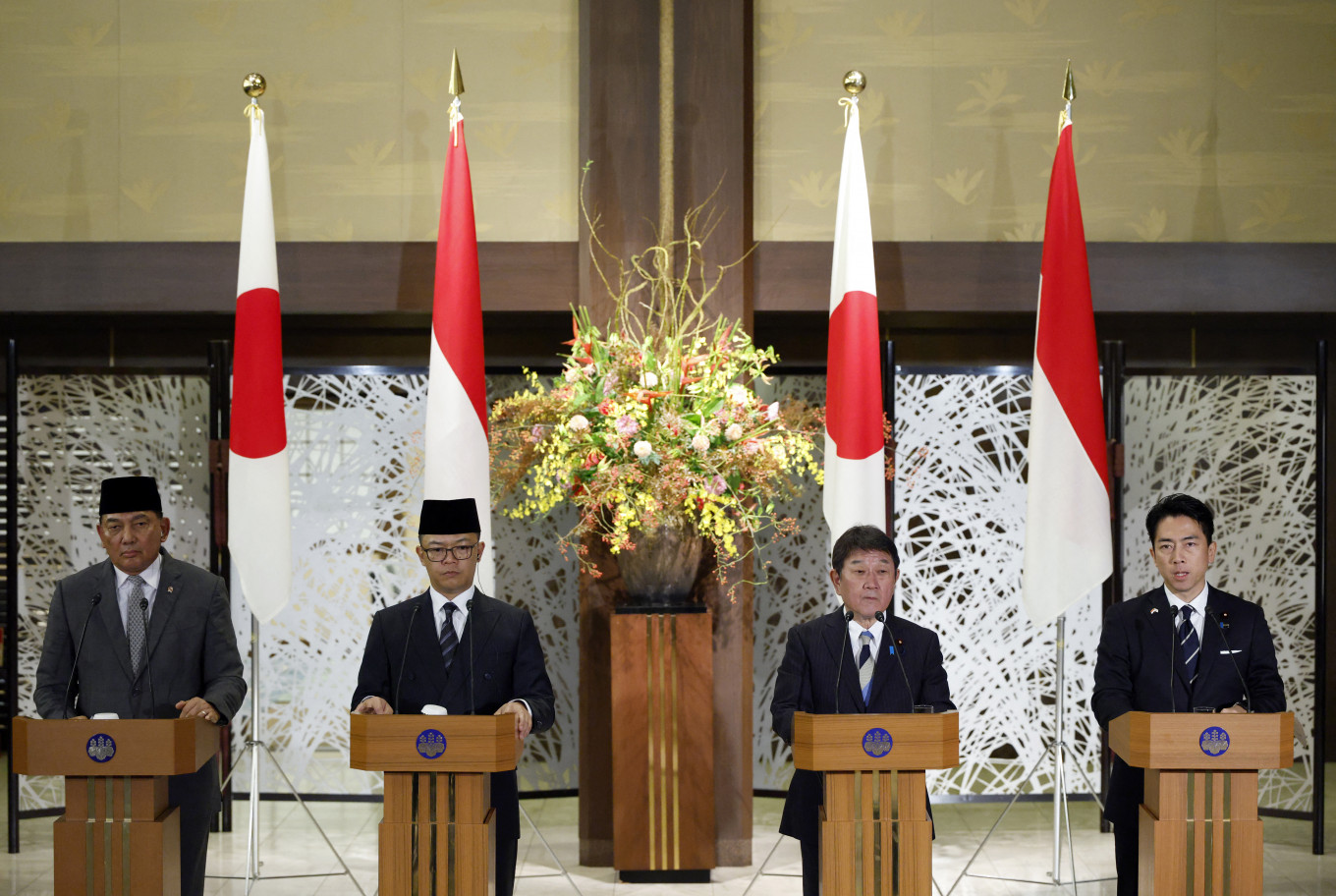 (left to the right) Defense Minister Sjafrie Sjamsoeddin, Foreign Minister Sugiono, Japanese Foreign Minister Toshimitsu Motegi and Japanese Defense Minister Shinjiro Koizumi attend a joint press announcement on Nov. 17, 2025 after their meeting at Iikura Guest House in Tokyo. (AFP/Franck Robichon)
A
s China continues its bellicose approach toward Japan and North Korea again launches ballistic missiles into waters off its east coast, the Indo-Pacific remains the foremost arena of geopolitical contestation.
The Philippines has been at the receiving end of China’s assertiveness, which threatens its economic sovereignty. Indonesia, a major maritime nation straddling key international waterways, contends with similar issues.
Bebas aktif (independent and active) is recognized as the basis of Indonesian foreign policy since president Sukarno era. President Prabowo Subianto has great ambitions for Indonesian power projection, and his approach to international affairs is widely seen as echoing this doctrine.
Prabowo simultaneously engages, for example, with United States President Donald Trump, Russia’s President Vladimir Putin and China’s President Xi Jinping, despite the tensions that exist between the three respective superpowers. Bebas aktif, however, dictates that Indonesia cannot fully align with any of the three.
Archipelagic states like Indonesia and the Philippines are best served by building strong bonds with countries that share their views on the importance of international law and the peaceful settlement of disputes. This is why Jakarta’s Comprehensive Strategic Partnership with Japan, another major power, and its analogous agreement with Australia, are important examples of the responsible exercise of middle-power status.
Japan’s Free and Open Indo-Pacific (FOIP) policy is aligned with Jakarta’s perceived vision of a peaceful, rules-based regional order, in which trade can flourish while national sovereignty is respected.

Tokyo-Jakarta relations rest on a mutual desire to maintain the regional status quo, and to prevent unilateral changes to it, via existing multilateral and bilateral frameworks. This is why ASEAN’s Outlook on the Indo-Pacific (AOIP), which is premised on ASEAN centrality, and Japan’s FOIP are not mutually exclusive; rather, they are converging outlooks that seek regional and global stability.