TheJakartaPost
Please Update your browser
Your browser is out of date, and may not be compatible with our website. A list of the most popular web browsers can be found below.
Just click on the icons to get to the download page.


Popular Reads
Top Results
No results found. Please check your search term and try again
Can't find what you're looking for?
View all search results
Popular Reads
Top Results
No results found. Please check your search term and try again
Can't find what you're looking for?
View all search resultsWhat the recent IDX stock drop reveals about market structure
Beyond the headlines of the IDX's sudden plunge lies a deeper story of thin tradable supply, where market mechanics and global index rules have turned low-float stocks into dangerous volatility amplifiers.
Change text size
Gift Premium Articles
to Anyone
Share the best of The Jakarta Post with friends, family, or colleagues. As a subscriber, you can gift 3 to 5 articles each month that anyone can read—no subscription needed!
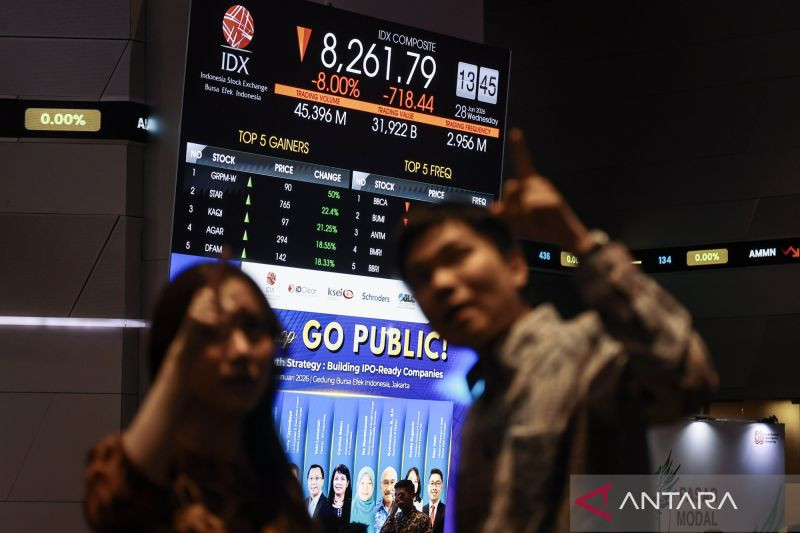 Employees stand near a screen showing the Indonesia Stock Exchange (IDX)Composite index down 8 percent in Jakarta on Jan. 28, 2026. The IDX temporarily halted trading that afternoon as the benchmark index dropped to 8,261.79 points following an announcement from Morgan Stanley Capital International's (MSCI) that it would temporarily suspend the index rebalancing process for Indonesian stocks. (Antara/Dhemas Reviyanto)
W
ednesday’s sharp fall in the Indonesia Stock Exchange (IDX) Composite index was triggered by an external shock rather than a collapse in domestic fundamentals. The index dropped by more than 5 percent shortly after opening, falling from around 8,974 to about 8,393 and briefly touching 8,349. To understand why the reaction was so strong, we need to look beyond today’s headlines and examine how the market has been moving structurally over the past two years.
Since early 2025, the Composite index has undergone a clear regime shift. After weakening to around 6,000 in March and April 2025, the index recovered, consolidated in the 7,200 to 7,400 range, and then entered a sustained upward trend. From August to November 2025, it stayed mostly around and above 8,000, and by December 2025 to January 2026 it reached the mid to upper 8,000s.
The long rally created confidence and attracted many retail investors. However, it also raised an important question: Was this growth driven by robust corporate performance, or was it a byproduct of market mechanics, specifically, limited tradable shares?
Past international evidence shows that free float, the portion of a company's shares available for public trading, is a primary determinant of price behavior. Global data from 55 countries indicate that developed markets maintain an average free float of approximately 75.6 percent, while emerging markets hover around 71.2 percent.
Indonesia, at 71.6 percent, aligns closely with the emerging market average. This means Indonesia is not extremely illiquid, but it is also not fully dispersed. Concentrated ownership remains a dominant force, allowing low-float stocks to sway the broader index with disproportionate ease.
The two-year data set reveals a significant evolution in market behavior. In 2024, the relationship between free float and price performance was weakly positive, with higher-float stocks generally outperforming their counterparts.

However, the defining characteristic of this period was dispersion. In stocks where the float fell below 20 percent, price action became erratic, ranging from negligible moves to extreme spikes exceeding 300 or even 500 percent. These low-float stocks acted as volatility hotspots, suggesting that the market was being driven as much by liquidity mechanics as by corporate fundamentals.