The Jakarta Post
Please Update your browser
Your browser is out of date, and may not be compatible with our website. A list of the most popular web browsers can be found below.
Just click on the icons to get to the download page.


Popular Reads
Top Results
No results found. Please check your search term and try again
Can't find what you're looking for?
View all search results
Popular Reads
Top Results
No results found. Please check your search term and try again
Can't find what you're looking for?
View all search resultsWeaving resilience into the fabric of the ASEAN Community
In 2026, Indonesia is in the position to recalibrate the region’s preparedness and response toward disasters and strengthen the region’s blueprint for a resilient future.
Change text size
Gift Premium Articles
to Anyone
Share the best of The Jakarta Post with friends, family, or colleagues. As a subscriber, you can gift 3 to 5 articles each month that anyone can read—no subscription needed!
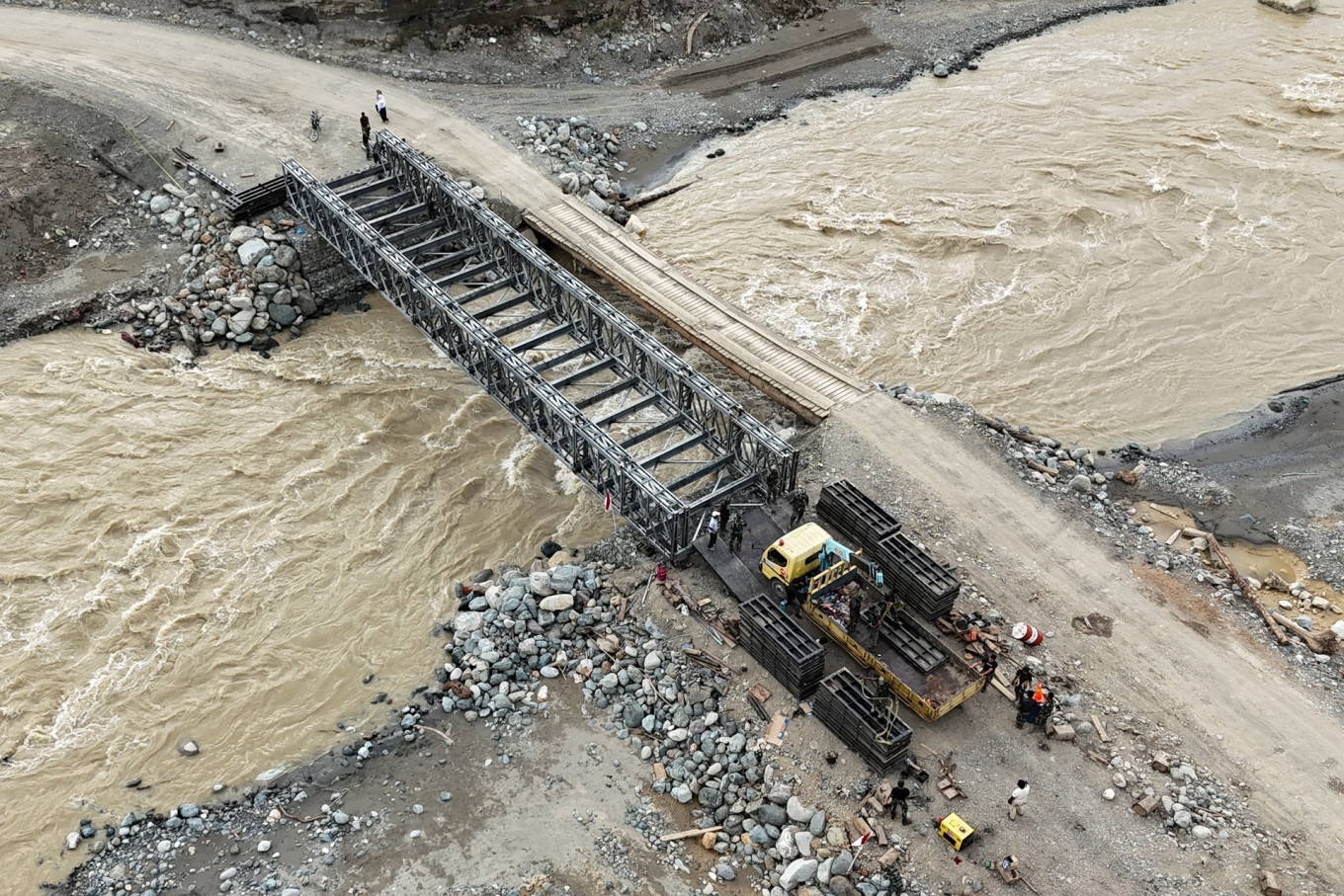 Workers and soldiers complete a Bailey bridge in Beutong Ateuh Banggalang district, Nagan Raya regency, Aceh on Jan 5, 2026 that would connect Central Aceh regency and Nagan Raya regency. (Antara/Syifa Yulinnas)
F
oreign Minister Sugiono has outlined a foreign policy blueprint centered on the security and prosperity of the people within a shifting global order. Central to this vision is dynamic resilience: the ability to weather crises and adapt without losing momentum. Minister Sugiono also emphasized that such resilience cannot be achieved in isolation.
To ground it closer to home, the recent devastating floods across northern Sumatra remind us that dynamic resilience is also a domestic necessity. A necessity that is also reflected in President Prabowo Subianto’s Asta Cita (eight goals) especially on the vision of aligning a harmonious life with the natural and cultural environment.
As the current chair of the ASEAN Committee on Disaster Management (ACDM) and ASEAN Ministerial Meeting on Disaster Management (AMMDM), Indonesia is in the right position to recalibrate the region’s preparedness and response toward disasters and strengthen the region’s blueprint for a resilient future. Particular attention should be given to addressing the gradual threats of slow-onset disasters.
Slow-onset disasters, such as floods, droughts, rising sea levels, biodiversity loss and forest degradation, pose a serious long-term threat on many fronts. But they are often overlooked and the region tends to focus more on rapid-onset disasters such as tsunamis and typhoons.
ASEAN has developed several instruments and frameworks to address slow-onset disasters. Yet, effective response and preparedness strategy remain challenging.
One is the difficulty in identifying triggers for action. Slow-onset events, by their nature, develop slowly, making it difficult to define specific, actionable thresholds for timely, coordinated responses. Another is a lack of localized data and data sharing platforms and technical expertise across ASEAN member states, especially at the local level, to accurately forecast and monitor long-term environmental degradation. Inadequate funding is also a problem with the budget allocation being spent more on rapid-onset disasters.

On funding inadequacy, Indonesia can drive high-level commitment from ASEAN members on budget allocations to combat slow-onset disasters. Indonesia can propose a regional threshold for minimum national budget allocation for slow-onset crisis prevention and response as one of the indicators for the ACDM’s Work Plan 2026–2030 and for the currently being developed Results Framework of the ASEAN Socio-Cultural Community Strategic Plan of the ASEAN Community Vision 2045. Indonesia can also propose broadening the funding base by better tapping the potential of the private sector, philanthropists, NGOs and even crowd-funding.