TheJakartaPost
Please Update your browser
Your browser is out of date, and may not be compatible with our website. A list of the most popular web browsers can be found below.
Just click on the icons to get to the download page.


Popular Reads
Top Results
No results found. Please check your search term and try again
Can't find what you're looking for?
View all search results
Popular Reads
Top Results
No results found. Please check your search term and try again
Can't find what you're looking for?
View all search resultsPower, trust and Indonesia’s stock crash
Change text size
Gift Premium Articles
to Anyone
Share the best of The Jakarta Post with friends, family, or colleagues. As a subscriber, you can gift 3 to 5 articles each month that anyone can read—no subscription needed!
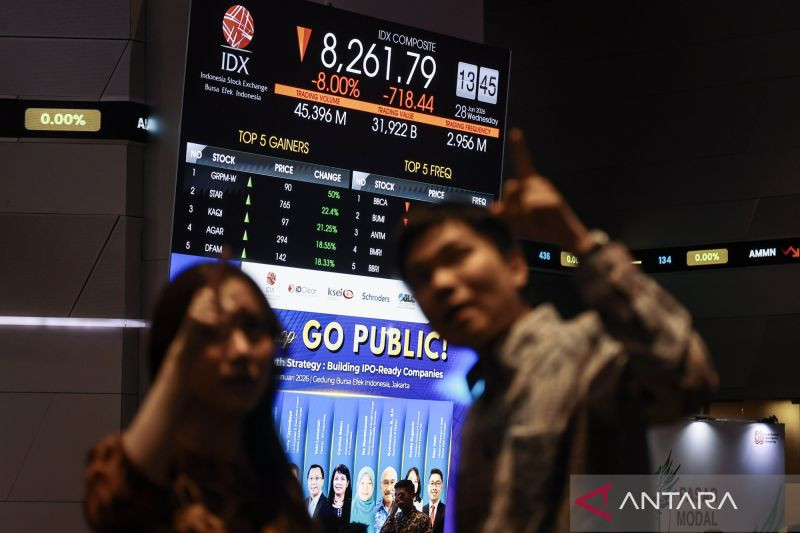 Employees stand near a screen showing the Jakarta Composite Index (JCI) down 8 percent on Jan. 28, 2026, at the Indonesia Stock Exchange (IDX) in Jakarta. (Antara/Dhemas Reviyanto)
T
he crash of Indonesian stock prices last week is less about market technicalities and more about a profound collapse of political trust.
Much commentary has focused on familiar explanations: low free float, foreign outflows, thin liquidity, global volatility. These factors matter, but they miss the larger point. Markets price credibility, predictability and legitimacy. What investors reacted to was not simply a bad trading week, but a deeper unease about how power is exercised in Indonesia, and whether its institutions still function as credible guardians of the public interest.
What unfolded in Jakarta was a political-economic moment, one that exposes deeper anxieties about governance in Indonesia today.
The speed and intensity of the decline, followed by emergency announcements and sudden resignations, suggest not a market calmly digesting information, but one reacting to accumulated uncertainty.
Those doubts have been building for some time. Morgan Stanley Capital International (MSCI), whose indices shape global capital flows, has already raised concerns over the lack of transparency in the ownership structures of Indonesian-listed companies and the possibility of coordinated trading behavior that undermines fair price formation.
Clients flagged unclear data obscuring how much stock is genuinely available for public trading, the so-called free float. Indonesia already has one of the lowest average free floats in Asia, with many major companies tightly controlled by dominant shareholders and thinly traded. For institutional investors, this makes entering and exiting positions difficult without distorting prices.

Opaque data, limited disclosure and elite concentration are not confined to the stock market. They echo across governance under President Prabowo Subianto’s administration: from the lack of transparency surrounding flagship programs such as the free nutritious school meal program, Danantara, food estates and the Red-and-White cooperatives, to persistent concerns about oligarchic capture of economic policy.