The Jakarta Post
Please Update your browser
Your browser is out of date, and may not be compatible with our website. A list of the most popular web browsers can be found below.
Just click on the icons to get to the download page.


Popular Reads
Top Results
No results found. Please check your search term and try again
Can't find what you're looking for?
View all search results
Popular Reads
Top Results
No results found. Please check your search term and try again
Can't find what you're looking for?
View all search resultsIndonesia’s realist bet on Trump’s Board of Peace
Joining the BoP may seem like a betrayal of our values. But not joining may mean total irrelevance in decisions that will affect Palestine’s future.
Change text size
Gift Premium Articles
to Anyone
Share the best of The Jakarta Post with friends, family, or colleagues. As a subscriber, you can gift 3 to 5 articles each month that anyone can read—no subscription needed!
 Set as preferred source
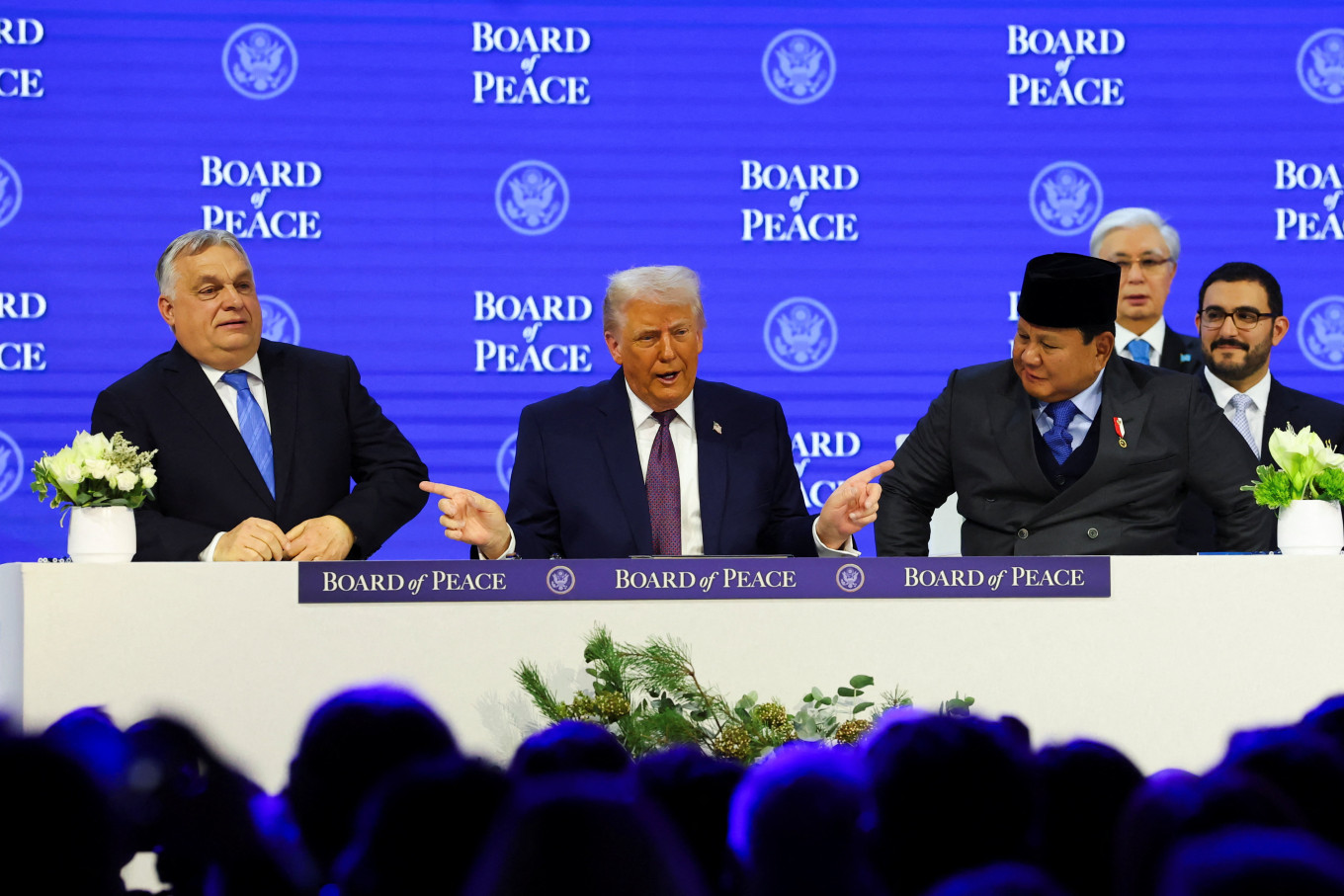 United States President Donald Trump (center) gestures toward President Prabowo Subianto (right) and Hungary's Prime Minister Viktor Orban, as they take part in a charter announcement on Jan. 22 for his Board of Peace initiative aimed at resolving global conflicts, alongside the 56th annual World Economic Forum (WEF), in Davos, Switzerland. (Reuters/Denis Balibouse)
M
uch has been written criticizing Indonesia’s decision to join United States President Donald Trump’s so-called Board of Peace (BoP). Rizal Sukma and many other foreign policy thinkers show that the BoP is nothing more than a vanity project: an authoritarian, unaccountable platform that reduces the complex Palestinian struggle to a commercial real estate fantasy and elevates Trump to the position of chairman for life. In their view, Indonesia’s participation undermines the principles of our long-cherished bebas aktif (independent and active) foreign policy and offers unearned legitimacy to a deeply flawed initiative.
These criticisms are not without merit. The BoP’s structure and symbolism are deeply problematic. But Indonesia’s foreign policy should not be guided by moral outrage alone. We must also speak frankly about the kind of world we now inhabit: one in which the liberal, rules-based order is collapsing, global institutions are weakened or paralyzed and transactionalism reigns supreme.
In such a world, strategic ambiguity and calibrated engagement are often necessary tools of statecraft.
As Canadian Prime Minister Mark Carney observed in Davos, we are entering a new era marked by the retreat of hegemony, the erosion of institutional norms and the return of brute power politics. The United Nations, long the cornerstone of multilateral diplomacy, is in disarray. The international consensus on Palestine is repeatedly ignored.
In this context, the BoP, however distasteful, offers an uncomfortable truth: decisions about Gaza’s future may soon be made unilaterally, without the participation of those who have historically defended Palestinian rights.
This is the core dilemma: yes, joining BoP may seem like a betrayal of our values. But not joining may mean total irrelevance in decisions that will affect Palestine’s future. The price of moral purity could be silence in the room where decisions are made.

Indonesia’s participation should not be read as endorsement, but as hedging, defined as a long-established strategy of middle powers navigating great power rivalry. Indonesia has done this before. We joined China’s Belt and Road Initiative, even as concerns about debt and sovereignty were raised. We adopted aspects of the US-driven Indo-Pacific strategy while asserting ASEAN centrality. We have even moved closer to BRICS, a bloc widely perceived as counter-hegemonic while at the same time trying to join OECD.