The Jakarta Post
Please Update your browser
Your browser is out of date, and may not be compatible with our website. A list of the most popular web browsers can be found below.
Just click on the icons to get to the download page.


Popular Reads
Top Results
No results found. Please check your search term and try again
Can't find what you're looking for?
View all search results
Popular Reads
Top Results
No results found. Please check your search term and try again
Can't find what you're looking for?
View all search resultsAnalysis: Electoral law reform: A test of the House’s faith in democracy
Change text size
Gift Premium Articles
to Anyone
Share the best of The Jakarta Post with friends, family, or colleagues. As a subscriber, you can gift 3 to 5 articles each month that anyone can read—no subscription needed!
 Set as preferred source
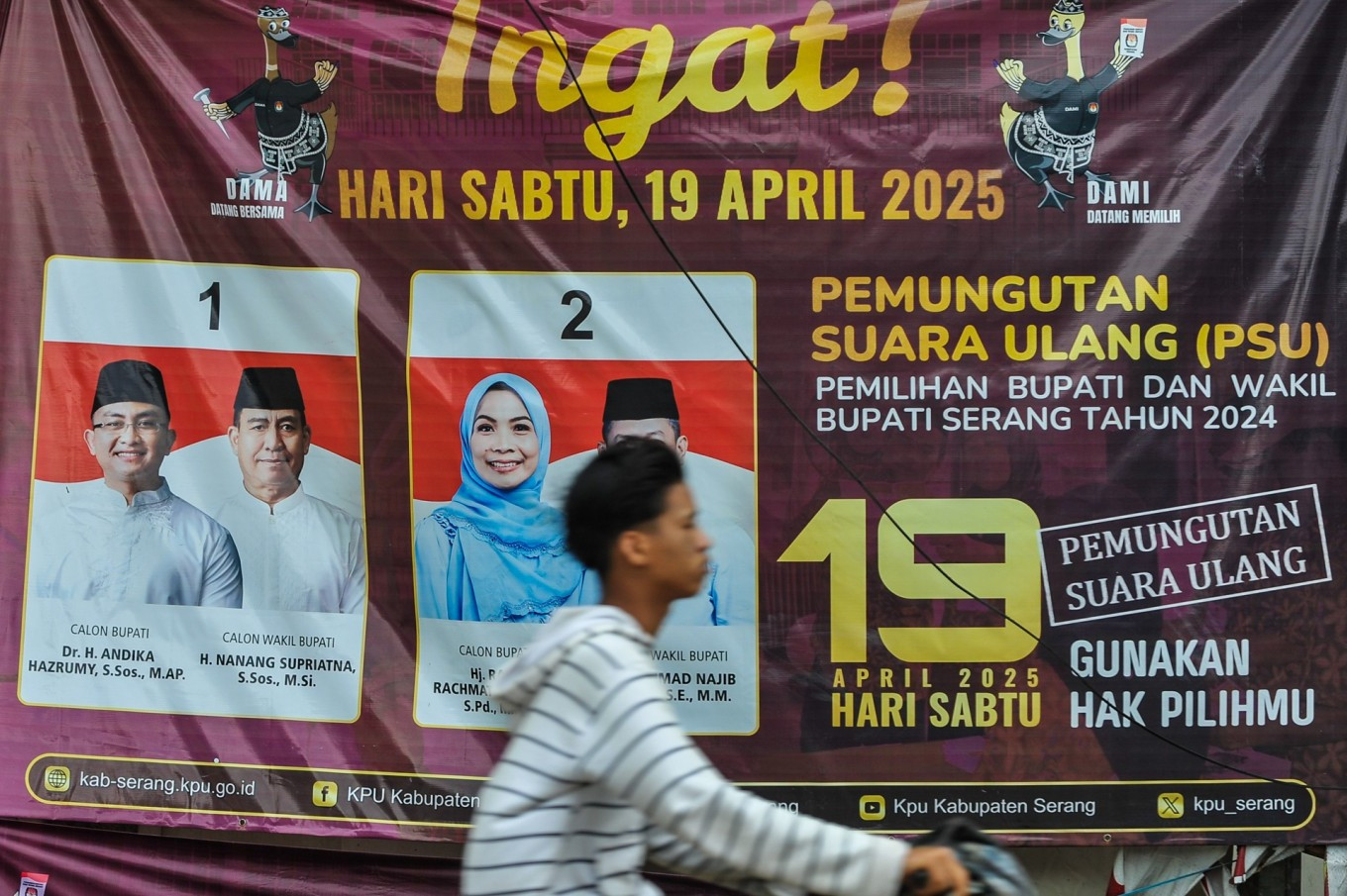 A motorist passes in front of a banner on April 18, 2025, about the 2024 regional election revote in Serang regency, Banten. The regency is one of 24 regions ordered by the Constitutional Court in February to hold a rerun of the 2024 regional elections. (Antara/Muhammad Bagus Khoirunas)
S
ince Jan. 20, the House of Representatives has been gathering input from academics and civil society groups regarding the proposed revision of the 2017 General Elections Law, formally submitted on Nov. 19, 2024. A central pillar of these discussions is the adoption of a "codification" approach, specifically, the consolidation of disparate election-related regulations into a single, unified political law package.
This move toward codification is not merely a technical preference but a strategic policy direction outlined in the 2025–2045 National Long-Term Development Plan (RPJPN). The plan envisions strengthening democratic development by integrating the General Elections Law, the Regional Elections Law and the Political Parties Law into a cohesive framework.
The constitutional mandate for this integrated approach was further solidified by Constitutional Court ruling No. 135/2024, delivered on June 26, 2025. In its decision, the court mandated that elections be conducted in two distinct stages. The first involves a national election to elect members of the House, the Regional Representatives Council (DPD), and the president and vice president. The second stage, following a gap of roughly two to two-and-a-half years, consists of local elections for Regional Legislative Council (DPRD) members and regional heads. Crucially, the court affirmed that regional elections are an inseparable part of the broader electoral legal regime.
Consequently, deliberations on the election bill and the regional elections bill should ideally proceed in tandem. While both bills are listed in the medium-term National Legislation Program (Prolegnas), only the election bill was included in this year’s legislative priority list. The House has justified its decision to prioritize the General Elections Law while postponing the Regional Elections Law by citing procedural constraints and its current legislative agenda. Essentially, the House has chosen to adhere to a rigid framework, focusing on one bill at a time rather than addressing the system as a whole.
This piecemeal strategy has drawn criticism from experts who argue that codification must be discussed simultaneously. They contend that isolated reforms risk producing unsynchronized changes, potentially creating new friction between institutional design and actual political practice. Beyond the architecture of the law, substantive issues like the legislative threshold have come under intense scrutiny. The goal is to strike a delicate balance: safeguarding political representation while simplifying the party system to ensure effective governance.
As the legislative threshold has fluctuated across election cycles, the volume of "wasted votes", ballots cast for parties that fail to enter the legislature, has become a critical metric. This issue is paramount, as every vote that fails to translate into a seat represents more than just a political cost; it creates a deficit in the administrative legitimacy of the entire electoral process.

An analysis of trends across the past four elections suggests that the relationship between the threshold level and wasted votes is not linear. In the 2009 election, for instance, a 2.5 percent threshold resulted in a staggering 19.05 million wasted votes, or 18.3 percent of all valid ballots. That race featured 38 political parties, only nine of which secured seats. By 2014, when the threshold was raised to 3.5 percent, the number of wasted votes dropped sharply to 2.96 million, or 2.4 percent. This coincided with a decline in participating parties to 12, with 10 winning representation.