The Jakarta Post
Please Update your browser
Your browser is out of date, and may not be compatible with our website. A list of the most popular web browsers can be found below.
Just click on the icons to get to the download page.


Popular Reads
Top Results
No results found. Please check your search term and try again
Can't find what you're looking for?
View all search results
Popular Reads
Top Results
No results found. Please check your search term and try again
Can't find what you're looking for?
View all search resultsBoard of Peace and the dilemma of Indonesia’s involvement
If ending occupation is not established as a non-negotiable prerequisite, then the destiny of Gaza and Palestine will not be shaped by the Palestinian people themselves, but by global geopolitical interests.
Change text size
Gift Premium Articles
to Anyone
Share the best of The Jakarta Post with friends, family, or colleagues. As a subscriber, you can gift 3 to 5 articles each month that anyone can read—no subscription needed!
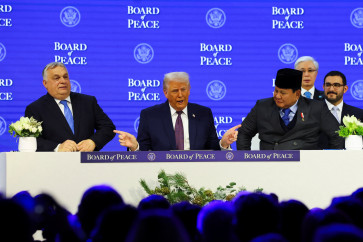
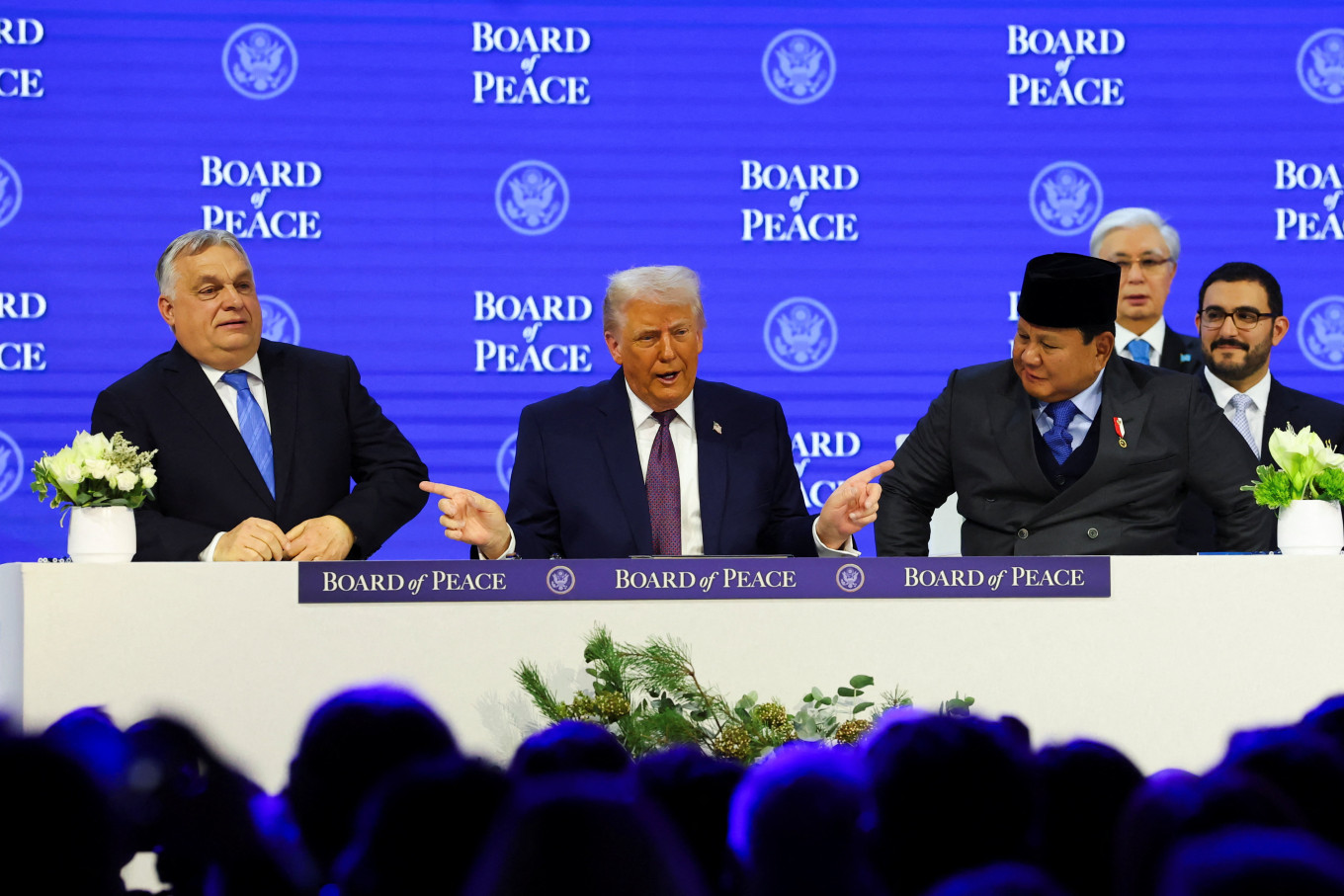 United States President Donald Trump (center) gestures toward President Prabowo Subianto (right) and Hungary's Prime Minister Viktor Orban, as they take part in a charter announcement for his Board of Peace initiative aimed at resolving global conflicts, alongside the 56th annual World Economic Forum (WEF), in Davos, Switzerland, on Jan. 22, 2026. (Reuters/Denis Balibouse)
T
he establishment of the Board of Peace, closely associated with the initiative of United States President Donald Trump and led by former British prime minister Tony Blair, has attracted global attention, as well as deep unease. Officially, the Board of Peace presents itself as an international forum dedicated to peace-building, stability and post-conflict reconstruction in conflict-affected regions, including Gaza and Palestine.
Several countries from the Muslim world, including Indonesia, have joined the initiative alongside non-Muslim countries, with Israel included as a member. On the surface, its objectives appear noble: ending violence and building a peaceful future.
From the outset, however, the Board of Peace has faced serious criticism. The fundamental question is not whether peace is desirable, but what kind of peace is being pursued and whose interests it ultimately serves.
Many observers argue that the Board of Peace rests on a morally fragile and politically problematic foundation. Its leadership and dominant influence lie in the hands of figures and Western networks whose record on Palestine has long been controversial. Trump’s first presidency was marked by openly pro-Israel policies, including the unilateral recognition of Jerusalem as Israel’s capital and the weakening of the United Nations Relief and Works Agency for Palestine Refugees in the Near East (UNRWA). Blair’s international engagements, meanwhile, have often emphasized stabilization and post-conflict management rather than addressing the structural injustices at the core of the Palestinian question.
Such an approach has drawn sharp criticism from a wide range of actors. UN special rapporteurs on human rights in the occupied Palestinian territory have repeatedly emphasized that any peace initiative that fails to recognize Israeli occupation as a violation of international law is fundamentally flawed. International human rights organizations such as Amnesty International and Human Rights Watch have similarly warned that peace frameworks that ignore apartheid, colonization and war crimes risk entrenching impunity rather than delivering justice.
Many scholars have described Trump-style peace initiatives as political engineering that trades justice for an illusion of stability. In this sense, the Board of Peace risks opening the door to a new form of neocolonialism. Comparable concerns have also been raised by Indonesian foreign policy experts, including Dino Patti Djalal and Rizal Sukma.

At the core of the problem lies Israel’s position within the Board of Peace. Israel is not treated as an occupying power that must be held accountable for grave violations, but rather as an equal stakeholder, placed on the same footing as countries such as Indonesia. This framing significantly shifts the Palestinian issue from one of colonization and self-determination to one of conflict management. Gaza and Palestine are reduced to objects of reconstruction and humanitarian assistance, rather than recognized as sovereign political subjects with the right to determine their own future. Under such a framework, the language of peace risks becoming a tool for normalizing occupation.