TheJakartaPost
Please Update your browser
Your browser is out of date, and may not be compatible with our website. A list of the most popular web browsers can be found below.
Just click on the icons to get to the download page.


Popular Reads
Top Results
No results found. Please check your search term and try again
Can't find what you're looking for?
View all search results
Popular Reads
Top Results
No results found. Please check your search term and try again
Can't find what you're looking for?
View all search resultsNational economic resilience faces a test of public transparency
Within MSCI’s methodology, a shift from emerging to frontier status is not merely symbolic; it reflects an assessment that a market has become less accessible or less safe for international capital.
Change text size
Gift Premium Articles
to Anyone
Share the best of The Jakarta Post with friends, family, or colleagues. As a subscriber, you can gift 3 to 5 articles each month that anyone can read—no subscription needed!
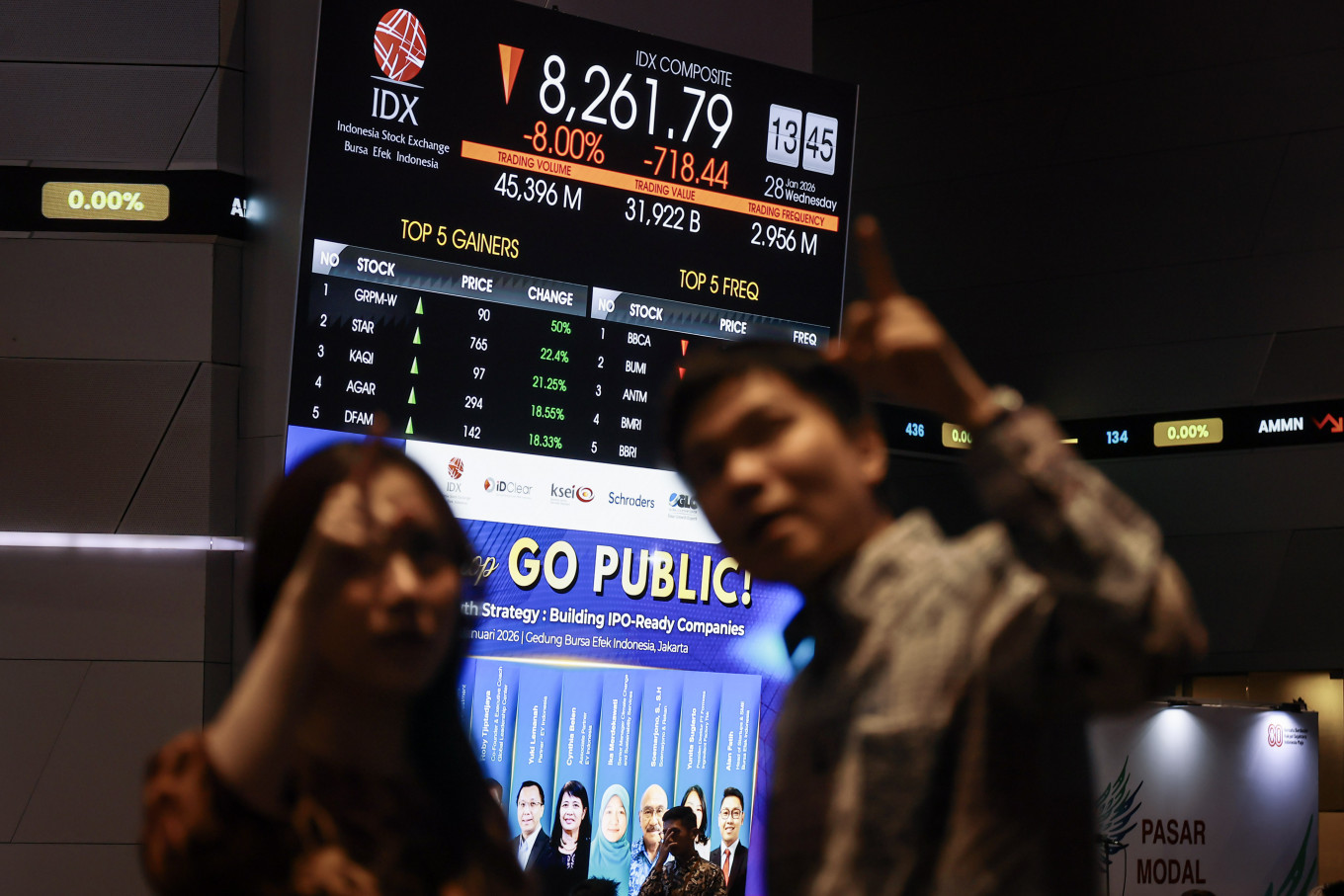 Employees watch a digital screen displaying stock movements on Jan. 28, 2026, at the Indonesia Stock Exchange (IDX) in Jakarta. (Antara/Dhemas Reviyanto)
P
ressure on the Indonesia Stock Exchange (IDX) intensified on Jan. 28 after Morgan Stanley Capital International (MSCI), a global index provider, announced a temporary suspension of certain index changes for Indonesia. The fallout escalated two days later, when severe market turmoil precipitated a crisis of confidence in capital market authorities.
MSCI’s primary concern was structural investability; the agency noted that issues regarding transparency and share ownership structures make it difficult for international investors to assess risk and accurately replicate the index. This announcement immediately triggered a sharp decline in the IDX Composite index and forced a halt to intraday trading due to extreme selling pressure.
The substance of MSCI’s critique lies in the opacity of the market. In consultation documents, MSCI highlighted that, despite incremental improvements in free-float data, significant uncertainty remains regarding ultimate ownership structures.
Furthermore, the agency pointed to potential coordinated trading patterns in specific stocks. Such conditions undermine fair price formation and reduce the reliability of indices as market representations. For global investors, these issues heighten uncertainty because stock prices cease to reflect fundamental information and are instead shaped by collective behaviors that are difficult to detect.
In response, the government announced a reform package emphasizing greater transparency, including plans to tighten minimum free-float requirements and strengthen oversight of share transactions. However, the clock is ticking.
International media reports indicate that MSCI has set a deadline around May to see material progress in market investability. This evaluation period will serve as the basis for subsequent judgments on Indonesia’s status within the Emerging Markets Index.

If improvements are deemed insufficient, the risks are severe: a reduction in Indonesia’s index weight or a reclassification to frontier market status.