TheJakartaPost
Please Update your browser
Your browser is out of date, and may not be compatible with our website. A list of the most popular web browsers can be found below.
Just click on the icons to get to the download page.


Popular Reads
Top Results
No results found. Please check your search term and try again
Can't find what you're looking for?
View all search results
Popular Reads
Top Results
No results found. Please check your search term and try again
Can't find what you're looking for?
View all search resultsPolice reform: When the instrument rejects its frame
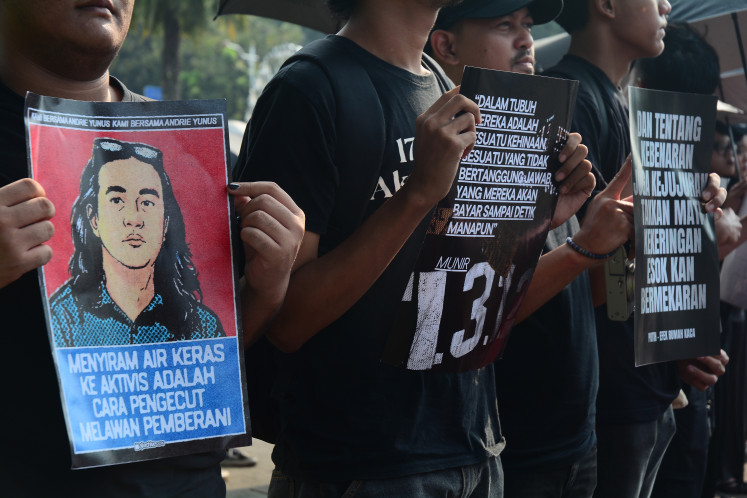
Civic space is narrowing in Indonesia, not through explicit bans, but through the routine presence of security forces across social life.
Change text size
Gift Premium Articles
to Anyone
Share the best of The Jakarta Post with friends, family, or colleagues. As a subscriber, you can gift 3 to 5 articles each month that anyone can read—no subscription needed!
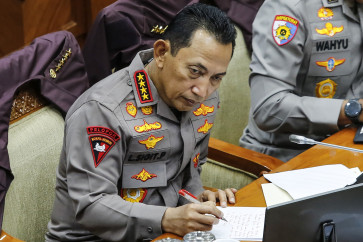
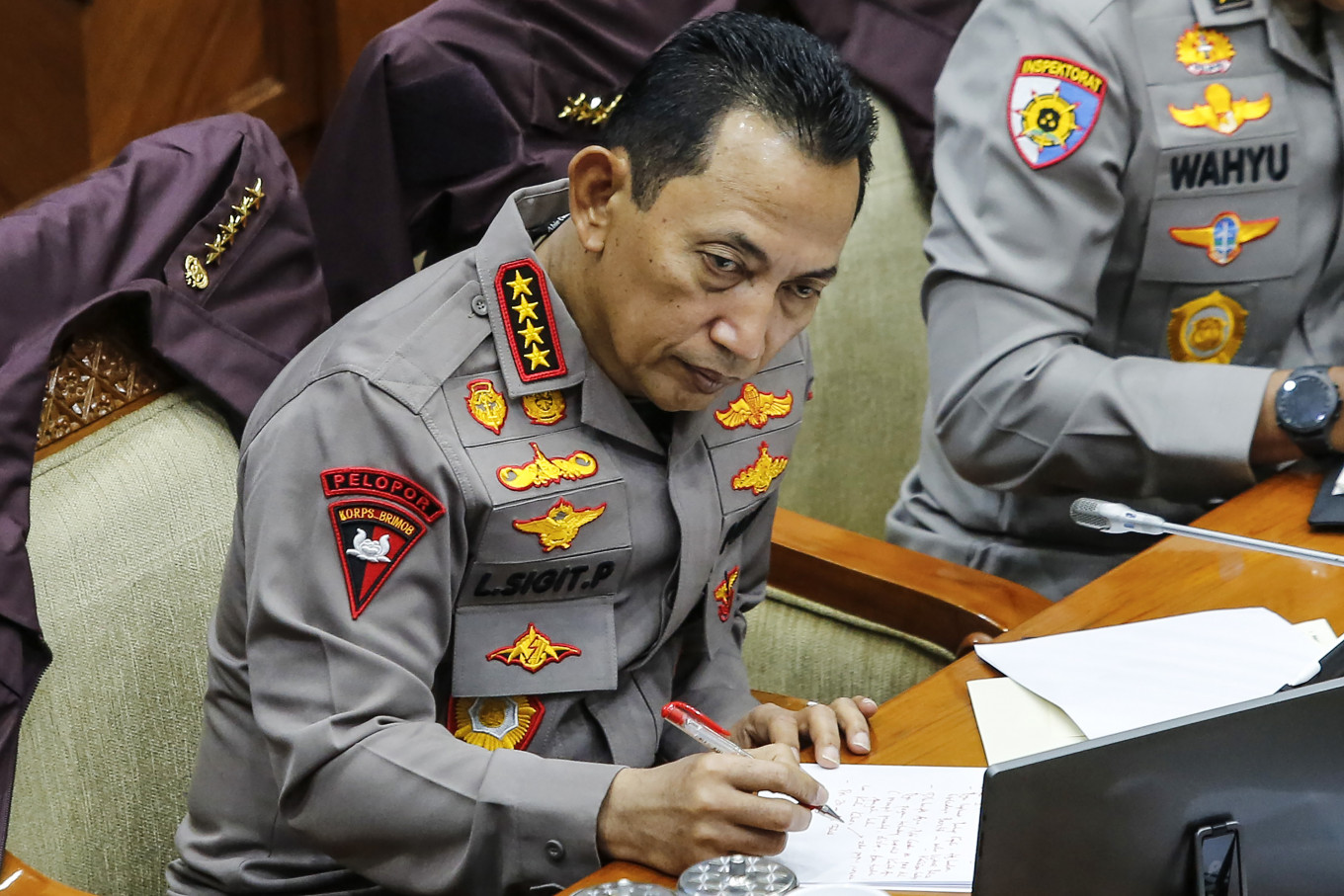 National Police chief Gen. Listyo Sigit Prabowo attends a hearing on Jan. 26, 2026, with House of Representatives Commission III, which oversees legal affairs, at the Senayan Legislative Complex in Central Jakarta. (Antara/Asprilla Dwi Adha)
T
he National Police chief’s rejection of the recent proposal to place the force under a ministry as part of its institutional reform, delivered with the seemingly casual remark, “I would rather become a farmer”, was far from a personal joke. It was instead a sign of the times.
In a republic accustomed to reading the body language of power, the statement resonated like a gavel striking a table. The police, referring to the remarks of their boss, Gen. Listyo Sigit Prabowo, do not wish to be framed. This is not because no minister is worthy, but because the frame itself is considered too narrow for a power that has grown both solid and expansive.
In politics, language is always layered; what is heard is rarely all that is meant. In this context, "farmer" is not a profession, but a metaphor for the reversal of hierarchy. A field is an open space, free from administrative superiors and civilian chains of command. It signals that the police have grown into a massive tree whose roots stretch across countless sectors. Placing it under a ministry would be akin to trying to move an entire forest into a flowerpot.
This statement indirectly affirms the controversial observation once made by former Indonesian Military (TNI) chief Gen. Gatot Nurmantyo, who claimed that while Prabowo Subianto is the president de jure, the National Police chief is the president de facto.
At the time, the comment was dismissed as political hyperbole; today, it reads like a reflection of the power landscape. When the head of a law enforcement institution speaks as though he holds the moral authority to reject constitutional design, the line between the instrument and the controller becomes blurred.
This situation did not emerge in a vacuum. Listyo formed an internal reform team ahead of the President’s own initiative. In politics, timing is everything, and those who move first often define the road ahead.

Listyo also issued a circular allowing active-duty police officers to occupy positions in 17 civilian institutions, despite the Constitutional Court’s rejection of such an expansion. A state governed by law should move according to clear signposts; here, however, the signs have been pushed aside while the convoy of power speeds down the center of the road.