TheJakartaPost
Please Update your browser
Your browser is out of date, and may not be compatible with our website. A list of the most popular web browsers can be found below.
Just click on the icons to get to the download page.


Popular Reads
Top Results
No results found. Please check your search term and try again
Can't find what you're looking for?
View all search results
Popular Reads
Top Results
No results found. Please check your search term and try again
Can't find what you're looking for?
View all search resultsThe promise of a middle-power alliance
A united middle-power alliance would have considerable leverage, as its members would each wield outsize influence over specific domains.
Change text size
Gift Premium Articles
to Anyone
Share the best of The Jakarta Post with friends, family, or colleagues. As a subscriber, you can gift 3 to 5 articles each month that anyone can read—no subscription needed!
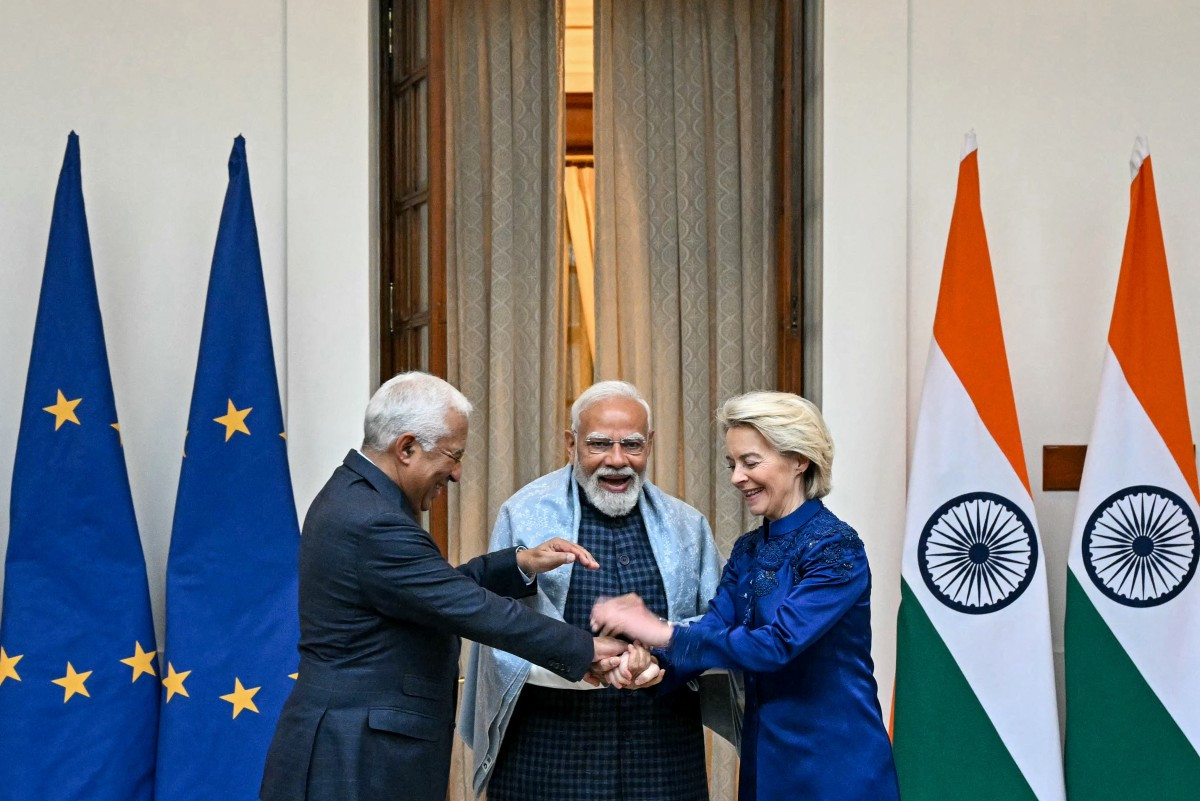 India's Prime Minister Narendra Modi (enter), European Commission President Ursula von der Leyen (right) and European Council President Antonio Costa gesture as they pose for a photograph before their meeting at the Hyderabad House in New Delhi on Jan. 27, 2026. (AFP/Sajjad Hussain)
A
mid escalating geopolitical tensions, the world is increasingly caught between the United States, an extractive superpower, and China, a “dependency superpower” whose global influence rests on making other countries reliant on its exports. In the absence of meaningful resistance, both are likely to remain on their course, with middle powers forced to comply with their demands or face retaliation.
But as Canadian Prime Minister Mark Carney argued in his landmark speech at the World Economic Forum’s annual gathering in Davos, Switzerland, last month, this outcome is not inevitable, especially if middle powers band together. In a “world of great power rivalry,” he noted, “the countries in between have a choice: compete with each other for favor or to combine to create a third path with impact.”
The question is how to construct this third path. Doing so will require identifying concrete areas for cooperation among middle powers, building alliances capable of delivering results and agreeing on institutional and policy changes, particularly within the European Union, that would make collective action more effective.
Five key priorities stand out, some of which Carney highlighted in his speech. First, middle powers should develop a new network of free-trade agreements, like the one just reached between the EU and India. Political and economic ties could be strengthened by expanding existing agreements, deepening cooperation between large trade blocs, most notably, the EU and the Comprehensive and Progressive Agreement for Trans-Pacific Partnership, and establishing comprehensive strategic partnerships like the one between the EU and Canada.
Second, supply-chain diversification must become a top priority. As the US turns to protectionism in order to reshore production and redirect investment flows away from its allies, middle powers have a shared interest in building more autonomous supply chains, including in sectors currently dominated by the US and China, such as digital infrastructure and AI. Over time, these supply chains should increasingly rely on domestic demand, reducing dependence on Chinese inputs and US markets.
Third, rebuilding the multilateral order should begin with reforming the World Trade Organization. Ahead of the WTO’s upcoming ministerial conference in Cameroon, EU member states, in coordination with other middle powers, should convene an international conference aimed at shaping a post-US agenda and present a shared proposal for ensuring free and fair trade.

Fourth, the legitimacy of any coalition of middle powers depends on its ability to support the world’s most vulnerable economies. The EU should lead international efforts to close the US$60 billion funding gap created by the dismantling of the US Agency for International Development (USAID) under President Donald Trump. Team Europe, a humanitarian and development-aid initiative bringing together EU institutions and member states, could begin by reallocating a portion of its roughly 90 billion euros ($107 billion) budget while urging countries like Canada, Japan and Australia to follow suit.