The Jakarta Post
Please Update your browser
Your browser is out of date, and may not be compatible with our website. A list of the most popular web browsers can be found below.
Just click on the icons to get to the download page.


Popular Reads
Top Results
No results found. Please check your search term and try again
Can't find what you're looking for?
View all search results
Popular Reads
Top Results
No results found. Please check your search term and try again
Can't find what you're looking for?
View all search resultsIndonesia Open Network: A new paradigm for an inclusive digital economy
ION, Indonesia's digital public infrastructure initiative, is set to not just revolutionize domestic e-commerce but also position the country as a leader among emerging economies.
Change text size
Gift Premium Articles
to Anyone
Share the best of The Jakarta Post with friends, family, or colleagues. As a subscriber, you can gift 3 to 5 articles each month that anyone can read—no subscription needed!
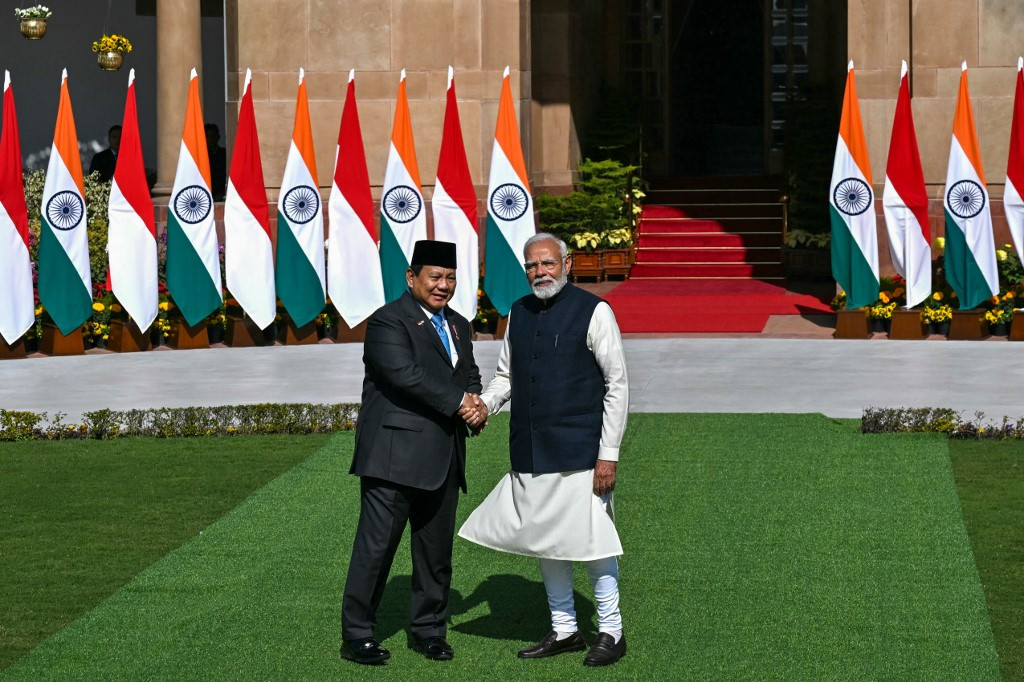 Indian Prime Minister Narendra Modi (right) welcomes President Prabowo Subianto on Jan. 25, 2025, at Hyderabad House in New Delhi. (AFP/Money Sharma)
A
recent The Jakarta Post story on e-commerce sellers in Indonesia having to contend with rising platform fees grabbed my attention. It also connected me to a bilateral commitment between India and Indonesia.
During the visit of President Prabowo Subianto to India in January 2025 at the invitation of Prime Minister Narendra Modi, both leaders affirmed to accelerate collaboration in areas such as digital public infrastructure (DPI) for inclusive growth as well as addressing global challenges, and expressed confidence in harnessing the power of emerging technologies.
Following up on the guidance provided by our leaders, a pathbreaking initiative in the form of the Indonesia Open Network (ION) is about to revolutionize the way e-commerce is done in this country.
Globally, there is a perceptible shift in digital architecture, away from closed platforms toward open, interoperable public infrastructure. Just as India demonstrated with its unique identification document Aadhaar, the Unified Payments Interface (UPI) for digital payments and the Open Network for Digital Commerce (ONDC), the next phase of digital globalization is not about exporting companies or digital products, but about establishing the digital rails that enable competition, inclusion and innovation.
ION represents Indonesia’s leap into this new paradigm, positioning it as a leader among emerging economies that are choosing openness over concentration. In a world grappling with platform dominance, rising costs for small businesses and fragmented digital markets, open commerce networks offer a replicable alternative with global relevance.
Two e-commerce models operate: warehouse or marketplace, which use either closed or open digital architectures. Most platforms that we know of, including the big, global e-commerce brands and even those in Indonesia, are closed platforms irrespective of whether they are warehouse or marketplace.

An e-commerce warehouse is a platform that has its products and ships them directly to customers. A marketplace, on the other hand, displays products from a larger number of participants, with the platform providing the coordinating role.