TheJakartaPost
Please Update your browser
Your browser is out of date, and may not be compatible with our website. A list of the most popular web browsers can be found below.
Just click on the icons to get to the download page.


Popular Reads
Top Results
No results found. Please check your search term and try again
Can't find what you're looking for?
View all search results
Popular Reads
Top Results
No results found. Please check your search term and try again
Can't find what you're looking for?
View all search resultsWhat new US investment rules mean for Indonesia's capital markets
The MSCI warning is not solely about IDX governance, it is amplified by the broader environment in which US fiduciaries may actively seek exit ramps from emerging market exposure that carries an additional compliance burden.
Change text size
Gift Premium Articles
to Anyone
Share the best of The Jakarta Post with friends, family, or colleagues. As a subscriber, you can gift 3 to 5 articles each month that anyone can read—no subscription needed!
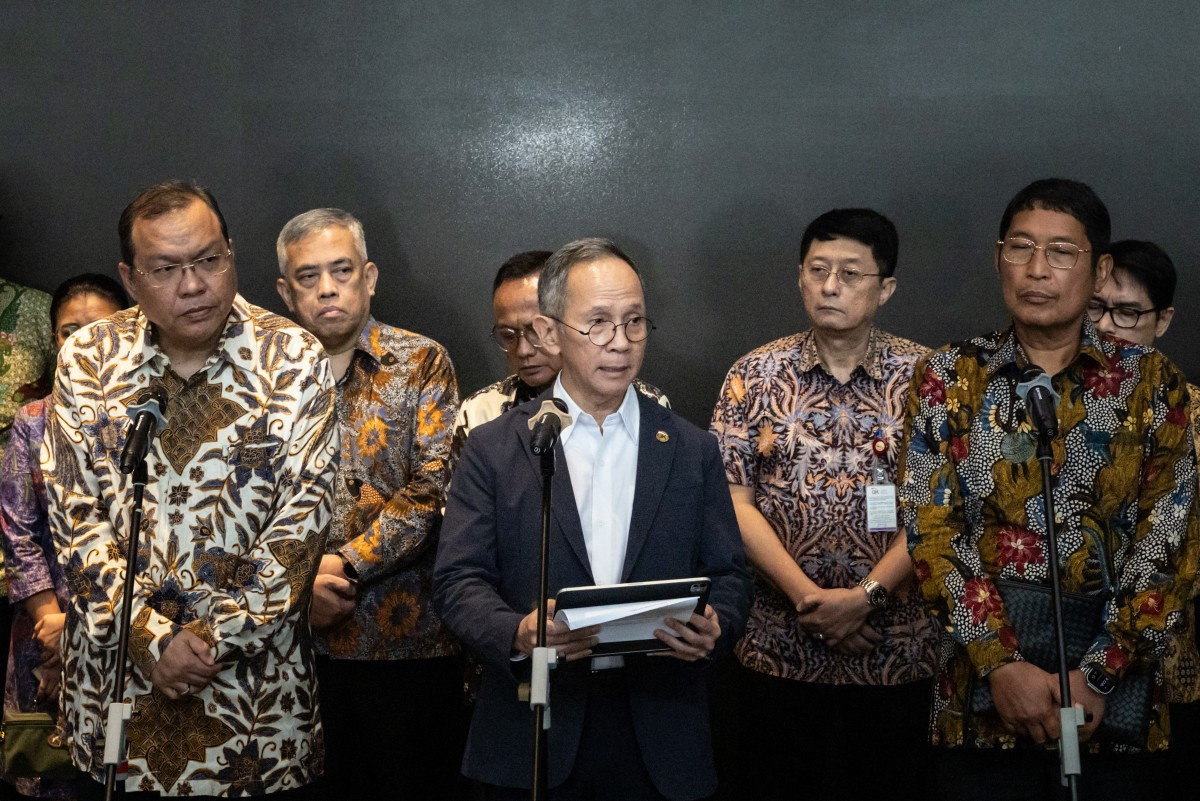 Financial Services Authority (OJK) chairman Mahendra Siregar (front row, center) speaks to the media at the Indonesia Stock Exchange (IDX) in Jakarta on January 29, following a market collapse triggered by an MSCI warning over transparency and trading manipulation. Mahendra along with IDX president director Iman Rachman (front row, left) and OJK commissioner Inarno Djajadi (front row, right) and deputy commissioner I.B. Aditya Jayaantara (back row, second from right) announced their resignation the next day. (AFP/Yasuyoshi Chiba)
T
he MSCI warning that Indonesia faces potential demotion to "Frontier Market" status has dominated headlines since the Jan. 30 leadership transition at the Indonesia Stock Exchange (IDX) and Financial Services Authority (OJK). The Moody's downgrade to negative outlook this week ensures that much of the commentary has—and will—focus inward: on governance gaps, shareholding opacity, and policy predictability. These concerns are legitimate and addressing them is necessary.
But domestic reform, while necessary, may not be sufficient. There is a larger story that has received less focus: Indonesia is not failing in isolation. It is caught in a structural shift in global capital flows—driven by new United States legislation that treats outbound investment as a national security matter.
Since the end of the Cold War, global capital flowed toward efficiency and growth potential, largely irrespective of geography. That era has ended. We have entered the age of Capital Geofencing.
The shift began taking legal form in October 2024, when the Biden administration finalized Treasury rules restricting American investment in Chinese semiconductors, AI and quantum computing. Those rules, which took effect Jan. 2, 2025, were the opening move. The main event came in December 2025, when President Trump signed the Comprehensive Outbound Investment National Security (COINS) Act as part of the Fiscal Year 2026 National Defense Authorization Act.
The COINS Act functions as a "Reverse CFIUS". For decades, the Committee on Foreign Investment in the US screened capital entering the US. Now, the US Treasury has statutory power to prohibit or require notification for US capital leaving, specifically, investments in sensitive technologies within "Countries of Concern". The geofence extends beyond China to include Russia, Iran, North Korea and Venezuela.
This is not a temporary tariff cycle. It is a structural divorce from 35 years of neutral liquidity. Washington has declared that US capital is a national security asset, not a global commodity.

For emerging markets like Indonesia, the COINS Act introduces three compliance frictions that will reshape capital flows.