TheJakartaPost
Please Update your browser
Your browser is out of date, and may not be compatible with our website. A list of the most popular web browsers can be found below.
Just click on the icons to get to the download page.


Popular Reads
Top Results
No results found. Please check your search term and try again
Can't find what you're looking for?
View all search results
Popular Reads
Top Results
No results found. Please check your search term and try again
Can't find what you're looking for?
View all search resultsWhen disasters test Indonesia's legal and recovery systems
The Sumatra disaster in late November indicates that judicial and law enforcement reform is needed to treat environmental destruction and damage as criminal violations, as well as to create a clear and transparent mechanism for the use of related compensation funds.
Change text size
Gift Premium Articles
to Anyone
Share the best of The Jakarta Post with friends, family, or colleagues. As a subscriber, you can gift 3 to 5 articles each month that anyone can read—no subscription needed!
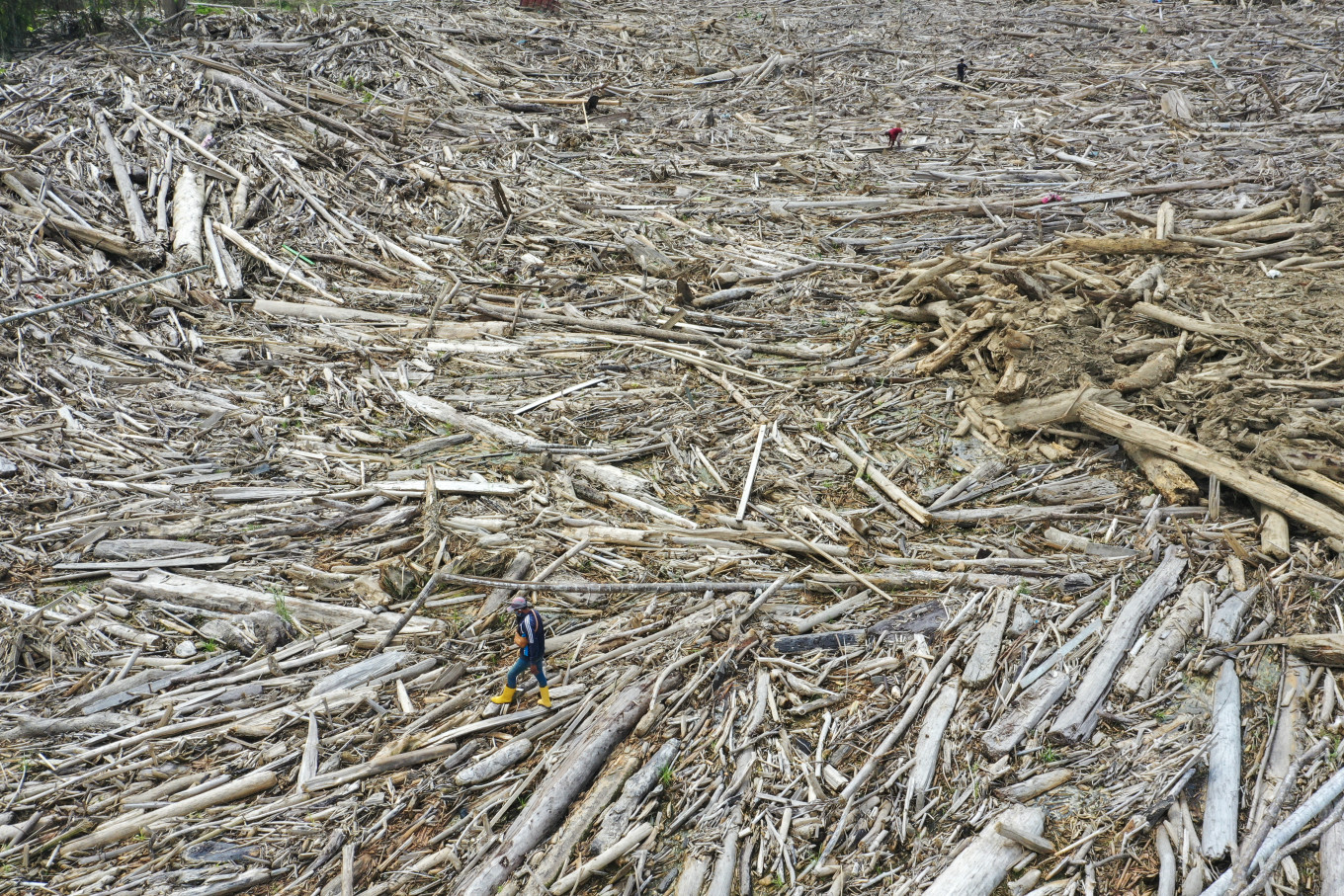 Logs and wood debris swept away by flooding and landslides in late November lay in a dense pile on Jan. 27, 2026, in Geudumbak village of Langkahan district, North Aceh regency, Aceh. (Antara/Nova Wahyudi)
M
ore than 69 days after an ecological disaster struck Sumatra, recovery has not shown significant progress and the disaster has shifted into a humanitarian crisis. Thousands of residents are still living in uncertainty. Their homes, land, livelihoods and even basic access to clean water and food have been lost.
The state has responded with emergency aid but has failed to address the root of the problem: Who is responsible for the collapse of the ecological infrastructure, how to prevent similar crimes from happening again and how to rebuild Sumatra in an extraordinary way.
In the process of rebuilding and restoring Sumatra, the state must not apply the same model it has used in the past. Important and critical ecosystems, such as watersheds and forest ecosystems that are part of the mountain ranges in Sumatra, should be designated as permit-free zones. In Aceh alone, there are 954 watersheds, while 60 percent of forests is damaged and 20 watersheds are in critical condition.
The government on Jan. 20 revoked the permits of 28 companies covering an area of approximately 1 million hectares in Sumatra, but unfortunately only a few days later, it announced that the revoked permits would be handed over to Danantara and then to state-owned enterprises to manage the concessions again.
It is clear that the government's only aim is to control company concessions. The revocation of these permits should be followed immediately by fundamental and long-term restoration, including the rehabilitation of forests and watersheds, as well as the restoration of people's rights through the redistribution of land from the revoked permits.
With regard to the restoration of the rights of affected communities, particularly in relation to plans to provide permanent housing, the government must ensure that these policies do not create new problems. Guarantees of clarity and the absence of disputes over land rights are key prerequisites before construction can take place. In addition, the distribution of permanent housing must be carried out in a fair and transparent manner that does not disadvantage any community or group.

The state is obliged to guarantee economic recovery for affected communities, recognize and protect land rights and fulfill the rights to a healthy environment and safety from preventable disasters. To that end, spatial planning at the regency, provincial and island-wide levels needs to be evaluated and reorganized, using disaster vulnerability maps as its main basis, in order to ensure fair and sustainable environmental management.