TheJakartaPost
Please Update your browser
Your browser is out of date, and may not be compatible with our website. A list of the most popular web browsers can be found below.
Just click on the icons to get to the download page.


Popular Reads
Top Results
No results found. Please check your search term and try again
Can't find what you're looking for?
View all search results
Popular Reads
Top Results
No results found. Please check your search term and try again
Can't find what you're looking for?
View all search resultsAnalysis: Police and lawmakers defy calls for sweeping reforms
Change text size
Gift Premium Articles
to Anyone
Share the best of The Jakarta Post with friends, family, or colleagues. As a subscriber, you can gift 3 to 5 articles each month that anyone can read—no subscription needed!
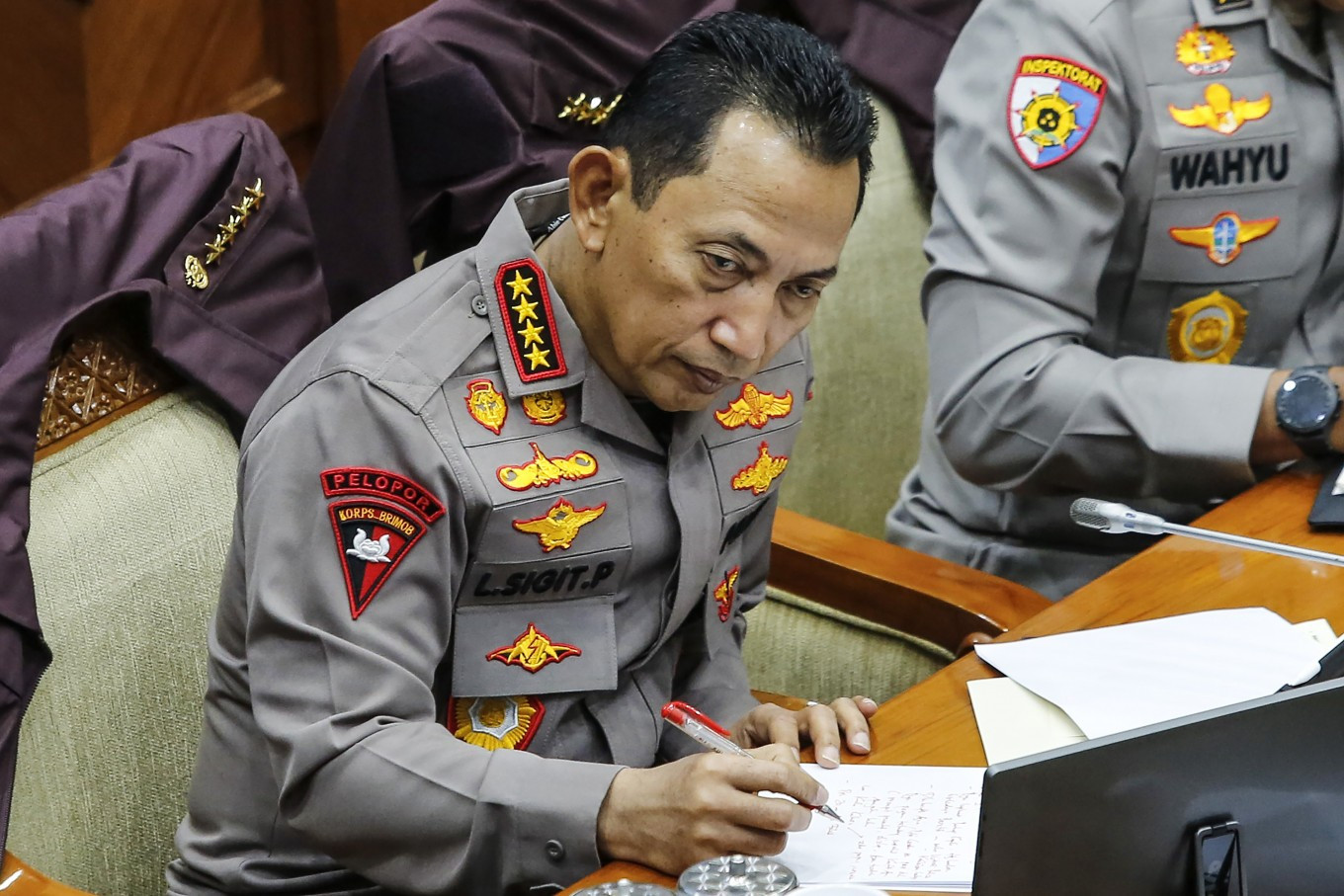 National Police chief Gen. Listyo Sigit Prabowo attends a hearing on Jan. 26, 2026, with House of Representatives Commission III, which oversees legal affairs, at the Senayan Legislative Complex in Central Jakarta. (Antara/Asprilla Dwi Adha)
T
he National Police appear increasingly emboldened in their bid to consolidate power, as the House of Representatives signals growing support for the force despite persistent public demands for comprehensive reform. Even recent rulings by the Constitutional Court, intended to restrict active-duty officers from holding civilian posts, now seem likely to be circumvented by an unholy alliance of legislative and security interests.
Public scrutiny of police authority intensified following the death of Affan Kurniawan, an online motorcycle transportation driver who was fatally crushed by a police vehicle during a protest in Jakarta last August. His death sparked nationwide outrage, fueling calls to end police brutality, corruption and the culture of impunity.
These protests, among the largest of President Prabowo Subianto’s early administration, prompted the establishment of a commission in November to review police policies. However, the subsequent political response has suggested that institutional loyalty is being prioritized over public accountability. Among the popular aspirations regarding police reforms is to restructure the law enforcement agency under a ministry’s supervision, rather than directly answering to the President.
On Jan. 27, House Commission III overseeing law enforcement reported that urgent improvements were necessary, yet the House’s consensus appeared to directly contradict the spirit of reform. Lawmakers from all the eight factions concluded that placing active-duty police in civilian positions does not violate the Constitution, a stance that defies a specific mandate from the nation's highest court.
In Decision No. 114/2025, the Constitutional Court explicitly prohibited active officers from holding civilian posts unless they first resign or retire, seeking to resolve legal ambiguities that previously allowed for "legal uncertainty".
This defiance of the court marks a significant erosion of judicial supremacy. When the House and the police seek ways to side-step mandates through secondary regulations, they signal that constitutional boundaries are negotiable. If the highest court’s decisions can be ignored, the judiciary loses its ability to protect the democratic framework from the whims of political elites.

The expansion of police roles into 17 ministries and state institutions further suggests a resurgence of a "security approach" reminiscent of the military "dual-function" logic of the past. By placing active-duty officers in civilian administrative roles, the government risks "securitizing" civil service tasks, prioritizing command-and-control over transparency. For the average citizen, this means that civilian matters, from maritime affairs to social welfare, may increasingly be viewed through the lens of national security rather than public service.