TheJakartaPost
Please Update your browser
Your browser is out of date, and may not be compatible with our website. A list of the most popular web browsers can be found below.
Just click on the icons to get to the download page.


Popular Reads
Top Results
No results found. Please check your search term and try again
Can't find what you're looking for?
View all search results
Popular Reads
Top Results
No results found. Please check your search term and try again
Can't find what you're looking for?
View all search resultsFrom GDP to good jobs: Managing AI’s barbell effect
As AI threatens to hollow out the middle of Indonesia's labor market, state policies must pivot from cost-cutting automation toward a human-centered pathway of skill-based hiring and high-value augmentation.
Change text size
Gift Premium Articles
to Anyone
Share the best of The Jakarta Post with friends, family, or colleagues. As a subscriber, you can gift 3 to 5 articles each month that anyone can read—no subscription needed!
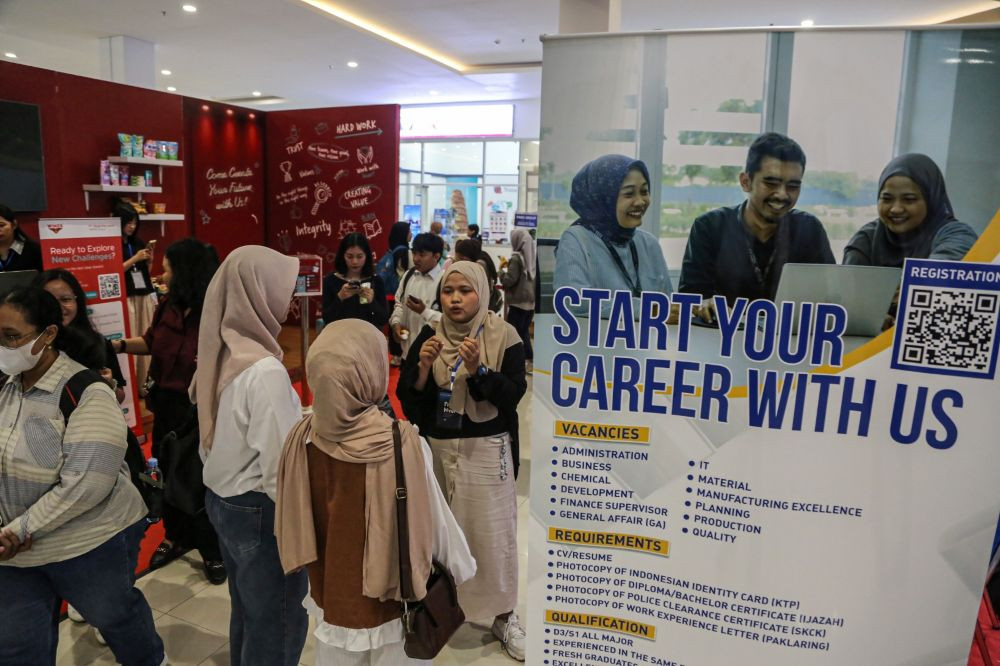 Career talks: A company booth attendant responds to inquiries from visitors on Jan. 29, 2026, during a job and career fair at the Muladi Dome within the premises of Diponegoro University in Semarang, Central Java. (Antara/Makna Zaezar)
Indonesia’s economy remains resilient. Based on Bank Indonesia’s projections, growth is expected to hold within the 4.7-5.5 percent range for 2025 and rise to 5.1-5.9 percent by 2027. While these numbers signal strength amid global uncertainty, growth does not automatically translate into better jobs.
A disconnect occurs when expansion is driven by capital-intensive investment and efficiency gains while formal job creation lags behind the labor force's growth. In plain terms, the economy can look healthy on paper while the quality of work and the opportunities for upward mobility remain uneven.
This gap is now being reshaped by artificial intelligence. A 2025 AWS study suggests that Indonesian firms deploy AI primarily to cut costs through process improvements and to boost revenues.
This is unsurprising, as businesses invest to protect the bottom line, but these areas point to two very different futures. AI can be used to automate tasks and reduce head count, or it can be used to augment workers by raising productivity and enabling them to take on higher-value work. In an augmentation model, AI serves as a tool while humans retain the decisive roles of judgment, accountability and responsibility.
Technology does not impact all jobs equally. David Autor, an economist at the Massachusetts Institute of Technology (MIT), describes a “barbell” pattern in the labor market where demand grows at both ends while the middle thins out: High-skill, high-wage jobs expand and low-skill manual roles remain necessary, but middle-skill routine jobs, which are easily standardized and digitized, shrink.

In Indonesia, this vulnerable middle includes administrative roles, back office functions and routine information processing. As AI automates these tasks, this group faces a double risk of failing to move up and being pushed down into lower-skill roles or informal work.