TheJakartaPost
Please Update your browser
Your browser is out of date, and may not be compatible with our website. A list of the most popular web browsers can be found below.
Just click on the icons to get to the download page.


Popular Reads
Top Results
No results found. Please check your search term and try again
Can't find what you're looking for?
View all search results
Popular Reads
Top Results
No results found. Please check your search term and try again
Can't find what you're looking for?
View all search resultsSustainability: Leadership, policy and action to close the capability gap
To turn Indonesia’s natural wealth into resilient prosperity, we must move beyond the vocabulary of net-zero and close the critical gap between ambitious policy and the human capability to execute it.
Change text size
Gift Premium Articles
to Anyone
Share the best of The Jakarta Post with friends, family, or colleagues. As a subscriber, you can gift 3 to 5 articles each month that anyone can read—no subscription needed!
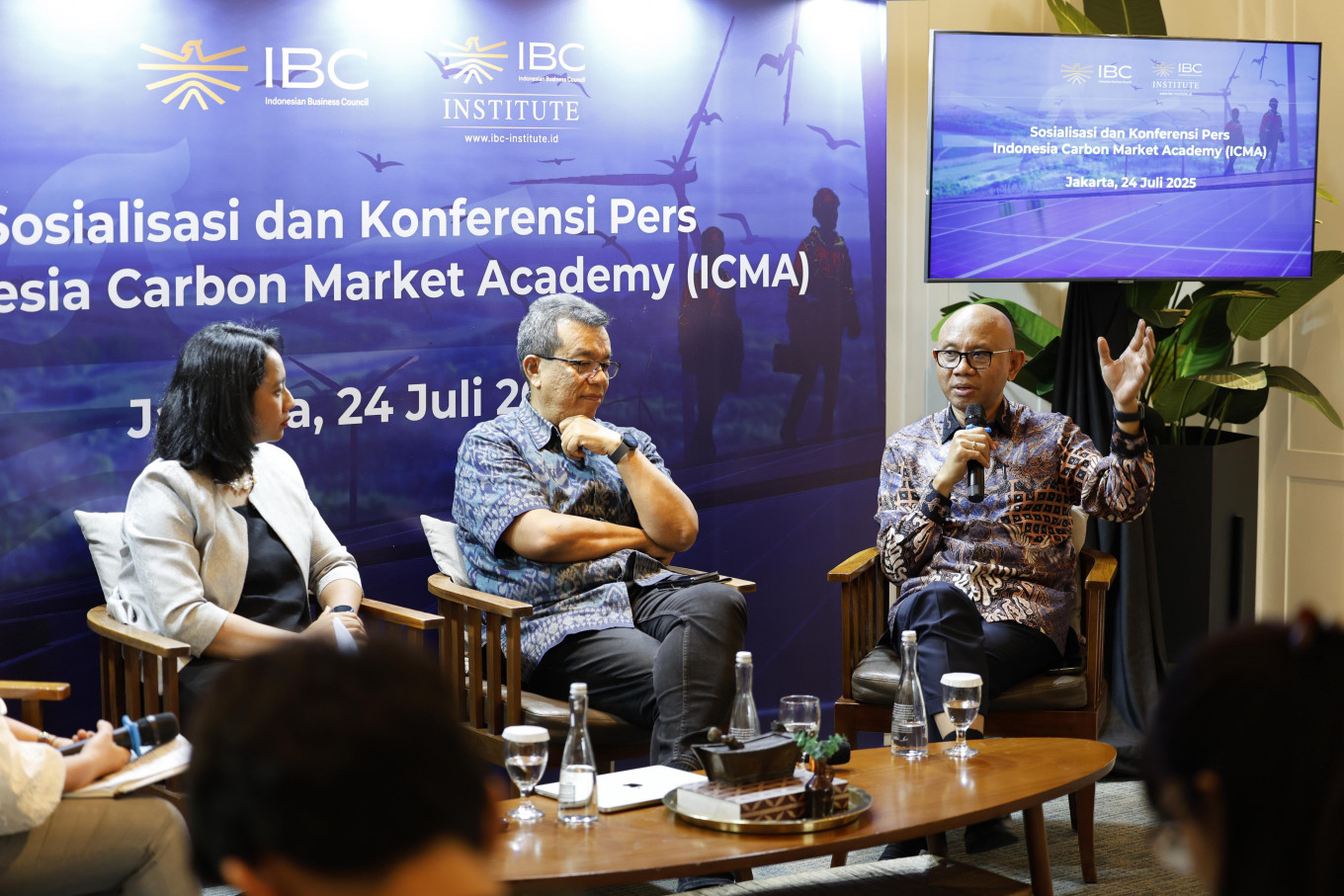 William Sabandar (right), COO of the Indonesian Business Council and director of the Sustainabilitas Center for Sustainability Studies, speaks at a press conference and launch event for the Indonesian Carbon Market Academy in Jakarta on July 24, 2025, alongside Natalia Rialucky Marsudi (left), founder and chief executive officer of Fairatmos, and Paul Butarbutar, executive director of the Indonesia Center for Renewable Energy Studies (ICRES). (Courtesy of IBC/-)
W
e’ve mastered the vocabulary of net-zero and carbon credits, but our boardrooms are moving faster than our backyards. While policy papers move at the speed of a speech, reality remains sobering. Projects struggle to reach financial close, regulations outpace implementation capacity and communities often feel the costs of "green" change long before they receive the benefits.
This is Indonesia’s sustainability paradox: We are abundantly rich in natural assets yet we remain short on the most decisive resource of all, human expertise. Without the ability to lead, design workable policy and execute action with integrity, our sustainable wealth will not translate into resilient prosperity.
We do not need more ambitious targets; we need people who know how to hit them. The real work now lies in the unglamorous task of upgrading our national skill set so we can lead these projects ourselves.
While ESG (environmental, social and governance) committees are now standard, they have yet to trigger a proportional shift in results. Look at the familiar pattern: Finance is available but projects aren't "bankable"; road maps exist but coordination is uneven; corporate goals are clear but supply chains are stagnant. When outcomes lag behind ambition, the failure is no longer due to a lack of ideas but a systemic deficit in delivery capability.
Sustainability is too often treated as a theme rather than a competency, a campaign rather than a capability, a niche rather than a standard. We must stop viewing this through the narrow lens of environmental stewardship or corporate social responsibility. It is, fundamentally, a matter of competitiveness.
As global industrial policy and capital costs are rewritten around these standards, treating sustainability as a segmented specialty risks national obsolescence. In a unified global market where sustainability is the entry requirement, building our local "muscles" is the only way to compete in the next era of value creation.

A simple analogy from practitioners captures the first pillar: "the singer, not the song". Sustainability comes with many instruments: regulations, reporting frameworks, AI, carbon markets and financing models. But instruments do not create music, leadership does.