The Jakarta Post
Please Update your browser
Your browser is out of date, and may not be compatible with our website. A list of the most popular web browsers can be found below.
Just click on the icons to get to the download page.


Popular Reads
Top Results
No results found. Please check your search term and try again
Can't find what you're looking for?
View all search results
Popular Reads
Top Results
No results found. Please check your search term and try again
Can't find what you're looking for?
View all search resultsWhen credibility becomes the real fiscal constraint
Indonesia is facing a credibility test. And credibility, once questioned, is costly to rebuild.
Change text size
Gift Premium Articles
to Anyone
Share the best of The Jakarta Post with friends, family, or colleagues. As a subscriber, you can gift 3 to 5 articles each month that anyone can read—no subscription needed!
 Set as preferred source
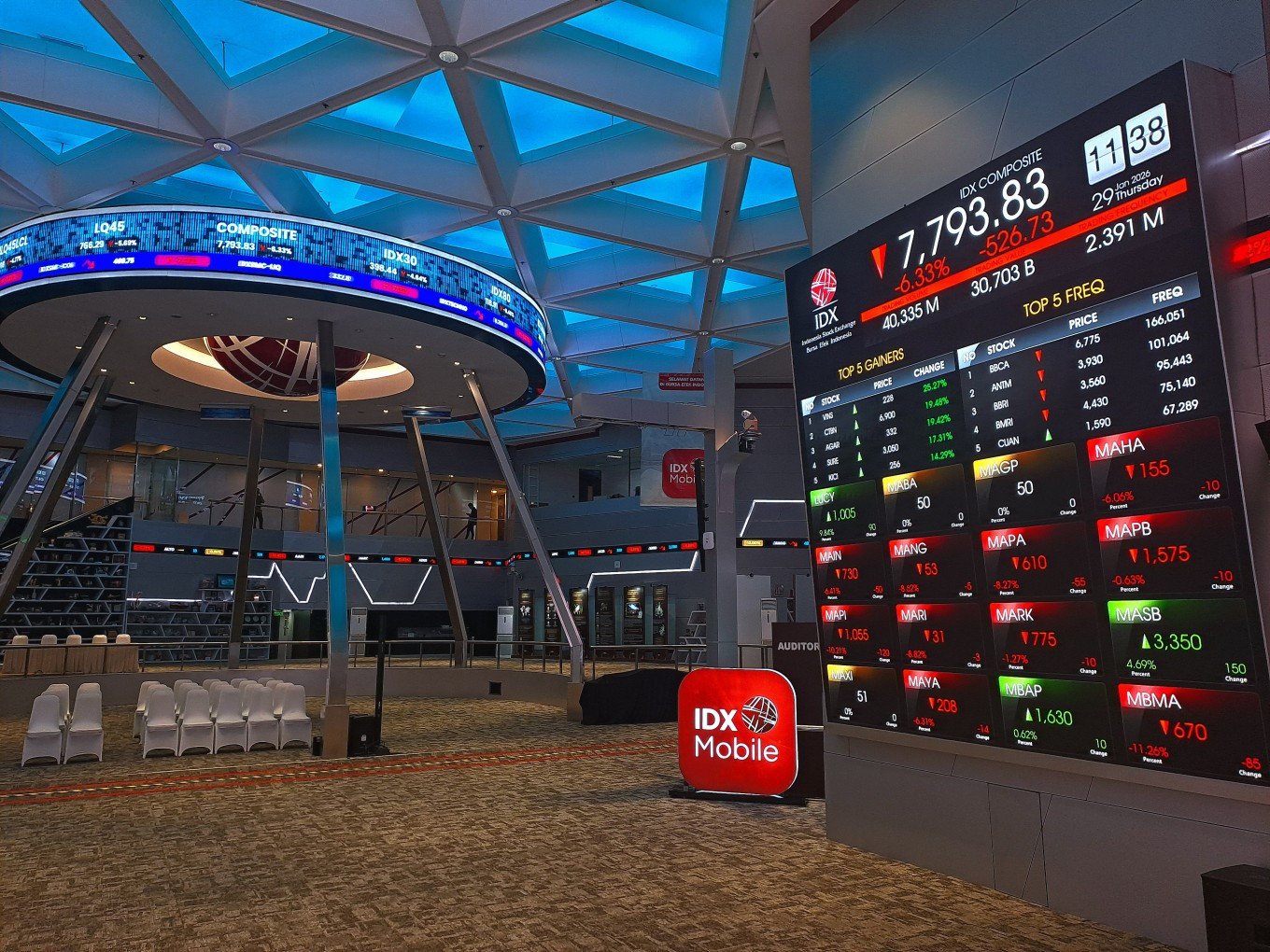 An electronic display board inside the main hall of the Indonesia Stock Exchange (IDX) in South Jakarta shows an overall downward movement across most stocks during the lunch break on Jan. 29, 2026. (TJP/Deni Ghifari)
I
ndonesia is not in crisis. But the probability of a crisis is rising, something Monica Wihardja, Vivi Alatas and I warned about last August in the “Survey of Recent Developments” in the Bulletin of Indonesian Economic Studies. At that time, the issue was not collapsing fundamentals, but creeping vulnerabilities. The same pattern is visible today.
On paper, Indonesia’s macroeconomic indicators remain reassuring. Public debt is around 40 percent of GDP, moderate by emerging-market standards. Inflation is within Bank Indonesia’s target range. The banking system is well capitalized, and non-performing loans are manageable. Foreign exchange reserves remain adequate. If one looks only at headline numbers, there appears to be little cause for alarm.
However, recent turbulence in Indonesia’s capital market should not be dismissed as routine volatility. When a global index provider such as MSCI raises concerns in its review process about market accessibility, structure or regulatory effectiveness, the issue is not technical. It is institutional.
Indonesia is facing a credibility test. And credibility, once questioned, is costly to rebuild.
The central issue today is not the level of public debt. It is the rising cost of servicing that debt. Many emerging-market crises do not begin with explosive debt ratios. They begin when refinancing costs increase and interest payments absorb fiscal space. Even with a stable debt-to-GDP ratio, higher yields mechanically raise interest expenditure. As a larger share of revenue is devoted to debt service, policy flexibility narrows. Spending becomes rigid. Adjustment becomes increasingly painful politically and economically.
Markets are pricing in risk ahead of visible fiscal deterioration. If investors demand a higher premium because of policy uncertainty or institutional slippage, interest costs rise before the debt ratio does. Perception precedes accounting.

At the same time, Indonesia’s public balance sheet is becoming more complex. Off-budget exposures, contingent liabilities and quasi-fiscal activities through state-linked entities blur the line between corporate risk and sovereign risk. When state-owned enterprises or state-backed investment vehicles expand aggressively, markets may assume that part of that risk will ultimately migrate to the sovereign balance sheet. It does not require an explicit bailout for investors to incorporate that expectation into sovereign spreads. In such circumstances, transparency is not cosmetic. It is macroeconomic insurance.