The Jakarta Post
Please Update your browser
Your browser is out of date, and may not be compatible with our website. A list of the most popular web browsers can be found below.
Just click on the icons to get to the download page.


Popular Reads
Top Results
No results found. Please check your search term and try again
Can't find what you're looking for?
View all search results
Popular Reads
Top Results
No results found. Please check your search term and try again
Can't find what you're looking for?
View all search resultsWhen education becomes conditional, the impact is suicidal
Social protection and education policies must be integrated to ensure that the most vulnerable do not fall through the cracks and end up being denied their fundamental, constitutionally guaranteed right through systemic exclusion.
Change text size
Gift Premium Articles
to Anyone
Share the best of The Jakarta Post with friends, family, or colleagues. As a subscriber, you can gift 3 to 5 articles each month that anyone can read—no subscription needed!
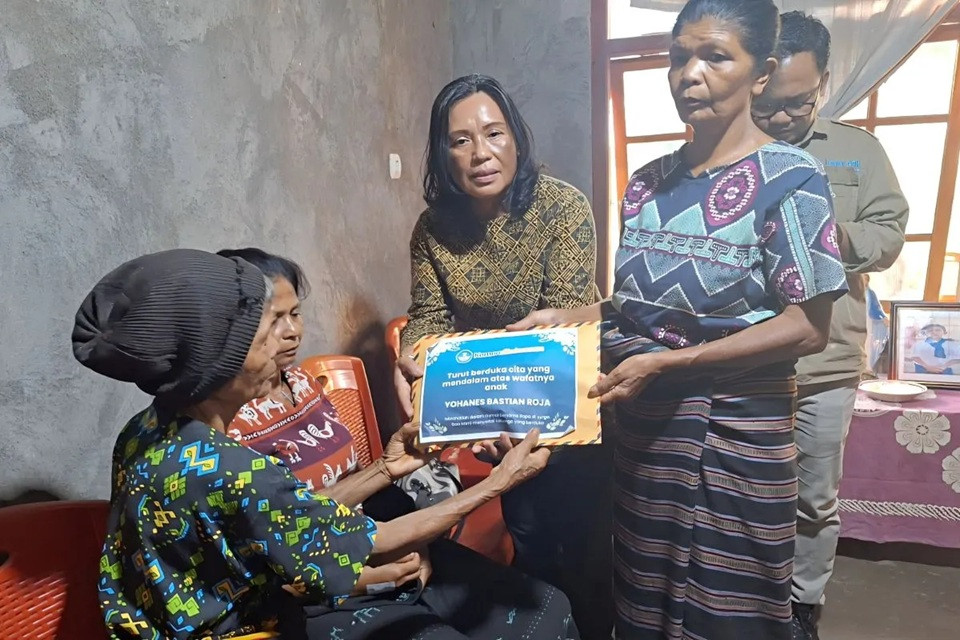 Relatives of an elementary school student who died of alleged suicide show an assistance package from the Elementary and Secondary Education Ministry on Feb. 5, 2026, at their home in Ngada regency, East Nusa Tenggara. (Antara/Public Relations Bureau of Primary and Secondary Education Ministry)
T
he death of an elementary school student in Ngada regency, East Nusa Tenggara (NTT), allegedly due to suicide and reportedly linked to an inability to afford basic school supplies costing less than Rp 10,000 (59 US cents), is a tragedy that should have never occurred.
This is not merely a story of individual despair; it is a stark warning of how Indonesia fails its youth when education is treated as a conditional privilege rather than a guaranteed right, as is clearly stipulated in the Constitution.
When access to schooling collapses under the weight of such trivial costs, the failure lies not with the child or the family but with a system that makes participation dependent on a household's immediate financial resilience. In a country that pledges to provide free basic education, this tragedy exposes a cavernous gap between policy promises and lived reality.
Indonesia frequently frames education as a fundamental right. Through a constitutional amendment, the state is even required to allocate 20 percent of the annual budget for education to realize mandatory 12-year schooling. In practice, however, schooling remains highly susceptible to informal costs, such as for books, pens, uniforms and transportation, which are quietly offloaded onto families.
For households living in extreme poverty, these costs are far from trivial. They are the deciding factors in whether a child remains in the classroom or slips unnoticed into the margins.
The student who died lived in a poor family that was not on the list of social assistance recipients due to administrative flaws, according to NTT Governor Emanual Melkiades Laka Lena.

Ngada regency boasts strong elementary and junior high school participation rates of 98.5 percent and 97.65 percent, respectively, but senior high school enrollment lags at 69.06 percent, according to 2024 data from Statistics Indonesia (BPS). These figures sit just below national levels, yet they underscore a deeper economic crisis: With 11.87 percent of the population living below the poverty line, earning less than Rp 609,000 monthly, the regency’s poverty rate far exceeds the national average of 8.57 percent.