TheJakartaPost
Please Update your browser
Your browser is out of date, and may not be compatible with our website. A list of the most popular web browsers can be found below.
Just click on the icons to get to the download page.


Popular Reads
Top Results
No results found. Please check your search term and try again
Can't find what you're looking for?
View all search results
Popular Reads
Top Results
No results found. Please check your search term and try again
Can't find what you're looking for?
View all search resultsWhy the 4Is of good corporate governance matter
Even though board members are claimed to be independent, they are often friends, associates or well-wishers of the owners and CEOs.
Change text size
Gift Premium Articles
to Anyone
Share the best of The Jakarta Post with friends, family, or colleagues. As a subscriber, you can gift 3 to 5 articles each month that anyone can read—no subscription needed!
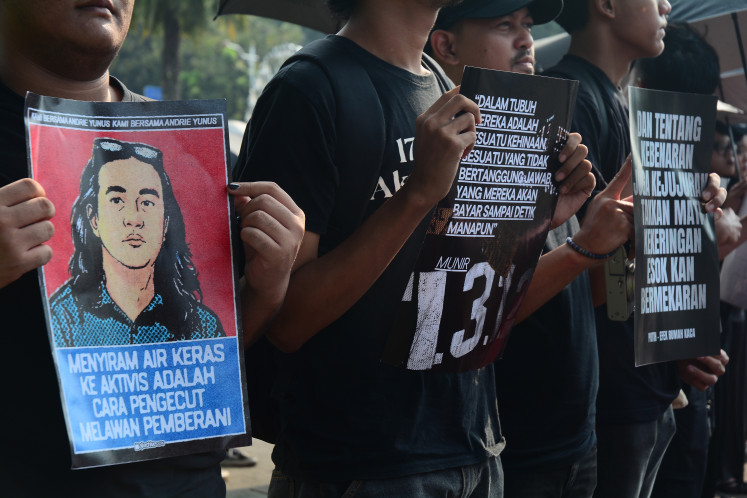
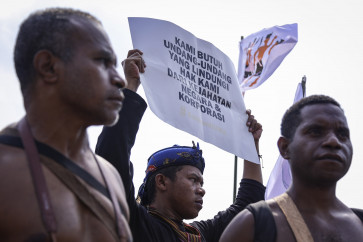
 A member of an indigenous community holds a poster that reads “We need regulations that protect our rights from state and corporate crimes“ on Oct. 11, 2024, during a protest in front of the Senayan Legislative Complex in Jakarta. The protesters demanded lawmakers to push for protection of indigenous communities' rights and acknowledgement of their areas, as well as a resolution to agrarian conflicts. (Antara/Dhemas Reviyanto)
E
xpressions of concern by investors must be taken seriously otherwise discontent can lead to a catastrophic pullout from capital markets as has happened at the Indonesian Stock Exchange (IDX) recently.
In developing countries like Indonesia, domestic institutional investors often appear unwilling to rock the boat and at times those controlled by the government are muzzled. This can seriously backfire as losses erode the net worth of state pension funds, insurance companies and asset management firms.
Retail investors, of which there is a large and growing cohort reaching almost 50 percent of total daily transactions, have few forums to question governance in the companies they are investing in. When a bloodbath occurs it is they that end up losing the most. Value of equity mutual funds exceeded Rp 800 trillion (US$47 billion) in April 2025, and incurred losses directly damage national savings, purchasing power, retirement plans and the financial well-being of families.
Foreign institutional investors, analysts and experts have for years remain unconvinced with the implementation of good corporate governance (GCG) practices in Indonesia. Though commitment to GCG is often touted in audited reports and press releases, the spate of controversies, scandals and corruption cases involving both state-owned and private companies, indicates that implementation of these principles is inconsistent at best and missing at worst.
The government’s decision to take legal action against six companies for around Rp 4.8 trillion over their alleged illegalities that significantly exacerbated the widespread losses and misery because of floods and landslides in North Sumatra and Aceh last year, indicates not just environmental failures but also absence of GCG.
Whenever a company fails to conduct a proper environment impact assessment (Amdal), clears protected rain forests, pays bribes to secure land permits and dumps toxic effluents in nearby water bodies, it is not only violating environmental but also governance principles. And if the company or its affiliates or group is listed on the stock exchange, its illegal actions end up exposing investors to huge risk.

We will address what I have termed as the 4Is of GCG that are essential for creating investor confidence. These are integrity, independence, institutional control and intervention.