The Jakarta Post
Please Update your browser
Your browser is out of date, and may not be compatible with our website. A list of the most popular web browsers can be found below.
Just click on the icons to get to the download page.


Popular Reads
Top Results
No results found. Please check your search term and try again
Can't find what you're looking for?
View all search results
Popular Reads
Top Results
No results found. Please check your search term and try again
Can't find what you're looking for?
View all search resultsBeyond Trump's America: Why the world needs NEFOS 2.0
As the era of guaranteed American multilateralism fades, a new global architecture is rising from the spirit of Bandung: NEFOS 2.0—a strategic coalition defined not by ideological alignment, but by collective technological sovereignty and distributed economic power.
Change text size
Gift Premium Articles
to Anyone
Share the best of The Jakarta Post with friends, family, or colleagues. As a subscriber, you can gift 3 to 5 articles each month that anyone can read—no subscription needed!
 Set as preferred source
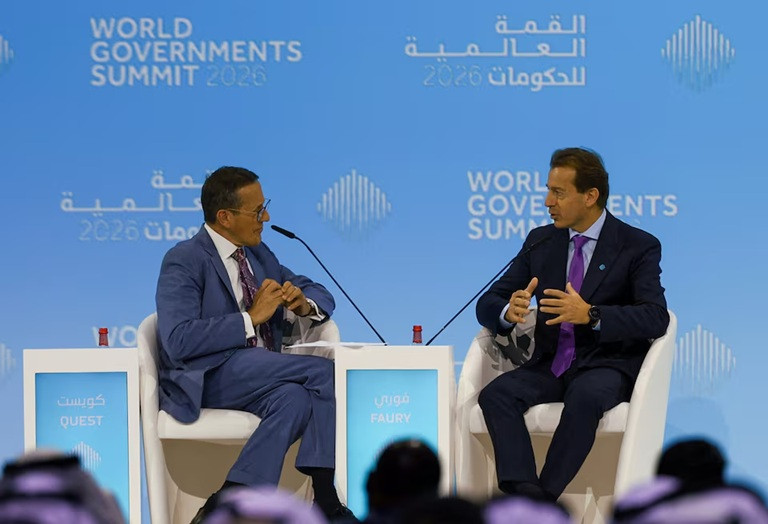 Guillaume Faury (left), CEO of Airbus, speaks to Richard Quest, CNN business editor-at-large, at the World Governments Summit, in Dubai, United Arab Emirates, on Feb. 3, 2026.
(Reuters/Rula Rouhana)
Guillaume Faury (left), CEO of Airbus, speaks to Richard Quest, CNN business editor-at-large, at the World Governments Summit, in Dubai, United Arab Emirates, on Feb. 3, 2026.
(Reuters/Rula Rouhana)
A
t the World Government Summit in Dubai on Feb. 3–5, where I represented Indonesia’s fifth president Megawati Sukarnoputri, I witnessed what may be a historic turning point in international cooperation.
Panel after panel brought together a global vanguard: presidents, Nobel laureates and CEOs. They spoke not merely of anxieties regarding the changing global role of the United States, but of concrete blueprints for a post-hegemonic world order.
The diversity of voices in Dubai underscored how widespread these concerns have become. Estonia’s president illustrated how a nation of just over 1 million people has become NATO's cybersecurity nerve center, a testament to the fact that in a digital age, strategic weight is derived from specialized expertise rather than sheer landmass.
Similar narratives emerged from Georgia, Kosovo, Latvia, and Montenegro: stories of nations building resilient institutions and attracting investment despite security volatilities and inconsistent support from major powers. Perhaps most poignant was President Ramos-Horta of Timor-Leste, who acknowledged Indonesia’s vital role in his nation’s journey from conflict to independence, the very brand of South-South cooperation the summit sought to champion.
This context illuminates why Megawati’s emphasis on her father’s Dasa Sila (10 Principles) of Bandung at the Zayed Award in Abu Dhabi carried such resonance.
The Bandung Principles, drafted at the 1955 Asia-Africa Conference, created a moral foundation for newly independent nations by rejecting both Western colonialism and Soviet hegemony. They demanded respect for sovereignty, racial equality, noninterference and peaceful conflict resolution. It was a bold declaration that nations newly freed from the yoke of empire deserved equal standing with their former colonizers.

The genius of the Dasa Sila lay in what they rejected: they denied that international order required hegemonic enforcement, that peace demanded ideological uniformity or that development necessitated dependency. This created the conceptual space for founding president Sukarno’s vision of the "New Emerging Forces" (NEFOS). Sukarno divided the world not by the binary of capitalism versus communism, but between the "Old Established Forces", the colonial and neo-colonial powers, and the "New Emerging Forces" of Asia, Africa and Latin America.