The Jakarta Post
Please Update your browser
Your browser is out of date, and may not be compatible with our website. A list of the most popular web browsers can be found below.
Just click on the icons to get to the download page.


Popular Reads
Top Results
No results found. Please check your search term and try again
Can't find what you're looking for?
View all search results
Popular Reads
Top Results
No results found. Please check your search term and try again
Can't find what you're looking for?
View all search resultsRussian diplomacy in an emerging multipolar world
Russian diplomacy will continue to focus on deepening a trust-based dialogue with Indonesia and other ASEAN member states, grounded in respect for international law, mutual interests, the principles of consensus, and noninterference in internal affairs.
Change text size
Gift Premium Articles
to Anyone
Share the best of The Jakarta Post with friends, family, or colleagues. As a subscriber, you can gift 3 to 5 articles each month that anyone can read—no subscription needed!
 Set as preferred source
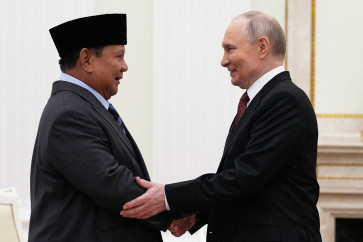
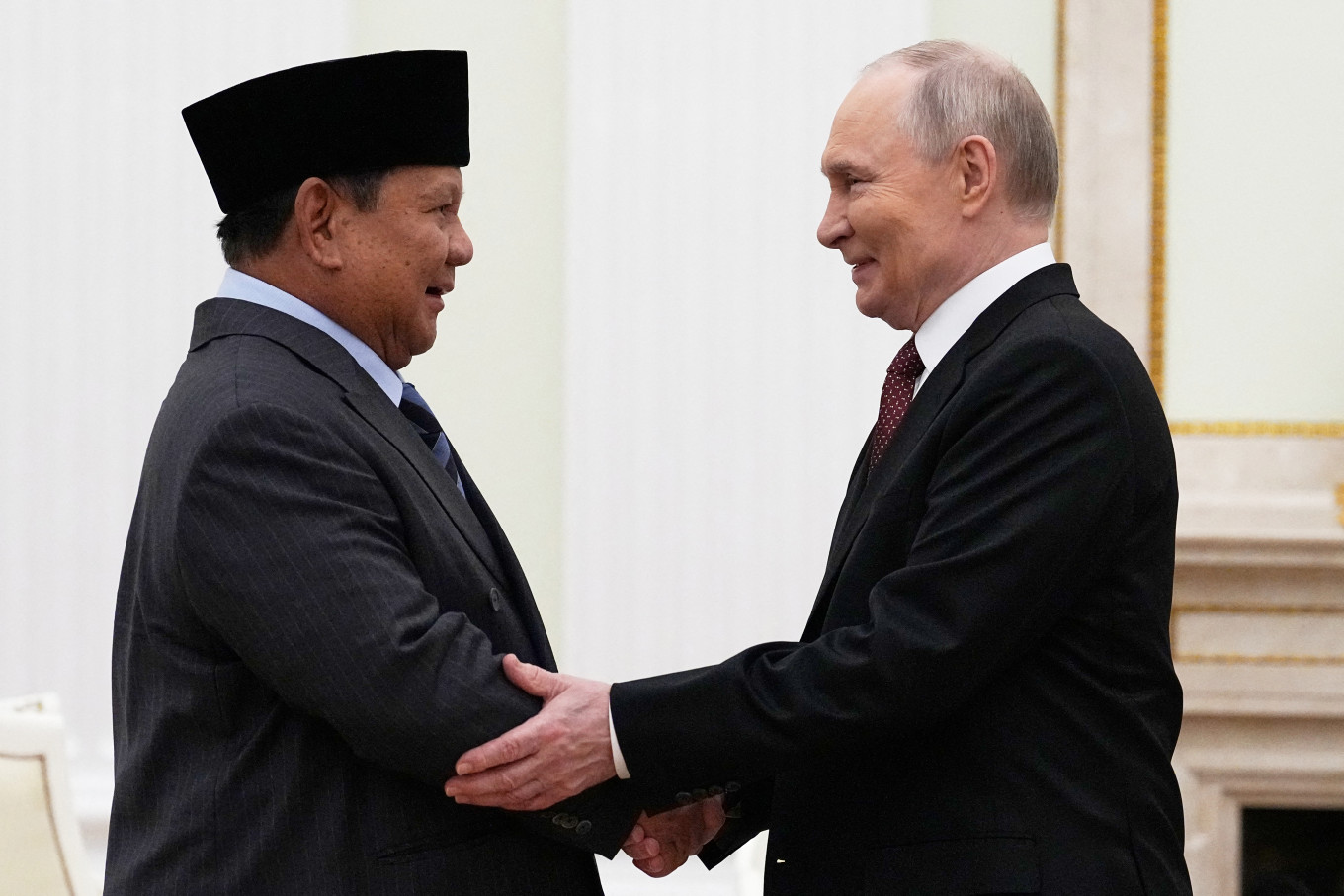 President Prabowo Subianto (left) and Russian President Vladimir Putin shake hands during their meeting at the Senate Palace of the Kremlin in Moscow on Dec. 10, 2025. (AFP/Pool/Alexander Zemlianichenko)
O
n Feb. 10, the staff of the Russian Foreign Ministry celebrate their professional holiday: Diplomats’ Day. On this date in 1549, archival documents first mentioned the “Posolsky Prikaz”, the historical prototype for today's Ministry of Foreign Affairs. Russian diplomacy cherishes these traditions; in our practical work, we integrate the best practices of the Russian Empire and Soviet eras, maintaining an invisible continuity of generations while adapting the experience of our predecessors to the demands of the modern age.
The Russian diplomatic service continues to address the challenging task of creating favorable external conditions for our country’s progressive socioeconomic development, while maintaining strategic balance and stability in global affairs. These provisions are enshrined in the Concept of the Foreign Policy of the Russian Federation, approved by President Vladimir Putin in March 2023. Through these diplomatic efforts, Russia remains a key guarantor of the emerging multipolar world order.
Russia consistently defends its interests, neither infringing upon the rights of others nor allowing its own to be compromised. We continue to expand diverse cooperation with the "Global Majority", the states of Greater Eurasia, Africa and Latin America. Together, we are building a Eurasian security architecture and international cooperation mechanisms that are resilient against the destructive influence of a "western minority".
The current fundamental shifts in the global order reflect a struggle occurring in the absence of the common criteria that once underpinned the International Monetary Fund (IMF), World Bank and World Trade Organization (WTO). The consequences are felt not only by countries in the Global South and East, but also by the West. The most striking recent example is Greenland.
While some western countries prefer to communicate "by the code". Russia conducts its relations with the Global Majority, and any western states interested in fair cooperation, on the basis of international law, equality and mutual respect.
Last year, Russian diplomacy achieved significant success in Indonesia. President Prabowo Subianto visited Russia twice: first in June as the guest of honor at the St. Petersburg International Economic Forum, where a bilateral declaration on strategic partnership was signed, and again in December for talks with President Putin. These milestones were bolstered by the signing of a free trade agreement between Indonesia and the Eurasian Economic Union (EAEU).

In 2025, our efforts focused on creating a zone of good-neighborliness within the "near abroad", spanning the Commonwealth of Independent States (CIS), the EAEU, the Collective Security Treaty Organization (CSTO) and the Shanghai Cooperation Organization (SCO). We continue to advance the initiative to create a greater Eurasian partnership and a pan-continental architecture of equal and indivisible security. All BRICS countries, including Indonesia, are our good partners.