TheJakartaPost
Please Update your browser
Your browser is out of date, and may not be compatible with our website. A list of the most popular web browsers can be found below.
Just click on the icons to get to the download page.


Popular Reads
Top Results
No results found. Please check your search term and try again
Can't find what you're looking for?
View all search results
Popular Reads
Top Results
No results found. Please check your search term and try again
Can't find what you're looking for?
View all search resultsMainstreaming ecological democracy: Challenges and opportunities
Eco-democracy seeks to create harmony between humanity and the environment, positioning ecological health as a core component of democratic rights and a vital alternative to the laissez-faire economic models.
Change text size
Gift Premium Articles
to Anyone
Share the best of The Jakarta Post with friends, family, or colleagues. As a subscriber, you can gift 3 to 5 articles each month that anyone can read—no subscription needed!
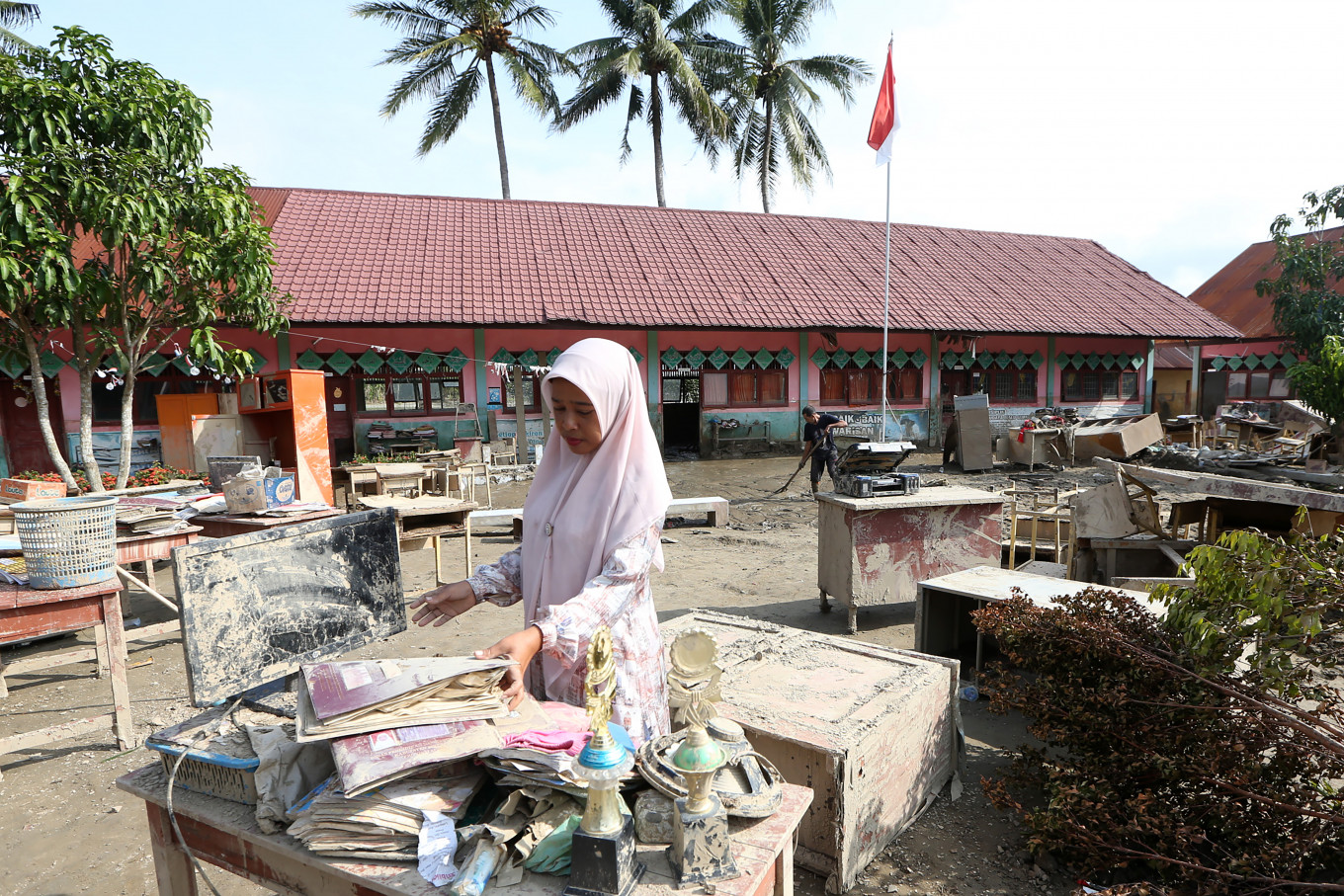 A teacher cleans up books and teaching equipment covered in mud on Jan. 4 at state elementary school SD Negeri 11 Kuta Blang in Keurumbok, Bireuen, Aceh, following recent flash floods hitting northern Sumatra. The Elementary and Secondary Education Ministry said 3,508 of 4,149 schools affected by hydrometeorological disasters in North Sumatra, West Sumatra and Aceh were ready to resume classes for the second semester starting on Monday. (Antara /Irwansyah Putra)
I
ndonesia’s environmental crisis is a multifaceted challenge that demands a comprehensive resolution. Beyond the immediate ecological disasters, the situation has exposed the systemic greed of companies manipulating forests, land and natural resources, actions that have culminated in a profound human tragedy across Sumatra, West Java and other provinces.
In response to the late 2025 disaster in Sumatra, President Prabowo Subianto recently revoked the permits of 28 companies responsible for serious ecological devastation. While this move deserves credit, the cost and time required to remediate such extensive damage are staggering. Of these 28 entities, 22 are corporations holding official concessions that straddle more than 1 million hectares, while the remaining six are involved in mining and plantations.
While the public largely expressed appreciation for the government’s action via social media, and environmental activists welcomed the move as a necessary first step, many view the revocation as a temporary fix.
Greenpeace Indonesia, for example, has asserted that the government must evaluate all extractive industries, particularly those linked to the floods and landslides in Sumatra that claimed 1,200 lives, damaged 175,000 houses and destroyed critical public infrastructure. Similarly, the Indonesian Forum for the Environment (Walhi) argued that the government should go beyond permit revocation by pursuing civil and criminal administrative penalties for the violations that led to these disasters.
Tragically, data from the National Disaster Mitigation Agency (BNPB) reveals that two months after the peak of the crisis, 166,579 people remains displaced across Aceh, North Sumatra and West Sumatra. Although the government has constructed thousands of temporary shelters, the scale of displacement is so vast that completing the necessary housing will take significant time.
In light of these events, Indonesia must mainstream ecological democracy, or eco-democracy. This framework encompasses democratic values that extend beyond a human-centric focus to include the rights of nature, the needs of future generations and the inherent integrity of ecosystems.

As John Dryzek argued, there is a strong correlation between eco-democracy and the values of deliberative democracy. Eco-democracy seeks to create harmony between humanity and the environment, positioning ecological health as a core component of democratic rights and a vital alternative to the laissez-faire economic models that drive environmental degradation.