TheJakartaPost
Please Update your browser
Your browser is out of date, and may not be compatible with our website. A list of the most popular web browsers can be found below.
Just click on the icons to get to the download page.


Popular Reads
Top Results
No results found. Please check your search term and try again
Can't find what you're looking for?
View all search results
Popular Reads
Top Results
No results found. Please check your search term and try again
Can't find what you're looking for?
View all search resultsGeneral Agus Widjojo, a passionate reformist in uniform
Agus believed that the military's territorial command needed to be overhauled in a gradual, systematic manner, proposing that its functions be transferred to local governments.
Change text size
Gift Premium Articles
to Anyone
Share the best of The Jakarta Post with friends, family, or colleagues. As a subscriber, you can gift 3 to 5 articles each month that anyone can read—no subscription needed!
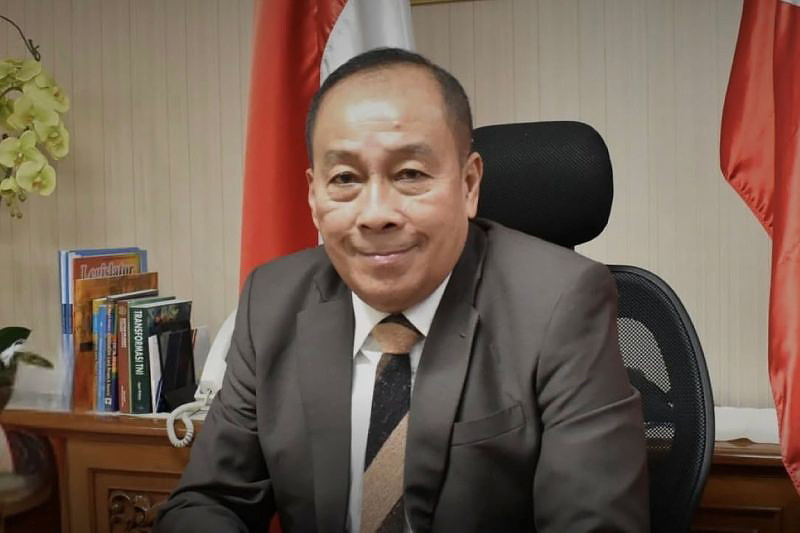 The late Indonesian Ambassador to the Philippines, retired Lt. Gen. Agus Widjojo, as broadcast on Feb. 9 by the Indonesian Embassy in Manila. (Antara/Handout-Indonesian Foreign Ministry)
T
he passing of a close acquaintance is always difficult to process. When Andi Widjajanto, former governor of the National Resilience Institute (Lemhannas), informed me on Sunday evening that Lt. Gen. (ret.) Agus Widjojo had passed away, I received the news in stunned silence. I soon found myself immersed in deep reflection, mourning the loss of one of the most consequential figures in the history of Indonesia’s arduous journey toward democracy.
Agus Widjojo, or Pak Agus as we called him, was an instrumental figure in charting the path for the Indonesian military's withdrawal from politics following the fall of the New Order in May 1998. At that time, Agus held a pivotal leadership position as the chief of staff for territorial affairs (Kaster) of the Indonesian Armed Forces (ABRI).
Alongside Lt. Gen. Susilo Bambang Yudhoyono, then ABRI’s chief of staff for social and political affairs who later became Indonesia’s sixth president, Agus was at the forefront of military reform. From the outset, he understood that redefining the military’s role within a democratic Indonesia was an agenda that could no longer be postponed.
Working closely with a group of reform-minded officers, Agus helped formulate the military’s internal roadmap for change. He believed that if Indonesia were to become a true democracy, there was no alternative: ABRI had to withdraw from politics. He argued that ABRI had overextended itself through the dwifungsi (dual function) doctrine and needed to restore its image as a professional force for the people.
In September 1999, ABRI issued an internal guideline known as Paradigma Baru (The New Paradigm). Agus played a central role in drafting this document. The landmark changes introduced after 1998, including the abolition of the military's political role, the ban on active officers holding civilian positions and the separation of the National Police from the military, were all rooted in this guideline. In short, he was the architect of the military’s exit from practical politics.
Later, as the chief of the ABRI Faction in the People’s Consultative Assembly (MPR), Agus was instrumental in persuading military leadership to relinquish their reserved seats in the national legislature. In that same capacity, he helped the MPR issue Decree No. VI/2000, which formally separated the functions of the Indonesian Military (TNI) as a national defense force from the National Police, which focuses on internal security and public order. Agus often argued that without a clear distinction between these two realms, it would be impossible to realize the goal of a professional defense force.

Agus was also renowned for his vision regarding the restructuring of the Army’s territorial command (Koter). He believed that Koter needed to be overhauled in a gradual, systematic manner, proposing that its functions be transferred to local governments.