The Jakarta Post
Please Update your browser
Your browser is out of date, and may not be compatible with our website. A list of the most popular web browsers can be found below.
Just click on the icons to get to the download page.


Popular Reads
Top Results
No results found. Please check your search term and try again
Can't find what you're looking for?
View all search results
Popular Reads
Top Results
No results found. Please check your search term and try again
Can't find what you're looking for?
View all search resultsMaking Bali ASRI again: Restoring harmony through food waste reform
To restore the sacred harmony of Tri Hita Karana, Bali must look beyond the beach and fix its broken food system before the island’s landfills, and its beauty, reach a breaking point.
Change text size
Gift Premium Articles
to Anyone
Share the best of The Jakarta Post with friends, family, or colleagues. As a subscriber, you can gift 3 to 5 articles each month that anyone can read—no subscription needed!
 Set as preferred source
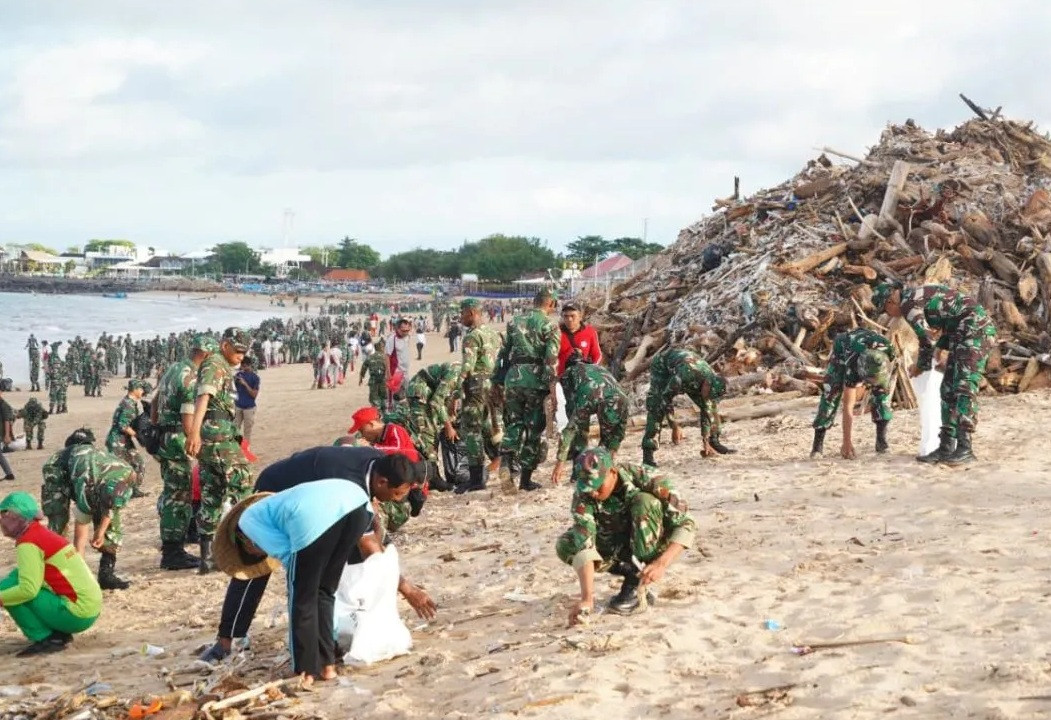 Hundreds of people, including students, and military and police personnel, participate in the cleanup campaign on Feb. 3, 2026, at Kuta Beach in Badung regency, Bali.
(Antara/Udayana Military Command)
Hundreds of people, including students, and military and police personnel, participate in the cleanup campaign on Feb. 3, 2026, at Kuta Beach in Badung regency, Bali.
(Antara/Udayana Military Command)
O
n a bright morning at Bali's famous Kuta Beach, rows of schoolchildren stood shoulder-to-shoulder with Indonesian Military (TNI) soldiers. Together, they collected plastic bottles, driftwood and organic debris scattered across the shoreline while tourists watched quietly from the sidelines.
This mass cleanup followed a direct warning from President Prabowo Subianto regarding Bali’s worsening waste crisis, a signal that waste management is no longer being treated as a localized sanitation issue, but as a pillar of national development.
President Prabowo recently reaffirmed that waste management must be addressed through a coordinated national movement under the Indonesia ASRI (Aman, Sehat, Resik, Indah) (Secure, Healthy, Clean, Beautiful) initiative. By fostering collective action across government institutions, schools and local communities, the movement aims to create more orderly and healthful environments.
The President emphasized that environmental cleanliness is a prerequisite for national competitiveness, particularly in tourism-dependent regions like Bali. With nearly all Indonesian landfill sites projected to exceed capacity by 2028, the urgency for systemic reform has never been greater.
To meet this challenge, the government has committed to launching 34 waste-to-energy projects across major cities, aiming to convert refuse into renewable energy while reducing landfill dependency. However, this national momentum also creates a critical opening to address one of Bali’s most overlooked environmental hurdles: food loss and waste.
While Bali is celebrated as Indonesia’s "tourism jewel", the island faces a sustainability paradox. Often dismissed as a mere matter of household behavior, a 2023 report by the UN Partnership for Action on Green Economy reveals that food loss and waste in Bali is actually a systemic failure spanning agriculture, markets and waste governance.

The scale of the issue is immense. In 2021, Bali generated approximately 877,000 tonnes of food loss and waste, roughly 201 kilograms per capita. Contrary to popular belief, nearly half of this waste occurs before food ever reaches a consumer's plate.