The Jakarta Post
Please Update your browser
Your browser is out of date, and may not be compatible with our website. A list of the most popular web browsers can be found below.
Just click on the icons to get to the download page.


Popular Reads
Top Results
No results found. Please check your search term and try again
Can't find what you're looking for?
View all search results
Popular Reads
Top Results
No results found. Please check your search term and try again
Can't find what you're looking for?
View all search resultsGatekeeping peace: Why the House must vet Indonesia’s pivot to BoP entry
President Prabowo’s pragmatic turn toward Indonesia joining the Board of Peace for Gaza will mean a seat at a table that includes Israel, but it is the House that holds the procedural power to ensure that our nation doesn't become an enabler of impunity.
Change text size
Gift Premium Articles
to Anyone
Share the best of The Jakarta Post with friends, family, or colleagues. As a subscriber, you can gift 3 to 5 articles each month that anyone can read—no subscription needed!
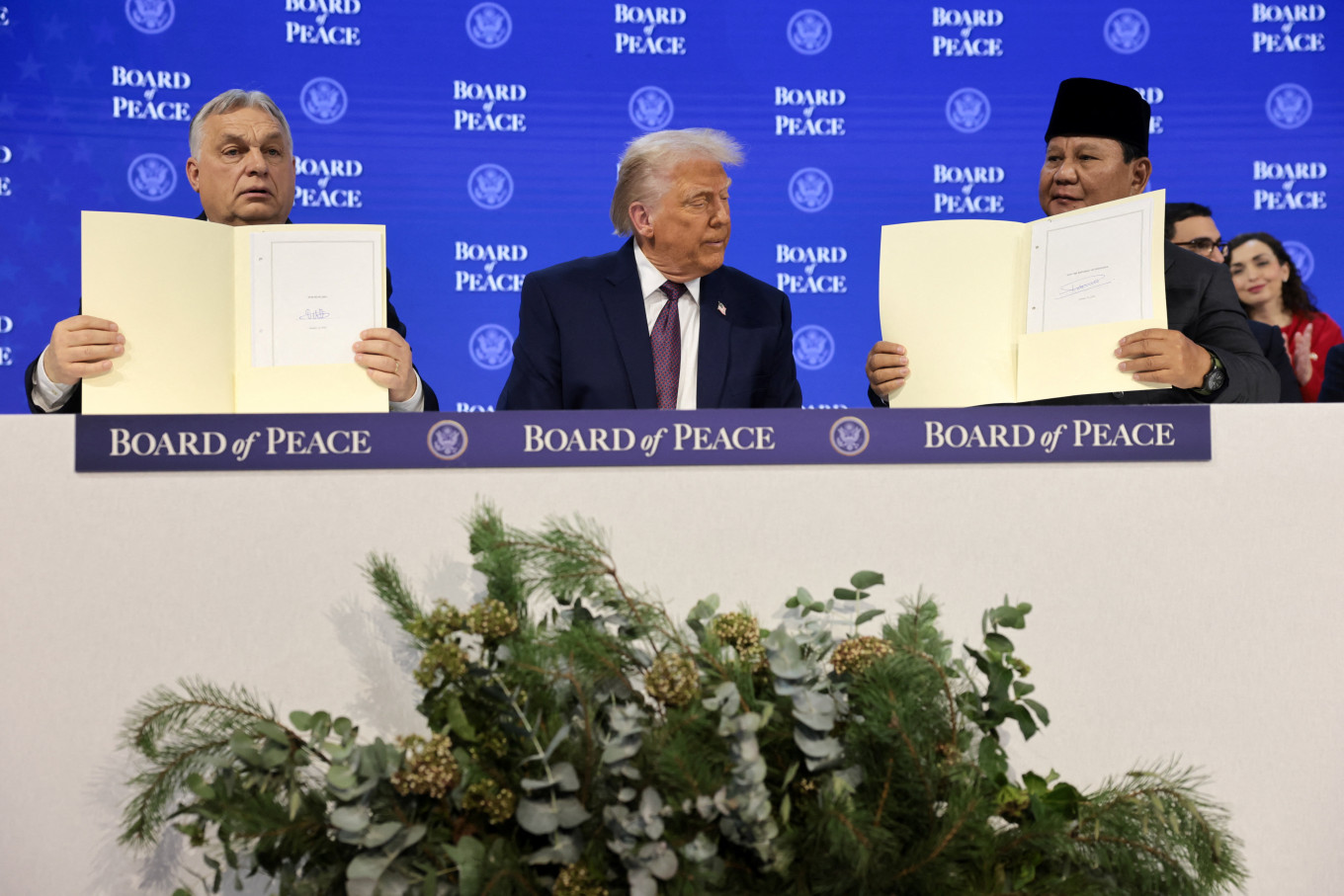 President Prabowo Subianto (right) and Hungarian Prime Minister Viktor Orban (left) flank United States President Donald Trump as they hold up copies of the founding charter for the Board of Peace (BoP), a multinational body to oversee Gaza’s ceasefire and reconstruction proposed by the US leader, during a signing ceremony on Jan. 22 at the World Economic Forum (WEF) Annual Meeting 2026 in Davos, Switzerland. (Reuters/Jonathan Ernst)
A
fter weeks of speculation, Prime Minister Benjamin Netanyahu announced on Tuesday Israeli participation on the Board of Peace (BoP). With Israel joining, it is noteworthy that President Prabowo Subianto’s decision to bring Indonesia to the BoP marks a pragmatic shift toward reconciling the situation in Palestine.
Indonesia’s decision to join the BoP constitutes a move where agility and involvement in relevant forums become the overarching values guiding the country’s foreign policy. This represents a stark departure from the long-standing, principled practice of avoiding direct engagement with Israel.
In defense of his decision, President Prabowo described Indonesia’s entry as “a historic opportunity” and “truly a chance to achieve peace in Gaza”. In the same vein, Foreign Minister Sugiono said joining the BoP was consistent with Indonesia’s position to help resolve the conflict, achieve peace and carry out post-conflict rehabilitation in Palestine.
Nonetheless, the President’s determination has ultimately drawn strong reactions at home. Among the sharper criticisms is the Bo{’s disproportionate structure, which seems to give little weight to Palestinian interests.
Another criticism stems from the flagrant centralization of the United States’ authority via President Donald Trump on the BoP. This raises the question of how Indonesia can navigate its role within the institution and to a greater extent, apply its “free and active” foreign policy principle.
President Prabowo has attempted to clarify these concerns through a series of strategic meetings with religious organizations and international relations experts. In policymaking, however, these substantive criticisms deserve to be publicly addressed by the government. This is because foreign policy issues, particularly those concerning Palestine, have become deeply embedded in the fabric of Indonesian society at multiple junctures in our history. When handled too exclusively, the issue may devolve into domestic repercussions.

In light of this, one often overlooked aspect should be optimized as an alternative avenue for engagement: the procedures that must follow a decision to join an international organization.